 Add to Chrome
 Add to Firefox
 Add to Edge
Point as Skeleton: Accumulated Point Cloud Enhanced Autoregressive Generation for Closed-Loop Autonomous Driving Simulation
Jul 07, 2026
Evaluating end-to-end autonomous driving (E2E-AD) remains challenging, as existing driving simulation methods often trade off closed-loop interactivity (e.g., CARLA) and real-world visual fidelity (e.g., nuScenes). We present \textbf{\emph{Point as Skeleton}}, a generative sensor simulation framework for state-updated autoregressive driving video generation, in which an autoregressive generator synthesizes visual observations from step-wise updated ego states, actor states, scene maps, and point-cloud skeleton conditions. To support closed-loop rollout, we introduce Reset-and-Roll, which adapts rolling diffusion inference to simulation by preventing future-conditioned latent states from being committed across simulation steps. To stabilize error accumulation during step-wise autoregressive rollout, we introduce point-cloud skeletons that decouple foreground and background assets and project them into camera-view painted-point and template-depth conditions, providing appearance and geometric cues. We further implement a nuPlan-based renderer-level closed-loop generative interface for evaluating generation under ego deviations from the original log. Experiments on nuScenes and nuPlan show that \textit{Point as Skeleton} improves autoregressive generation quality during closed-loop rollout, demonstrating its potential for visually faithful closed-loop driving simulation. The code is available at https://github.com/krauwu/point-as-skeleton.

Following the Flow: Advection-Consistent Modeling for Event-based Small Object Detection
Jun 21, 2026Event cameras enable high-frequency visual perception with microsecond latency, offering advantages for dynamic scenes. However, event-based small object detection remains challenging due to sparse asynchronous measurements and weak object responses that are easily disrupted by noise. Limited spatial support causes small-object signals to lose temporal continuity, resulting in fragmented and unstable predictions. To address this issue, we propose a physics-guided advection-consistent modeling framework, termed PACT, which formulates event evolution as a motion-driven feature transport process. Instead of relying solely on local spatio-temporal aggregation, PACT propagates features along estimated velocity fields and enforces trajectory-level consistency through advection constraints. This design preserves weak event responses over time and prevents their degradation under complex background interference. Technically, PACT integrates motion-aware feature extraction with a differentiable advection-based transport operator, enabling coherent motion representation and effective noise suppression during temporal evolution. Extensive experiments on benchmark event-based datasets demonstrate that PACT consistently outperforms state-of-the-art methods, achieving improvements of 20.72\% in IoU and 15.03\% in accuracy while maintaining comparable computational efficiency. The code is publicly available at https://github.com/fulongcai/PACT.
Dual-level Adaptation for Multi-Object Tracking: Building Test-Time Calibration from Experience and Intuition
Mar 23, 2026Multiple Object Tracking (MOT) has long been a fundamental task in computer vision, with broad applications in various real-world scenarios. However, due to distribution shifts in appearance, motion pattern, and catagory between the training and testing data, model performance degrades considerably during online inference in MOT. Test-Time Adaptation (TTA) has emerged as a promising paradigm to alleviate such distribution shifts. However, existing TTA methods often fail to deliver satisfactory results in MOT, as they primarily focus solely on frame-level adaptation while neglecting temporal consistency and identity association across frames and videos. Inspired by human decision-making process, this paper propose a Test-time Calibration from Experience and Intuition (TCEI) framework. In this framework, the Intuitive system utilizes transient memory to recall recently observed objects for rapid predictions, while the Experiential system leverages the accumulated experience from prior test videos to reassess and calibrate these intuitive predictions. Furthermore, both confident and uncertain objects during online testing are exploited as historical priors and reflective cases, respectively, enabling the model to adapt to the testing environment and alleviate performance degradation. Extensive experiments demonstrate that the proposed TCEI framework consistently achieves superior performance across multiple benchmark datasets and significantly enhances the model's adaptability under distribution shifts. The code will be released at https://github.com/1941Zpf/TCEI.
DT-ICU: Towards Explainable Digital Twins for ICU Patient Monitoring via Multi-Modal and Multi-Task Iterative Inference
Jan 12, 2026We introduce DT-ICU, a multimodal digital twin framework for continuous risk estimation in intensive care. DT-ICU integrates variable-length clinical time series with static patient information in a unified multitask architecture, enabling predictions to be updated as new observations accumulate over the ICU stay. We evaluate DT-ICU on the large, publicly available MIMIC-IV dataset, where it consistently outperforms established baseline models under different evaluation settings. Our test-length analysis shows that meaningful discrimination is achieved shortly after admission, while longer observation windows further improve the ranking of high-risk patients in highly imbalanced cohorts. To examine how the model leverages heterogeneous data sources, we perform systematic modality ablations, revealing that the model learnt a reasonable structured reliance on interventions, physiological response observations, and contextual information. These analyses provide interpretable insights into how multimodal signals are combined and how trade-offs between sensitivity and precision emerge. Together, these results demonstrate that DT-ICU delivers accurate, temporally robust, and interpretable predictions, supporting its potential as a practical digital twin framework for continuous patient monitoring in critical care. The source code and trained model weights for DT-ICU are publicly available at https://github.com/GUO-W/DT-ICU-release.
From COCO to COCO-FP: A Deep Dive into Background False Positives for COCO Detectors
Sep 12, 2024
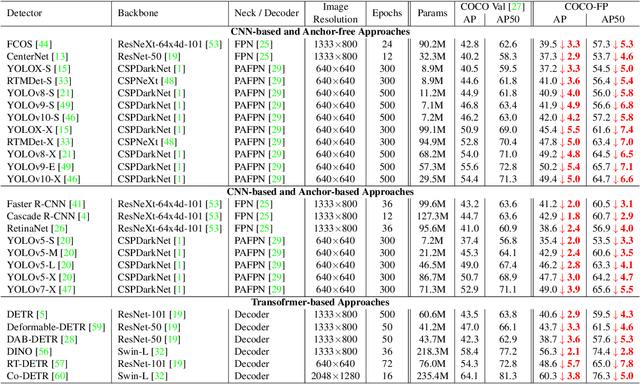

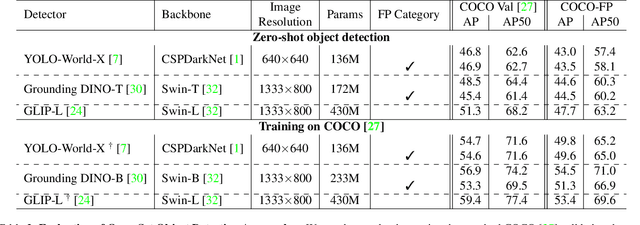
Reducing false positives is essential for enhancing object detector performance, as reflected in the mean Average Precision (mAP) metric. Although object detectors have achieved notable improvements and high mAP scores on the COCO dataset, analysis reveals limited progress in addressing false positives caused by non-target visual clutter-background objects not included in the annotated categories. This issue is particularly critical in real-world applications, such as fire and smoke detection, where minimizing false alarms is crucial. In this study, we introduce COCO-FP, a new evaluation dataset derived from the ImageNet-1K dataset, designed to address this issue. By extending the original COCO validation dataset, COCO-FP specifically assesses object detectors' performance in mitigating background false positives. Our evaluation of both standard and advanced object detectors shows a significant number of false positives in both closed-set and open-set scenarios. For example, the AP50 metric for YOLOv9-E decreases from 72.8 to 65.7 when shifting from COCO to COCO-FP. The dataset is available at https://github.com/COCO-FP/COCO-FP.
LivelySpeaker: Towards Semantic-Aware Co-Speech Gesture Generation
Sep 17, 2023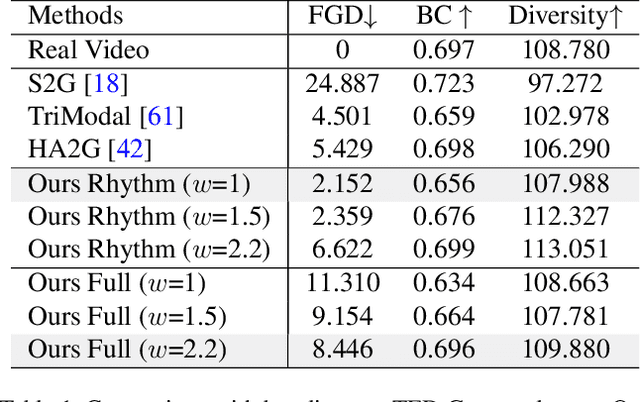
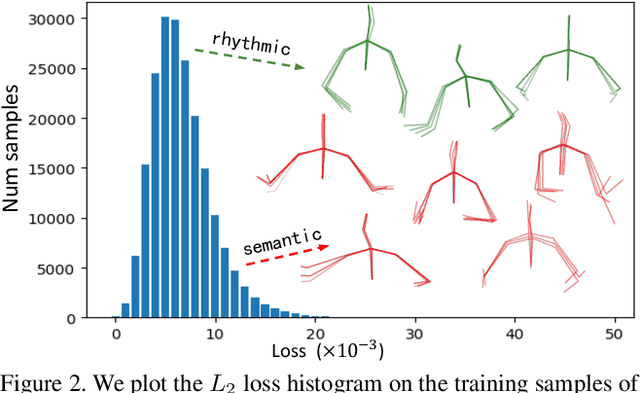
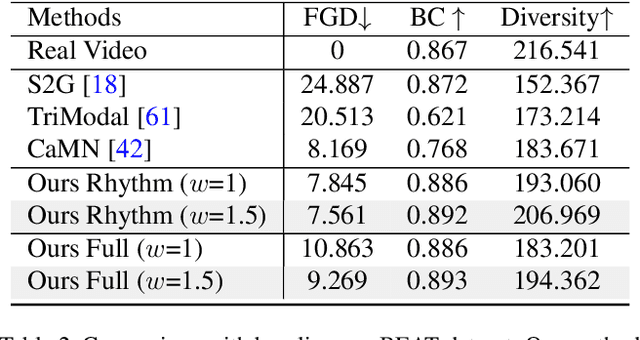
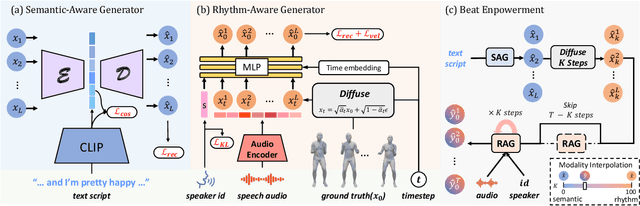
Gestures are non-verbal but important behaviors accompanying people's speech. While previous methods are able to generate speech rhythm-synchronized gestures, the semantic context of the speech is generally lacking in the gesticulations. Although semantic gestures do not occur very regularly in human speech, they are indeed the key for the audience to understand the speech context in a more immersive environment. Hence, we introduce LivelySpeaker, a framework that realizes semantics-aware co-speech gesture generation and offers several control handles. In particular, our method decouples the task into two stages: script-based gesture generation and audio-guided rhythm refinement. Specifically, the script-based gesture generation leverages the pre-trained CLIP text embeddings as the guidance for generating gestures that are highly semantically aligned with the script. Then, we devise a simple but effective diffusion-based gesture generation backbone simply using pure MLPs, that is conditioned on only audio signals and learns to gesticulate with realistic motions. We utilize such powerful prior to rhyme the script-guided gestures with the audio signals, notably in a zero-shot setting. Our novel two-stage generation framework also enables several applications, such as changing the gesticulation style, editing the co-speech gestures via textual prompting, and controlling the semantic awareness and rhythm alignment with guided diffusion. Extensive experiments demonstrate the advantages of the proposed framework over competing methods. In addition, our core diffusion-based generative model also achieves state-of-the-art performance on two benchmarks. The code and model will be released to facilitate future research.
Back to MLP: A Simple Baseline for Human Motion Prediction
Jul 04, 2022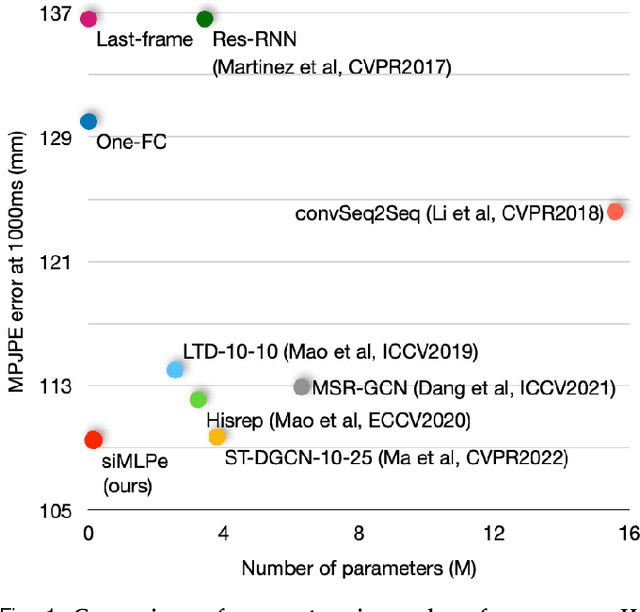
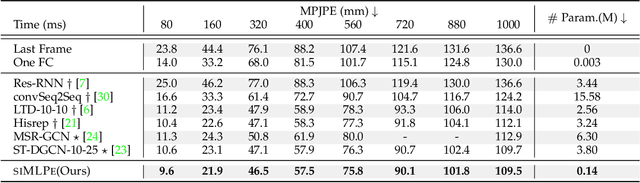
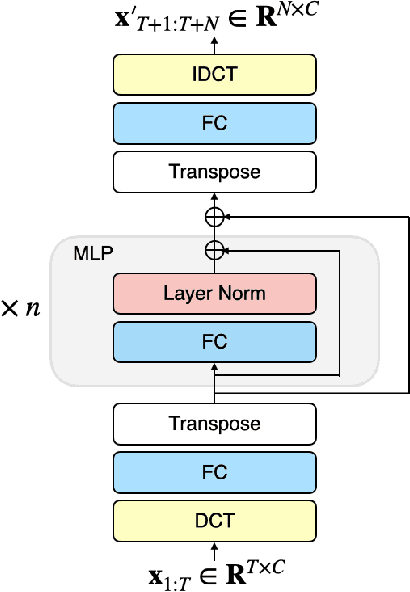

This paper tackles the problem of human motion prediction, consisting in forecasting future body poses from historically observed sequences. Despite of their performance, current state-of-the-art approaches rely on deep learning architectures of arbitrary complexity, such as Recurrent Neural Networks~(RNN), Transformers or Graph Convolutional Networks~(GCN), typically requiring multiple training stages and more than 3 million of parameters. In this paper we show that the performance of these approaches can be surpassed by a light-weight and purely MLP architecture with only 0.14M parameters when appropriately combined with several standard practices such as representing the body pose with Discrete Cosine Transform (DCT), predicting residual displacement of joints and optimizing velocity as an auxiliary loss. An exhaustive evaluation on Human3.6M, AMASS and 3DPW datasets shows that our method, which we dub siMLPe, consistently outperforms all other approaches. We hope that our simple method could serve a strong baseline to the community and allow re-thinking the problem of human motion prediction and whether current benchmarks do really need intricate architectural designs. Our code is available at \url{https://github.com/dulucas/siMLPe}.
HiT-DVAE: Human Motion Generation via Hierarchical Transformer Dynamical VAE
Apr 04, 2022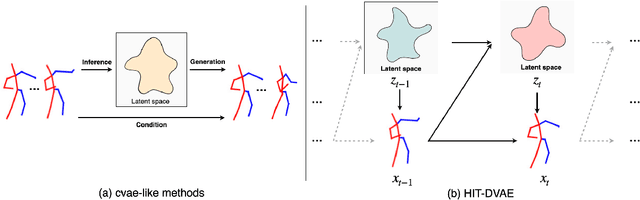
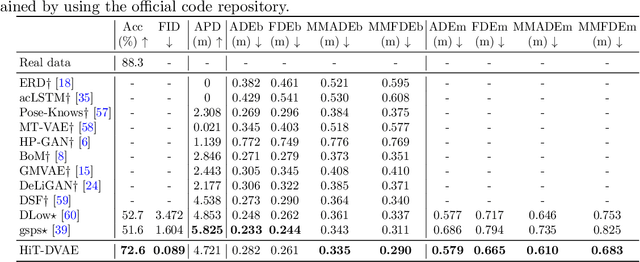
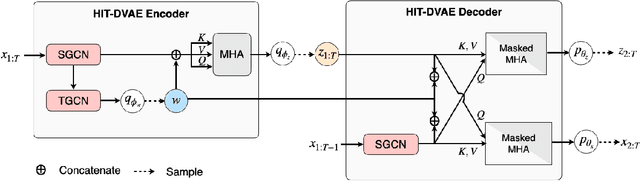
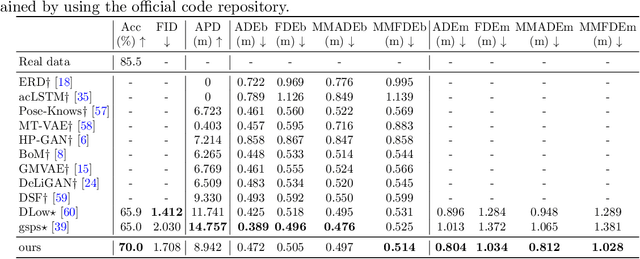
Studies on the automatic processing of 3D human pose data have flourished in the recent past. In this paper, we are interested in the generation of plausible and diverse future human poses following an observed 3D pose sequence. Current methods address this problem by injecting random variables from a single latent space into a deterministic motion prediction framework, which precludes the inherent multi-modality in human motion generation. In addition, previous works rarely explore the use of attention to select which frames are to be used to inform the generation process up to our knowledge. To overcome these limitations, we propose Hierarchical Transformer Dynamical Variational Autoencoder, HiT-DVAE, which implements auto-regressive generation with transformer-like attention mechanisms. HiT-DVAE simultaneously learns the evolution of data and latent space distribution with time correlated probabilistic dependencies, thus enabling the generative model to learn a more complex and time-varying latent space as well as diverse and realistic human motions. Furthermore, the auto-regressive generation brings more flexibility on observation and prediction, i.e. one can have any length of observation and predict arbitrary large sequences of poses with a single pre-trained model. We evaluate the proposed method on HumanEva-I and Human3.6M with various evaluation methods, and outperform the state-of-the-art methods on most of the metrics.
UVO Challenge on Video-based Open-World Segmentation 2021: 1st Place Solution
Nov 01, 2021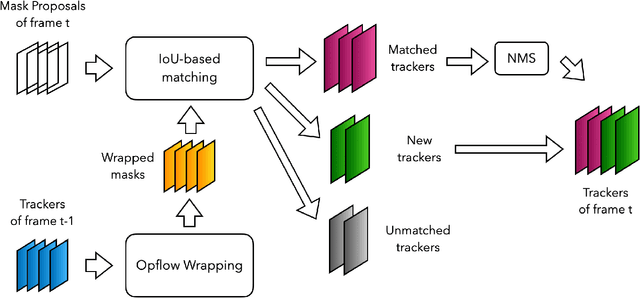
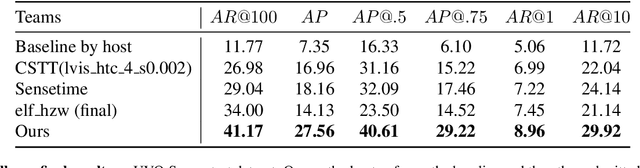
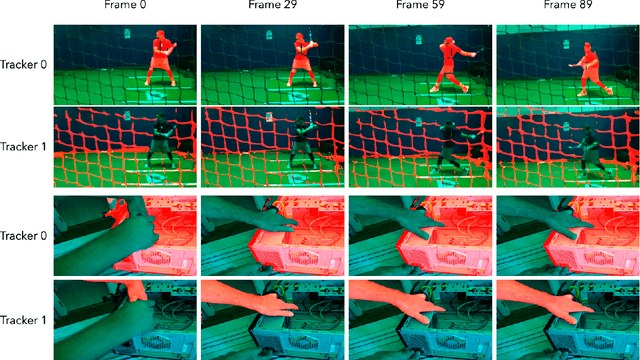
In this report, we introduce our (pretty straightforard) two-step "detect-then-match" video instance segmentation method. The first step performs instance segmentation for each frame to get a large number of instance mask proposals. The second step is to do inter-frame instance mask matching with the help of optical flow. We demonstrate that with high quality mask proposals, a simple matching mechanism is good enough for tracking. Our approach achieves the first place in the UVO 2021 Video-based Open-World Segmentation Challenge.
1st Place Solution for the UVO Challenge on Image-based Open-World Segmentation 2021
Oct 19, 2021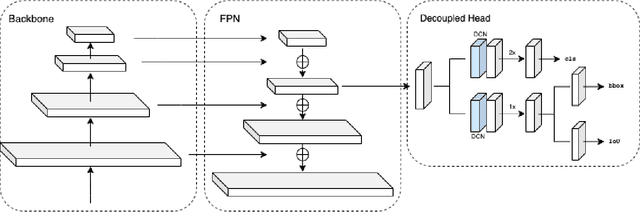
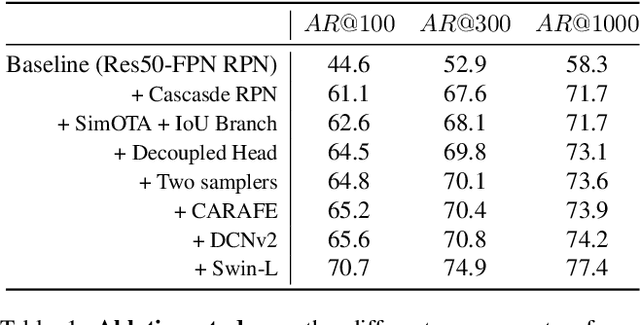
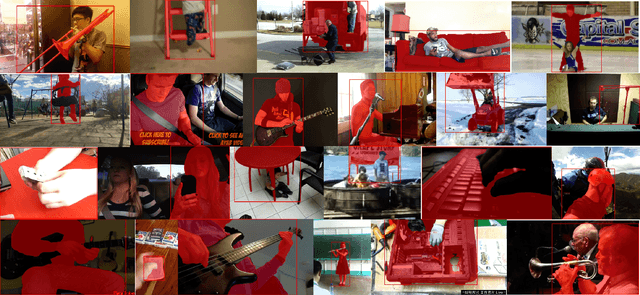
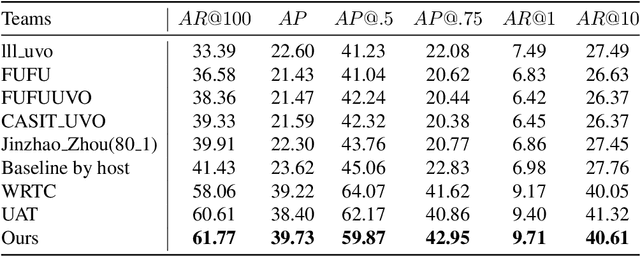
We describe our two-stage instance segmentation framework we use to compete in the challenge. The first stage of our framework consists of an object detector, which generates object proposals in the format of bounding boxes. Then, the images and the detected bounding boxes are fed to the second stage, where a segmentation network is applied to segment the objects in the bounding boxes. We train all our networks in a class-agnostic way. Our approach achieves the first place in the UVO 2021 Image-based Open-World Segmentation Challenge.