 Add to Chrome
 Add to Firefox
 Add to Edge
OnlineCache: Learning Dynamic Caching Policies with Error Correction for Efficient Diffusion Inference
Jul 31, 2026
Diffusion models have revolutionized generative tasks but incur high latency due to iterative denoising. While cache-based strategies accelerate inference by reusing intermediate features, they largely rely on static, sample-agnostic schedules. We argue that this rigidity overlooks two facts empirically validated in this paper: (i) generation difficulty varies across prompts, requiring adaptive resource allocation--complex inputs demand more computation while simpler ones require less; (ii) error sensitivity fluctuates across timesteps, where static policies may cache high-error steps or waste computation on low-error ones. We therefore propose OnlineCache, a dynamic caching framework that jointly learns when to cache and how to correct approximation errors. We leverage policy gradient to train a lightweight network for adaptive speed-quality trade-offs, and incorporate a learnable corrector to mitigate caching-induced errors. Both modules are jointly optimized under a bilevel optimization framework, with the policy targeting global generation quality and the corrector minimizing local errors. Our method automatically allocates computational resources across both samples and timesteps, improving overall generation quality. Extensive experiments demonstrate clear superiority. On FLUX.1-dev model, OnlineCache achieves nearly 3 speedup while preserving generation fidelity. On DiT and CogVideoX, it similarly delivers competitive acceleration without compromising quality; across all scenarios, it consistently outperforms existing cache-based acceleration baselines.

Advanced Black-Box Tuning of Large Language Models with Limited API Calls
Nov 17, 2025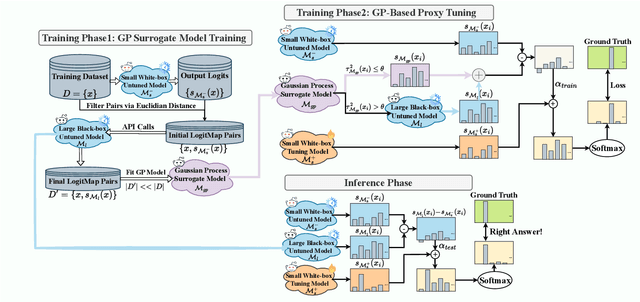
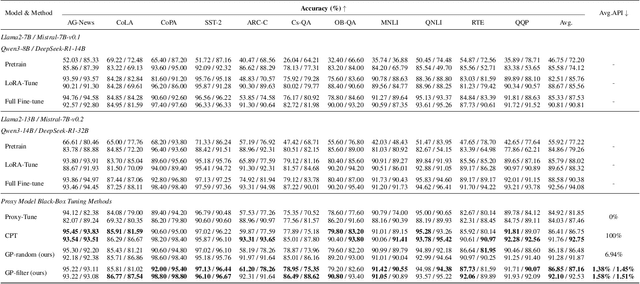

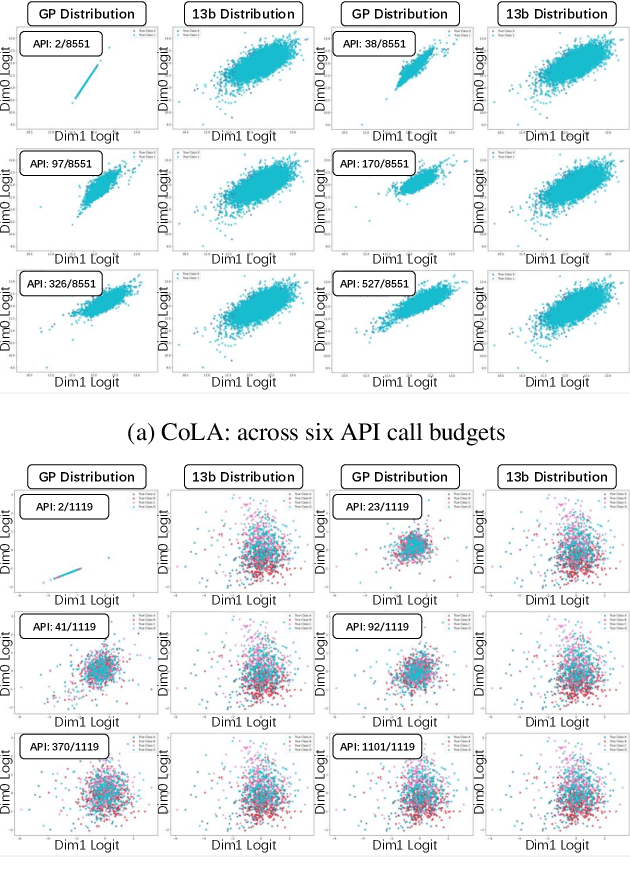
Black-box tuning is an emerging paradigm for adapting large language models (LLMs) to better achieve desired behaviors, particularly when direct access to model parameters is unavailable. Current strategies, however, often present a dilemma of suboptimal extremes: either separately train a small proxy model and then use it to shift the predictions of the foundation model, offering notable efficiency but often yielding limited improvement; or making API calls in each tuning iteration to the foundation model, which entails prohibitive computational costs. Therefore, we propose a novel advanced black-box tuning method for LLMs with limited API calls. Our core strategy involves training a Gaussian Process (GP) surrogate model with "LogitMap Pairs" derived from querying the foundation model on a minimal but highly informative training subset. This surrogate can approximate the outputs of the foundation model to guide the training of the proxy model, thereby effectively reducing the need for direct queries to the foundation model. Extensive experiments verify that our approach elevates pre-trained language model accuracy from 55.92% to 86.85%, reducing the frequency of API queries to merely 1.38%. This significantly outperforms offline approaches that operate entirely without API access. Notably, our method also achieves comparable or superior accuracy to query-intensive approaches, while significantly reducing API costs. This offers a robust and high-efficiency paradigm for language model adaptation.