 Add to Chrome
 Add to Firefox
 Add to Edge
Filter, Then Reweight: Rethinking Optimization Granularity in On-Policy Distillation
Jun 04, 2026
On-Policy distillation (OPD) in large language models is shifting from full-trace KL supervision toward more selective training paradigms. Recent OPD methods increasingly focus on selecting which trajectories to learn from, which tokens are most informative, and which supervision signals are most reliable. Motivated by this trend, we rethink optimization granularity of OPD and propose \fireicon\ FiRe-OPD (Filter, then Reweight), which jointly adjusts supervision signals at both trajectory and token levels. In details, FiRe-OPD first filters trajectories to remove low-quality rollout samples, and then applies soft reweighting within the retained trajectories to emphasize informative tokens. Compared with hard token selection, FiRe-OPD leverages a soft-weighting mechanism to effectively mitigate information loss and enhance optimization stability, thereby achieving finer-grained OPD optimization. We validate the effectiveness of FiRe-OPD across strong-to-weak, single-teacher, and multi-teacher settings, and demonstrate its superiority over recent token-level OPD methods ( (e.g., +6.25 on AIME 2024 in strong-to-weak, +18.81 on Miner in multi-teacher). Our code is available at https://github.com/YuYingLi0/FiRe-OPD.

Plan First, Judge Later, Run Better: A DMAIC-Inspired Agentic System for Industrial Anomaly Detection
Jun 03, 2026Large language model (LLM) agents have shown promise in automating complex data-analysis workflows, but their reliable deployment remains challenging in high-stakes industrial scenarios. Industrial anomaly detection (IAD) is essential for manufacturing quality, safety, and efficiency, yet existing LLM-based IAD agents mainly focus on execution while under-exploiting strategy formulation. Consequently, they struggle to handle heterogeneous modalities in a unified and cost-effective manner. Inspired by the DMAIC quality-management framework, we propose DMAIC-IAD (DMAIC-inspired Agentic Industrial Anomaly Detection), a "Plan First, Judge Later" multi-agent system that aligns LLM agents with structured industrial problem-solving. DMAIC-IAD distills heterogeneous references into standardized operating procedures (SOPs) before strategy generation, and introduces a pre-trained execution-free judge model to rank candidate strategies without costly runtime trials. Extensive experiments across four modalities show that DMAIC-IAD improves average detection performance over applicable agentic baselines by 37.76%.
A Survey of Time Series Foundation Models: Generalizing Time Series Representation with Large Language Model
May 07, 2024
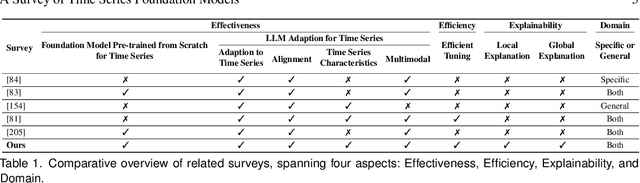

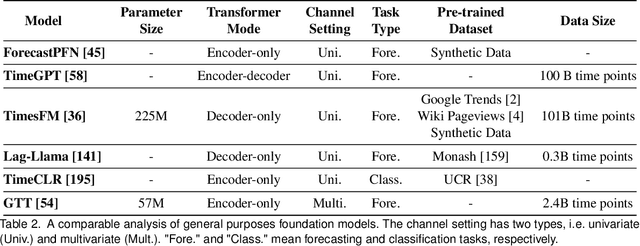
Time series data are ubiquitous across various domains, making time series analysis critically important. Traditional time series models are task-specific, featuring singular functionality and limited generalization capacity. Recently, large language foundation models have unveiled their remarkable capabilities for cross-task transferability, zero-shot/few-shot learning, and decision-making explainability. This success has sparked interest in the exploration of foundation models to solve multiple time series challenges simultaneously. There are two main research lines, namely pre-training foundation models from scratch for time series and adapting large language foundation models for time series. They both contribute to the development of a unified model that is highly generalizable, versatile, and comprehensible for time series analysis. This survey offers a 3E analytical framework for comprehensive examination of related research. Specifically, we examine existing works from three dimensions, namely Effectiveness, Efficiency and Explainability. In each dimension, we focus on discussing how related works devise tailored solution by considering unique challenges in the realm of time series. Furthermore, we provide a domain taxonomy to help followers keep up with the domain-specific advancements. In addition, we introduce extensive resources to facilitate the field's development, including datasets, open-source, time series libraries. A GitHub repository is also maintained for resource updates (https://github.com/start2020/Awesome-TimeSeries-LLM-FM).