 Add to Chrome
 Add to Firefox
 Add to Edge
Boosted Distributional Reinforcement Learning: Analysis and Healthcare Applications
Apr 06, 2026
Researchers and practitioners are increasingly considering reinforcement learning to optimize decisions in complex domains like robotics and healthcare. To date, these efforts have largely utilized expectation-based learning. However, relying on expectation-focused objectives may be insufficient for making consistent decisions in highly uncertain situations involving multiple heterogeneous groups. While distributional reinforcement learning algorithms have been introduced to model the full distributions of outcomes, they can yield large discrepancies in realized benefits among comparable agents. This challenge is particularly acute in healthcare settings, where physicians (controllers) must manage multiple patients (subordinate agents) with uncertain disease progression and heterogeneous treatment responses. We propose a Boosted Distributional Reinforcement Learning (BDRL) algorithm that optimizes agent-specific outcome distributions while enforcing comparability among similar agents and analyze its convergence. To further stabilize learning, we incorporate a post-update projection step formulated as a constrained convex optimization problem, which efficiently aligns individual outcomes with a high-performing reference within a specified tolerance. We apply our algorithm to manage hypertension in a large subset of the US adult population by categorizing individuals into cardiovascular disease risk groups. Our approach modifies treatment plans for median and vulnerable patients by mimicking the behavior of high-performing references in each risk group. Furthermore, we find that BDRL improves the number and consistency of quality-adjusted life years compared with reinforcement learning baselines.

MoRe: Motion-aware Feed-forward 4D Reconstruction Transformer
Mar 05, 2026Reconstructing dynamic 4D scenes remains challenging due to the presence of moving objects that corrupt camera pose estimation. Existing optimization methods alleviate this issue with additional supervision, but they are mostly computationally expensive and impractical in real-time applications. To address these limitations, we propose MoRe, a feedforward 4D reconstruction network that efficiently recovers dynamic 3D scenes from monocular videos. Built upon a strong static reconstruction backbone, MoRe employs an attention-forcing strategy to disentangle dynamic motion from static structure. To further enhance robustness, we fine-tune the model on large-scale, diverse datasets encompassing both dynamic and static scenes. Moreover, our grouped causal attention captures temporal dependencies and adapts to varying token lengths across frames, ensuring temporally coherent geometry reconstruction. Extensive experiments on multiple benchmarks demonstrate that MoRe achieves high-quality dynamic reconstructions with exceptional efficiency.
EverybodyDance: Bipartite Graph-Based Identity Correspondence for Multi-Character Animation
Dec 18, 2025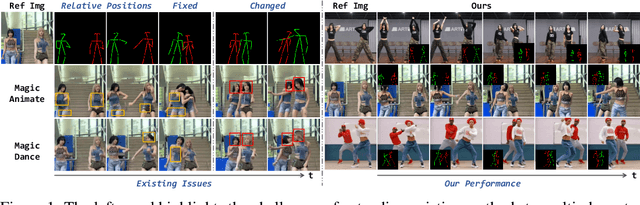
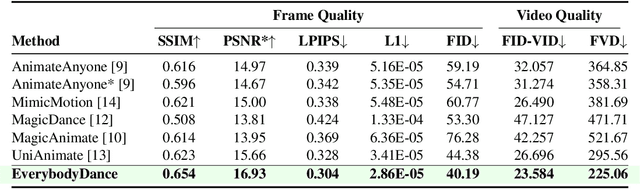
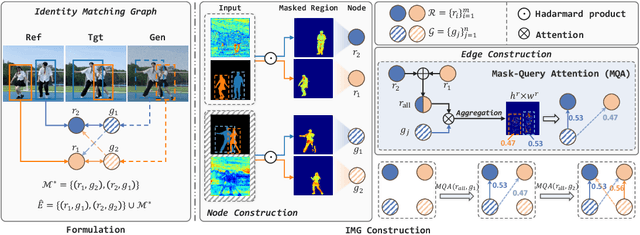
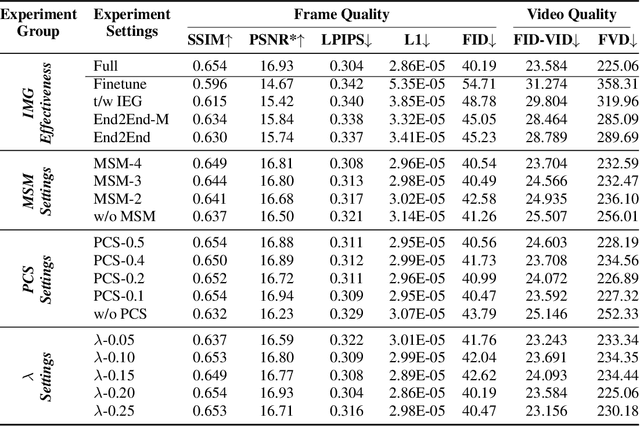
Consistent pose-driven character animation has achieved remarkable progress in single-character scenarios. However, extending these advances to multi-character settings is non-trivial, especially when position swap is involved. Beyond mere scaling, the core challenge lies in enforcing correct Identity Correspondence (IC) between characters in reference and generated frames. To address this, we introduce EverybodyDance, a systematic solution targeting IC correctness in multi-character animation. EverybodyDance is built around the Identity Matching Graph (IMG), which models characters in the generated and reference frames as two node sets in a weighted complete bipartite graph. Edge weights, computed via our proposed Mask-Query Attention (MQA), quantify the affinity between each pair of characters. Our key insight is to formalize IC correctness as a graph structural metric and to optimize it during training. We also propose a series of targeted strategies tailored for multi-character animation, including identity-embedded guidance, a multi-scale matching strategy, and pre-classified sampling, which work synergistically. Finally, to evaluate IC performance, we curate the Identity Correspondence Evaluation benchmark, dedicated to multi-character IC correctness. Extensive experiments demonstrate that EverybodyDance substantially outperforms state-of-the-art baselines in both IC and visual fidelity.
PreF3R: Pose-Free Feed-Forward 3D Gaussian Splatting from Variable-length Image Sequence
Nov 25, 2024


We present PreF3R, Pose-Free Feed-forward 3D Reconstruction from an image sequence of variable length. Unlike previous approaches, PreF3R removes the need for camera calibration and reconstructs the 3D Gaussian field within a canonical coordinate frame directly from a sequence of unposed images, enabling efficient novel-view rendering. We leverage DUSt3R's ability for pair-wise 3D structure reconstruction, and extend it to sequential multi-view input via a spatial memory network, eliminating the need for optimization-based global alignment. Additionally, PreF3R incorporates a dense Gaussian parameter prediction head, which enables subsequent novel-view synthesis with differentiable rasterization. This allows supervising our model with the combination of photometric loss and pointmap regression loss, enhancing both photorealism and structural accuracy. Given a sequence of ordered images, PreF3R incrementally reconstructs the 3D Gaussian field at 20 FPS, therefore enabling real-time novel-view rendering. Empirical experiments demonstrate that PreF3R is an effective solution for the challenging task of pose-free feed-forward novel-view synthesis, while also exhibiting robust generalization to unseen scenes.