 Add to Chrome
 Add to Firefox
 Add to Edge
Deform360: A Massive Multi-view Visuotactile Dataset for Deformable World Models
Jul 06, 2026
Predicting object dynamics (i.e., world modeling) is a fundamental challenge for robotic manipulation, and modeling deformable objects presents a particularly difficult case due to their high-dimensional state spaces and complex material properties. While current world models approach this through two distinct paradigms: learning the dynamics over the 2D pixel space or more explicit 3D geometric space. A systematic understanding of their relative strengths and limitations remains elusive due to the lack of diverse, large-scale real-world data. To address this, we present Deform360, a large-scale visuotactile dataset featuring 198 daily-life objects, 1,980 interaction sequences, and over 215 hours of observations from 41 surround-view cameras and bimanual tactile grippers to capture both global motion and contact-induced local deformations. Leveraging a novel markerless visuotactile 3D tracking pipeline to extract dense geometry and motion, we systematically evaluate current state-of-the-art world models, comparing 2D video models against 3D particle models. Finally, we provide a preliminary demonstration indicating the real-world applicability of our dataset by performing robot planning tasks on deformable objects. Our analysis reveals key insights into the trade-offs between structural priors and scalability, providing a solid benchmark for future research in generalizable deformable object-centric world modeling. Project website: https://deform360.lhy.xyz

UniTac: Whole-Robot Touch Sensing Without Tactile Sensors
Jul 10, 2025Robots can better interact with humans and unstructured environments through touch sensing. However, most commercial robots are not equipped with tactile skins, making it challenging to achieve even basic touch-sensing functions, such as contact localization. We present UniTac, a data-driven whole-body touch-sensing approach that uses only proprioceptive joint sensors and does not require the installation of additional sensors. Our approach enables a robot equipped solely with joint sensors to localize contacts. Our goal is to democratize touch sensing and provide an off-the-shelf tool for HRI researchers to provide their robots with touch-sensing capabilities. We validate our approach on two platforms: the Franka robot arm and the Spot quadruped. On Franka, we can localize contact to within 8.0 centimeters, and on Spot, we can localize to within 7.2 centimeters at around 2,000 Hz on an RTX 3090 GPU without adding any additional sensors to the robot. Project website: https://ivl.cs.brown.edu/research/unitac.
GigaHands: A Massive Annotated Dataset of Bimanual Hand Activities
Dec 05, 2024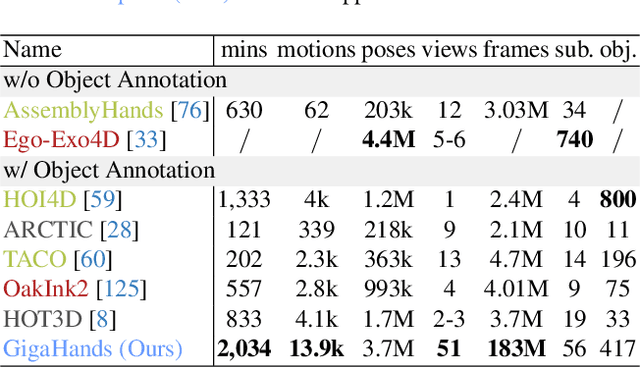
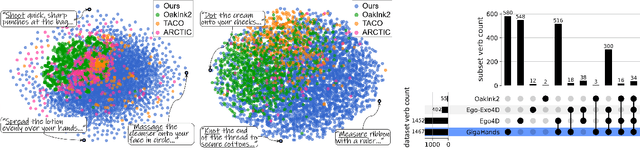

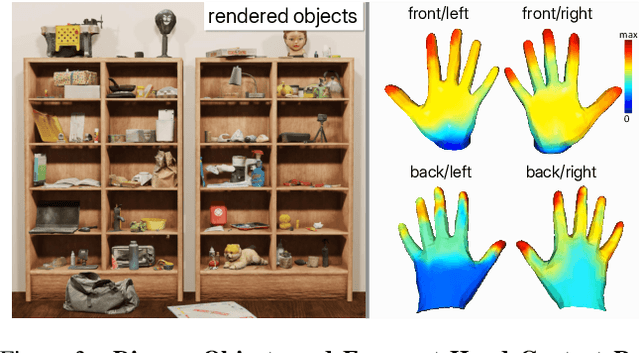
Understanding bimanual human hand activities is a critical problem in AI and robotics. We cannot build large models of bimanual activities because existing datasets lack the scale, coverage of diverse hand activities, and detailed annotations. We introduce GigaHands, a massive annotated dataset capturing 34 hours of bimanual hand activities from 56 subjects and 417 objects, totaling 14k motion clips derived from 183 million frames paired with 84k text annotations. Our markerless capture setup and data acquisition protocol enable fully automatic 3D hand and object estimation while minimizing the effort required for text annotation. The scale and diversity of GigaHands enable broad applications, including text-driven action synthesis, hand motion captioning, and dynamic radiance field reconstruction.