 Add to Chrome
 Add to Firefox
 Add to Edge
Deform360: A Massive Multi-view Visuotactile Dataset for Deformable World Models
Jul 06, 2026
Predicting object dynamics (i.e., world modeling) is a fundamental challenge for robotic manipulation, and modeling deformable objects presents a particularly difficult case due to their high-dimensional state spaces and complex material properties. While current world models approach this through two distinct paradigms: learning the dynamics over the 2D pixel space or more explicit 3D geometric space. A systematic understanding of their relative strengths and limitations remains elusive due to the lack of diverse, large-scale real-world data. To address this, we present Deform360, a large-scale visuotactile dataset featuring 198 daily-life objects, 1,980 interaction sequences, and over 215 hours of observations from 41 surround-view cameras and bimanual tactile grippers to capture both global motion and contact-induced local deformations. Leveraging a novel markerless visuotactile 3D tracking pipeline to extract dense geometry and motion, we systematically evaluate current state-of-the-art world models, comparing 2D video models against 3D particle models. Finally, we provide a preliminary demonstration indicating the real-world applicability of our dataset by performing robot planning tasks on deformable objects. Our analysis reveals key insights into the trade-offs between structural priors and scalability, providing a solid benchmark for future research in generalizable deformable object-centric world modeling. Project website: https://deform360.lhy.xyz

Federated Causality Learning with Explainable Adaptive Optimization
Dec 09, 2023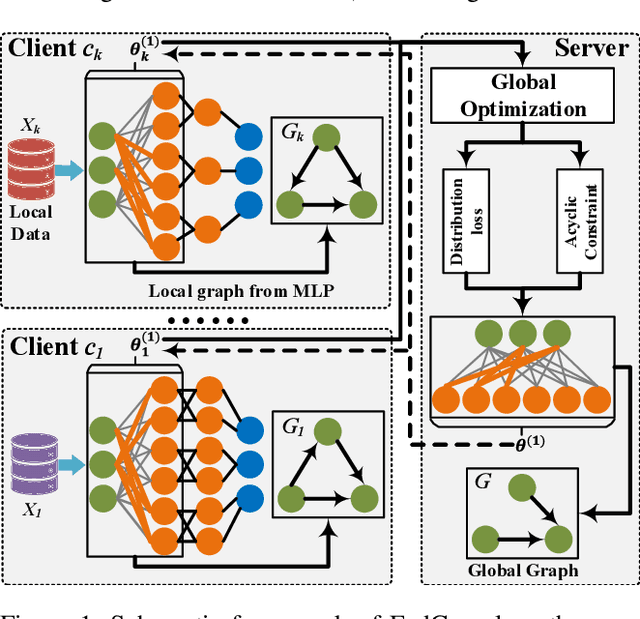

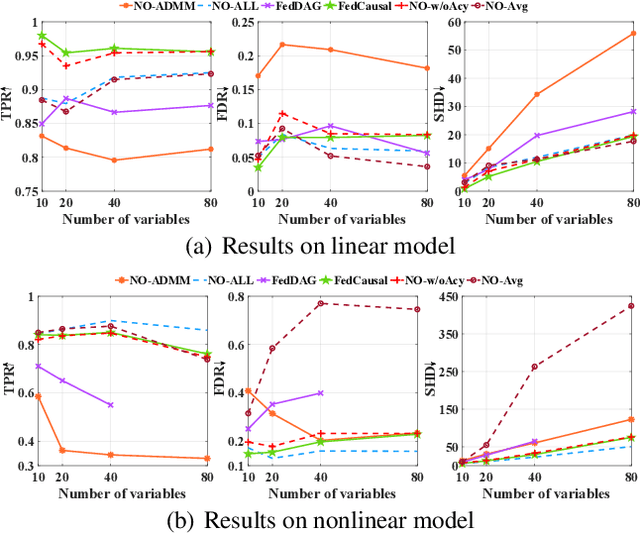
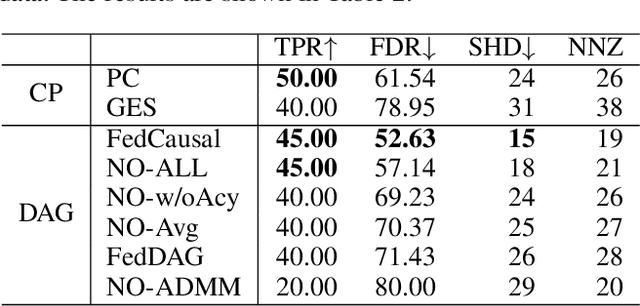
Discovering the causality from observational data is a crucial task in various scientific domains. With increasing awareness of privacy, data are not allowed to be exposed, and it is very hard to learn causal graphs from dispersed data, since these data may have different distributions. In this paper, we propose a federated causal discovery strategy (FedCausal) to learn the unified global causal graph from decentralized heterogeneous data. We design a global optimization formula to naturally aggregate the causal graphs from client data and constrain the acyclicity of the global graph without exposing local data. Unlike other federated causal learning algorithms, FedCausal unifies the local and global optimizations into a complete directed acyclic graph (DAG) learning process with a flexible optimization objective. We prove that this optimization objective has a high interpretability and can adaptively handle homogeneous and heterogeneous data. Experimental results on synthetic and real datasets show that FedCausal can effectively deal with non-independently and identically distributed (non-iid) data and has a superior performance.