 Add to Chrome
 Add to Firefox
 Add to Edge
SPEARBench: A Benchmark for Naturalness Evaluation in Streaming Speech-to-Speech Language Models
Jul 06, 2026
Streaming speech-to-speech language models aim to answer spoken queries directly with synthetic speech. However, standard speech and text benchmarks do not capture whether these systems behave naturally in conversations, where timing, turn-taking, prosody, interpersonal stance, language and dialect consistency, and relationship-aware appropriateness jointly shape perceived quality. We introduce SPEARBench, a benchmark for evaluating naturalness in speech-to-speech language models from question-answer interactions. SPEARBench constructs controlled dialogue prompts from the Seamless Interaction corpus, runs inference across multiple models, and evaluates generated answers using a multidimensional protocol that covers response latency, interruptions, speech quality, ASR robustness, language and dialect consistency, emotional naturalness, interpersonal stance, and explainable distributional baselines. The benchmark includes original human answers as a reference condition and reports results for several contemporary models. Results show that current models can achieve high signal-level quality and low ASR error while still differing from human conversational behavior in latency, overlap, dialect preservation, emotional adaptation, and interpersonal stance dynamics.

TurnNat: Automatic Evaluation of Turn-Taking Naturalness in Dyadic Spoken Dialogue
Jul 01, 2026Turn-taking naturalness is central to full-duplex spoken dialogue systems, yet its automatic evaluation remains limited. Existing evaluations often rely on human judgments or behavior-specific timing metrics, making it difficult to compare heterogeneous timing failures within a unified framework. We propose TurnNat, a likelihood-based framework for automatic turn-taking naturalness evaluation in two-channel spoken dialogue. A causal turn-taking prediction model trained on natural conversations estimates future two-speaker voice-activity states, and the negative log-likelihood (NLL) of the observed future activity measures timing atypicality. TurnNat pools frame-level NLLs over turn-taking boundary units (TBUs) extracted from utterance onsets and offsets, and aggregates mean and tail TBU scores into a dialogue-level naturalness score. We further construct a controlled perturbation benchmark of paired natural and perturbed dialogue clips, validated by human naturalness judgments. Experiments on this benchmark show that TurnNat successfully identifies unnatural turn-taking perturbations across heterogeneous timing failures.
Reference-Based Prosody and Rhythm Evaluation for Spoken Dialogue Systems
Jun 30, 2026Speech-to-speech (S2S) AI agents are advancing rapidly, yet evaluation lacks interpretable speech-native measures for conversational prosody and rhythm. Because $F_0$, speaking rate, articulation rate, and pausing shift with model-predicted speaker traits and interaction state, pooled human statistics can be poorly calibrated for evaluating a particular output. Using 4000+ hours of dyadic English conversation from the Seamless Interaction dataset, we construct matched reference regimes for $F_0$ mean, $F_0$ expressivity, speech rate, articulation rate, pause ratio, and mean pause duration. We then define a percentile-based evaluation protocol: extract the same metrics from an S2S output waveform, compare them to the closest matched human reference stratum, and report percentile deviations or 5th-95th percentile out-of-regime flags. On held-out human rows, pooled references over-flag state-conditioned $F_0$ expressivity and rhythm, while matched references return flag rates closer to the nominal 10% and make deviation direction interpretable. These outputs serve as behavioral plausibility checks that complement, rather than replace, perceptual and user-centered evaluation.
TRACE: Temporal Relationship-Aware Conversational Entrainment Detection in Dyadic Speech
Jun 29, 2026With the proliferation of speech AI agents, understanding emotional entrainment in conversational interaction has become increasingly important. Emotional entrainment is shaped by social relationships and conversational context, influencing affective coordination over time. We introduce DyadEE, a dataset for emotional entrainment detection in dyadic speech interactions, containing both emotionally entrained conversations and synthetic interactions where entrainment is disrupted through partner swapping and emotion resynthesis. We further propose TRACE, a window-level framework that models dyadic interaction as ordered sequences of acoustic embeddings derived from emotion fine-tuned Whisper representations, treating each sample as an interaction trace rather than pooled utterances. Experimental results on DyadEE show that incorporating conversational context and relationship information improves emotional entrainment detection, with TRACE achieving the best accuracy of 97.01%.
Hearing Between the Lines: Unlocking the Reasoning Power of LLMs for Speech Evaluation
Jan 24, 2026Large Language Model (LLM) judges exhibit strong reasoning capabilities but are limited to textual content. This leaves current automatic Speech-to-Speech (S2S) evaluation methods reliant on opaque and expensive Audio Language Models (ALMs). In this work, we propose TRACE (Textual Reasoning over Audio Cues for Evaluation), a novel framework that enables LLM judges to reason over audio cues to achieve cost-efficient and human-aligned S2S evaluation. To demonstrate the strength of the framework, we first introduce a Human Chain-of-Thought (HCoT) annotation protocol to improve the diagnostic capability of existing judge benchmarks by separating evaluation into explicit dimensions: content (C), voice quality (VQ), and paralinguistics (P). Using this data, TRACE constructs a textual blueprint of inexpensive audio signals and prompts an LLM to render dimension-wise judgments, fusing them into an overall rating via a deterministic policy. TRACE achieves higher agreement with human raters than ALMs and transcript-only LLM judges while being significantly more cost-effective. We will release the HCoT annotations and the TRACE framework to enable scalable and human-aligned S2S evaluation.
Dimension-First Evaluation of Speech-to-Speech Models with Structured Acoustic Cues
Jan 20, 2026Large Language Model (LLM) judges exhibit strong reasoning capabilities but are limited to textual content. This leaves current automatic Speech-to-Speech (S2S) evaluation methods reliant on opaque and expensive Audio Language Models (ALMs). In this work, we propose TRACE (Textual Reasoning over Audio Cues for Evaluation), a novel framework that enables LLM judges to reason over audio cues to achieve cost-efficient and human-aligned S2S evaluation. To demonstrate the strength of the framework, we first introduce a Human Chain-of-Thought (HCoT) annotation protocol to improve the diagnostic capability of existing judge benchmarks by separating evaluation into explicit dimensions: content (C), voice quality (VQ), and paralinguistics (P). Using this data, TRACE constructs a textual blueprint of inexpensive audio signals and prompts an LLM to render dimension-wise judgments, fusing them into an overall rating via a deterministic policy. TRACE achieves higher agreement with human raters than ALMs and transcript-only LLM judges while being significantly more cost-effective. We will release the HCoT annotations and the TRACE framework to enable scalable and human-aligned S2S evaluation.
The Interspeech 2025 Speech Accessibility Project Challenge
Jul 29, 2025While the last decade has witnessed significant advancements in Automatic Speech Recognition (ASR) systems, performance of these systems for individuals with speech disabilities remains inadequate, partly due to limited public training data. To bridge this gap, the 2025 Interspeech Speech Accessibility Project (SAP) Challenge was launched, utilizing over 400 hours of SAP data collected and transcribed from more than 500 individuals with diverse speech disabilities. Hosted on EvalAI and leveraging the remote evaluation pipeline, the SAP Challenge evaluates submissions based on Word Error Rate and Semantic Score. Consequently, 12 out of 22 valid teams outperformed the whisper-large-v2 baseline in terms of WER, while 17 teams surpassed the baseline on SemScore. Notably, the top team achieved the lowest WER of 8.11\%, and the highest SemScore of 88.44\% at the same time, setting new benchmarks for future ASR systems in recognizing impaired speech.
Mitigating Bad Ground Truth in Supervised Machine Learning based Crop Classification: A Multi-Level Framework with Sentinel-2 Images
Mar 14, 2025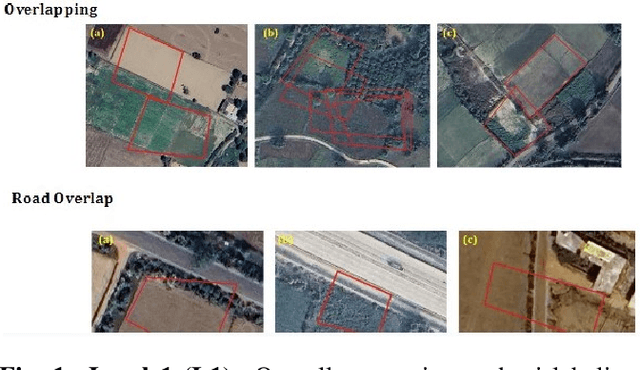
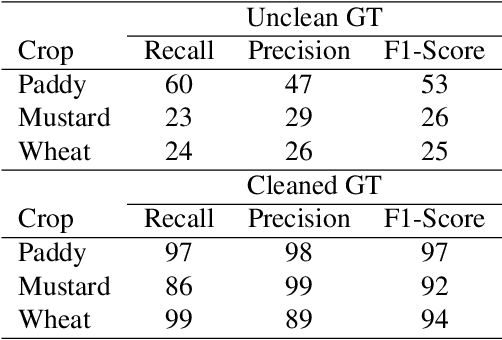
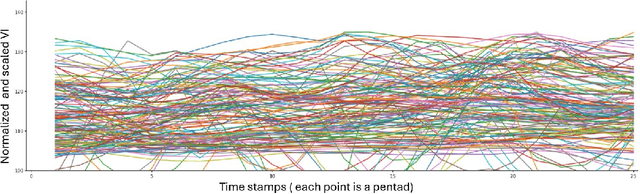
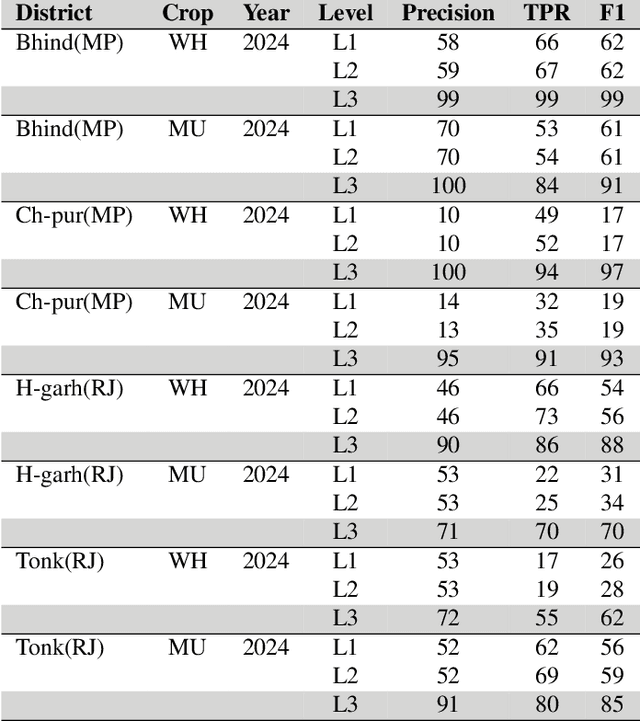
In agricultural management, precise Ground Truth (GT) data is crucial for accurate Machine Learning (ML) based crop classification. Yet, issues like crop mislabeling and incorrect land identification are common. We propose a multi-level GT cleaning framework while utilizing multi-temporal Sentinel-2 data to address these issues. Specifically, this framework utilizes generating embeddings for farmland, clustering similar crop profiles, and identification of outliers indicating GT errors. We validated clusters with False Colour Composite (FCC) checks and used distance-based metrics to scale and automate this verification process. The importance of cleaning the GT data became apparent when the models were trained on the clean and unclean data. For instance, when we trained a Random Forest model with the clean GT data, we achieved upto 70\% absolute percentage points higher for the F1 score metric. This approach advances crop classification methodologies, with potential for applications towards improving loan underwriting and agricultural decision-making.
Multi-Stage Multi-Modal Pre-Training for Automatic Speech Recognition
Mar 28, 2024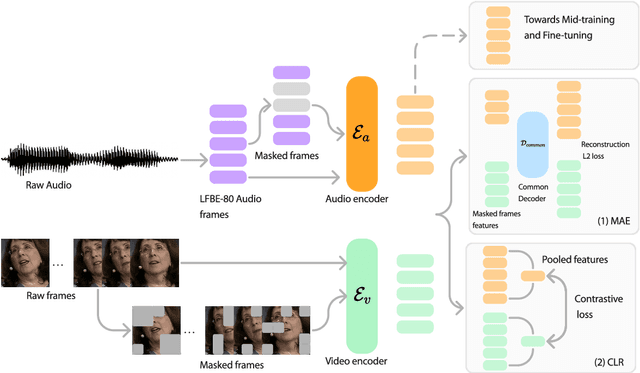
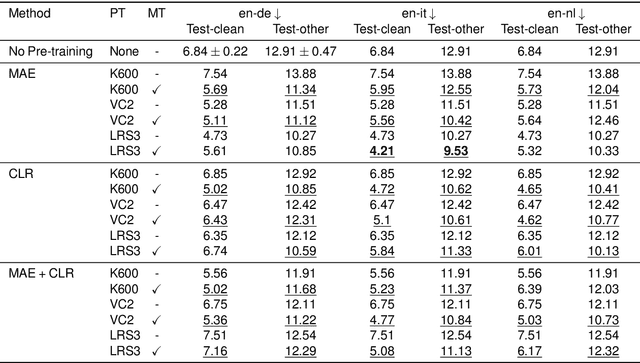
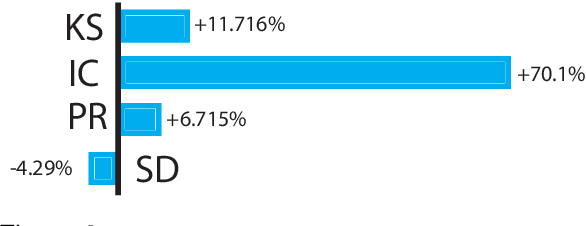
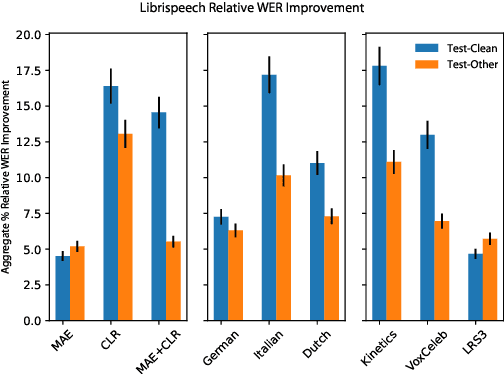
Recent advances in machine learning have demonstrated that multi-modal pre-training can improve automatic speech recognition (ASR) performance compared to randomly initialized models, even when models are fine-tuned on uni-modal tasks. Existing multi-modal pre-training methods for the ASR task have primarily focused on single-stage pre-training where a single unsupervised task is used for pre-training followed by fine-tuning on the downstream task. In this work, we introduce a novel method combining multi-modal and multi-task unsupervised pre-training with a translation-based supervised mid-training approach. We empirically demonstrate that such a multi-stage approach leads to relative word error rate (WER) improvements of up to 38.45% over baselines on both Librispeech and SUPERB. Additionally, we share several important findings for choosing pre-training methods and datasets.
Turn-taking and Backchannel Prediction with Acoustic and Large Language Model Fusion
Jan 26, 2024


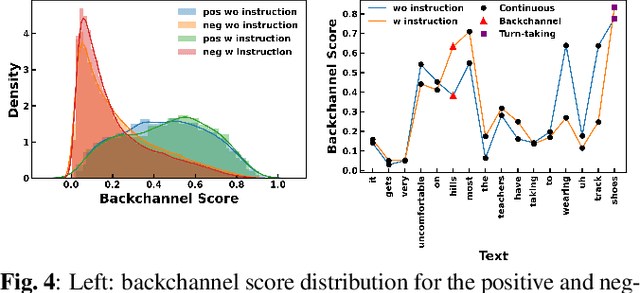
We propose an approach for continuous prediction of turn-taking and backchanneling locations in spoken dialogue by fusing a neural acoustic model with a large language model (LLM). Experiments on the Switchboard human-human conversation dataset demonstrate that our approach consistently outperforms the baseline models with single modality. We also develop a novel multi-task instruction fine-tuning strategy to further benefit from LLM-encoded knowledge for understanding the tasks and conversational contexts, leading to additional improvements. Our approach demonstrates the potential of combined LLMs and acoustic models for a more natural and conversational interaction between humans and speech-enabled AI agents.