 Add to Chrome
 Add to Firefox
 Add to Edge
Do Audio Language Models Use Paralinguistic Evidence? Counterfactual Audits for Response Evaluation
Aug 07, 2026
Audio-language models (ALMs) are increasingly used as judges for speech-to-speech systems, but a judge that receives audio may not actually use paralinguistic evidence. We introduce counterfactual audits for paralinguistic response evaluation. Each audit item holds the transcript fixed while varying affect, prosody, or the timing of an affective shift, forcing a valid judge to track the audio cue rather than lexical content or response style. We evaluate ALM judges using a native one-context judgment protocol and a contrastive recoverability control, then further decompose each item into its constituent perception and response-mapping skills. This yields useful diagnostic states that identify different sources of judge failures. Across Gemini, GPT, and open audio models, we find that contrastive success often overstates native judge reliability, and that similar aggregate accuracies can hide different failure modes. These results suggest that ALM judges should not be evaluated by accuracy alone, instead requiring thorough behavioral audits before deployment.

Layerwise Dynamics for In-Context Classification in Transformers
Apr 13, 2026Transformers can perform in-context classification from a few labeled examples, yet the inference-time algorithm remains opaque. We study multi-class linear classification in the hard no-margin regime and make the computation identifiable by enforcing feature- and label-permutation equivariance at every layer. This enables interpretability while maintaining functional equivalence and yields highly structured weights. From these models we extract an explicit depth-indexed recursion: an end-to-end identified, emergent update rule inside a softmax transformer, to our knowledge the first of its kind. Attention matrices formed from mixed feature-label Gram structure drive coupled updates of training points, labels, and the test probe. The resulting dynamics implement a geometry-driven algorithmic motif, which can provably amplify class separation and yields robust expected class alignment.
Hearing Between the Lines: Unlocking the Reasoning Power of LLMs for Speech Evaluation
Jan 24, 2026Large Language Model (LLM) judges exhibit strong reasoning capabilities but are limited to textual content. This leaves current automatic Speech-to-Speech (S2S) evaluation methods reliant on opaque and expensive Audio Language Models (ALMs). In this work, we propose TRACE (Textual Reasoning over Audio Cues for Evaluation), a novel framework that enables LLM judges to reason over audio cues to achieve cost-efficient and human-aligned S2S evaluation. To demonstrate the strength of the framework, we first introduce a Human Chain-of-Thought (HCoT) annotation protocol to improve the diagnostic capability of existing judge benchmarks by separating evaluation into explicit dimensions: content (C), voice quality (VQ), and paralinguistics (P). Using this data, TRACE constructs a textual blueprint of inexpensive audio signals and prompts an LLM to render dimension-wise judgments, fusing them into an overall rating via a deterministic policy. TRACE achieves higher agreement with human raters than ALMs and transcript-only LLM judges while being significantly more cost-effective. We will release the HCoT annotations and the TRACE framework to enable scalable and human-aligned S2S evaluation.
Dimension-First Evaluation of Speech-to-Speech Models with Structured Acoustic Cues
Jan 20, 2026Large Language Model (LLM) judges exhibit strong reasoning capabilities but are limited to textual content. This leaves current automatic Speech-to-Speech (S2S) evaluation methods reliant on opaque and expensive Audio Language Models (ALMs). In this work, we propose TRACE (Textual Reasoning over Audio Cues for Evaluation), a novel framework that enables LLM judges to reason over audio cues to achieve cost-efficient and human-aligned S2S evaluation. To demonstrate the strength of the framework, we first introduce a Human Chain-of-Thought (HCoT) annotation protocol to improve the diagnostic capability of existing judge benchmarks by separating evaluation into explicit dimensions: content (C), voice quality (VQ), and paralinguistics (P). Using this data, TRACE constructs a textual blueprint of inexpensive audio signals and prompts an LLM to render dimension-wise judgments, fusing them into an overall rating via a deterministic policy. TRACE achieves higher agreement with human raters than ALMs and transcript-only LLM judges while being significantly more cost-effective. We will release the HCoT annotations and the TRACE framework to enable scalable and human-aligned S2S evaluation.
BabyVLM-V2: Toward Developmentally Grounded Pretraining and Benchmarking of Vision Foundation Models
Dec 11, 2025Early children's developmental trajectories set up a natural goal for sample-efficient pretraining of vision foundation models. We introduce BabyVLM-V2, a developmentally grounded framework for infant-inspired vision-language modeling that extensively improves upon BabyVLM-V1 through a longitudinal, multifaceted pretraining set, a versatile model, and, most importantly, DevCV Toolbox for cognitive evaluation. The pretraining set maximizes coverage while minimizing curation of a longitudinal, infant-centric audiovisual corpus, yielding video-utterance, image-utterance, and multi-turn conversational data that mirror infant experiences. DevCV Toolbox adapts all vision-related measures of the recently released NIH Baby Toolbox into a benchmark suite of ten multimodal tasks, covering spatial reasoning, memory, and vocabulary understanding aligned with early children's capabilities. Experimental results show that a compact model pretrained from scratch can achieve competitive performance on DevCV Toolbox, outperforming GPT-4o on some tasks. We hope the principled, unified BabyVLM-V2 framework will accelerate research in developmentally plausible pretraining of vision foundation models.
BIG5-TPoT: Predicting BIG Five Personality Traits, Facets, and Items Through Targeted Preselection of Texts
Nov 12, 2025Predicting an individual's personalities from their generated texts is a challenging task, especially when the text volume is large. In this paper, we introduce a straightforward yet effective novel strategy called targeted preselection of texts (TPoT). This method semantically filters the texts as input to a deep learning model, specifically designed to predict a Big Five personality trait, facet, or item, referred to as the BIG5-TPoT model. By selecting texts that are semantically relevant to a particular trait, facet, or item, this strategy not only addresses the issue of input text limits in large language models but also improves the Mean Absolute Error and accuracy metrics in predictions for the Stream of Consciousness Essays dataset.
BabyVLM: Data-Efficient Pretraining of VLMs Inspired by Infant Learning
Apr 13, 2025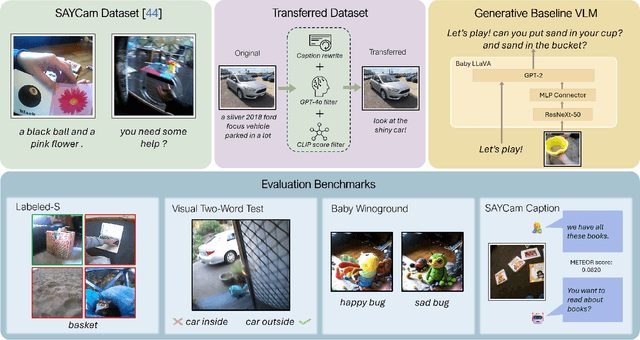
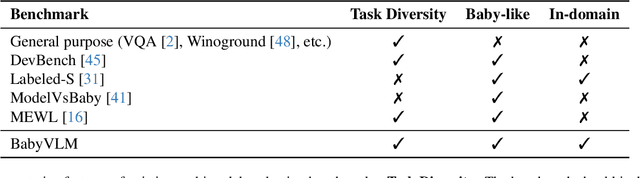
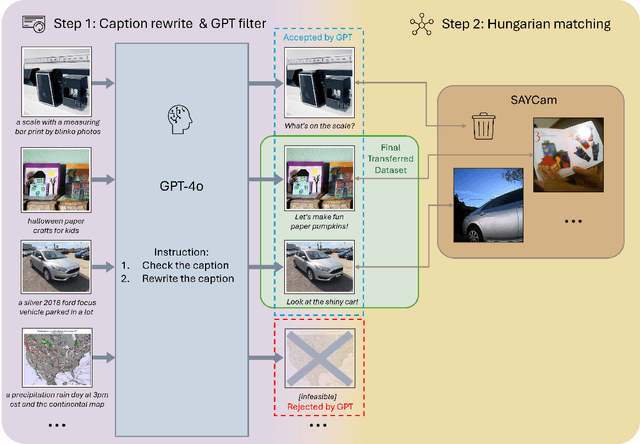
Human infants rapidly develop visual reasoning skills from minimal input, suggesting that developmentally inspired pretraining could significantly enhance the efficiency of vision-language models (VLMs). Although recent efforts have leveraged infant-inspired datasets like SAYCam, existing evaluation benchmarks remain misaligned--they are either too simplistic, narrowly scoped, or tailored for large-scale pretrained models. Additionally, training exclusively on infant data overlooks the broader, diverse input from which infants naturally learn. To address these limitations, we propose BabyVLM, a novel framework comprising comprehensive in-domain evaluation benchmarks and a synthetic training dataset created via child-directed transformations of existing datasets. We demonstrate that VLMs trained with our synthetic dataset achieve superior performance on BabyVLM tasks compared to models trained solely on SAYCam or general-purpose data of the SAYCam size. BabyVLM thus provides a robust, developmentally aligned evaluation tool and illustrates how compact models trained on carefully curated data can generalize effectively, opening pathways toward data-efficient vision-language learning paradigms.
Efficient Parallel Methods for Deep Reinforcement Learning
May 16, 2017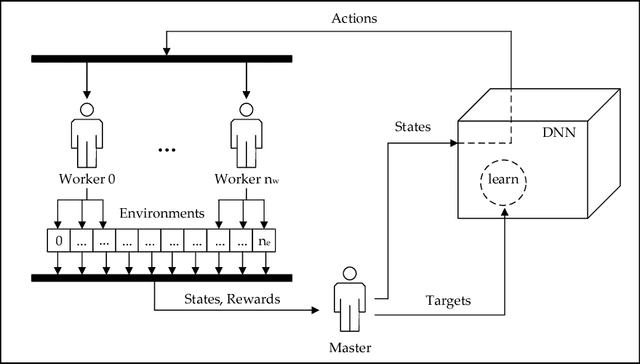
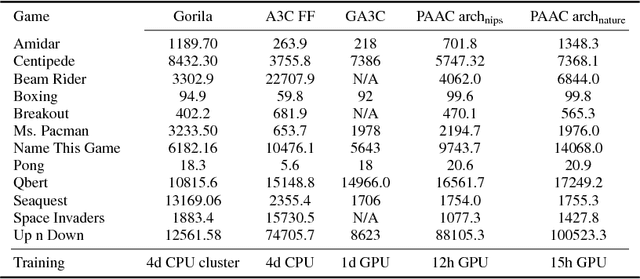
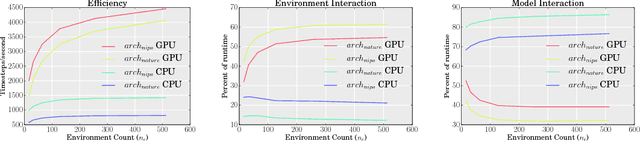
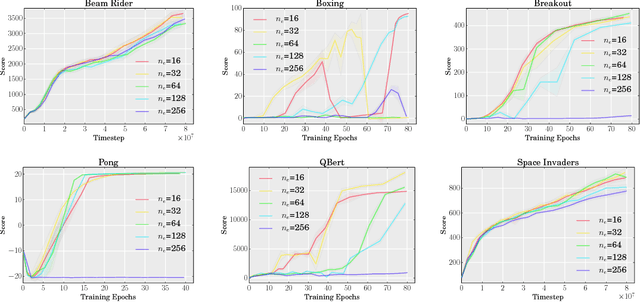
We propose a novel framework for efficient parallelization of deep reinforcement learning algorithms, enabling these algorithms to learn from multiple actors on a single machine. The framework is algorithm agnostic and can be applied to on-policy, off-policy, value based and policy gradient based algorithms. Given its inherent parallelism, the framework can be efficiently implemented on a GPU, allowing the usage of powerful models while significantly reducing training time. We demonstrate the effectiveness of our framework by implementing an advantage actor-critic algorithm on a GPU, using on-policy experiences and employing synchronous updates. Our algorithm achieves state-of-the-art performance on the Atari domain after only a few hours of training. Our framework thus opens the door for much faster experimentation on demanding problem domains. Our implementation is open-source and is made public at https://github.com/alfredvc/paac