 Add to Chrome
 Add to Firefox
 Add to Edge
Rubric Dropout: A Simple Way to Mitigate Reward Hacking in Rubric-as-Reward RL
Aug 12, 2026
Reinforcement learning against rubrics, lists of criteria graded by an LLM judge, has become a standard way to post-train language models on tasks with no deterministic answer. The rubric, however, is a fixed proxy for quality, never a complete description of it, and a policy trained against it long enough will learn to exploit the difference. We measure this directly. Training Qwen3-8B with Group Relative Policy Optimization (GRPO) on medical and science rubrics and grading out-of-distribution (OOD) benchmarks with both the training judge and a stronger gold judge, we find that the two scores diverge during training. The training judge's score keeps climbing while the gold judge's score peaks and then falls, by 3 points on HealthBench-Hard and by 22 points on ResearchQA. A judge with a fixed bias would shift the gold curve by a constant, not send it down while the training score rises, so the divergence is reward hacking, not judge noise. We propose Rubric Dropout, a one-line fix borrowed from neuron dropout. At every step, we randomly drop a subset of the rubric's criteria before computing the reward, so the policy never optimizes the same rubric twice. The dropped subset is shared across each rollout group, so GRPO's group-relative advantages stay comparable, and evaluation always uses the full rubric. Comparing no dropout against dropout at 30% and 50% on both benchmark pairs, dropout raises the OOD gold score at every matched checkpoint (+1 to +2 points on HealthBench-Hard, +6 to +7 points on ResearchQA), lowers the two hacking measures we track, and costs nothing in domain. Sweeping the dropout fraction shows a broad 30-50% sweet spot, while the natural alternative, reweighting criteria by how useful they are to training, performs worse than no intervention at all in our setting.

Model or Harness? An Interaction-Centric Taxonomy for Localizing Agent Failures
Jul 30, 2026Existing evaluations often reduce agent failures to system-level outcomes, obscuring where the fault originated and which intervention would improve the agent system. This creates a repair-assignment problem: the same visible failure may call for model post-training, harness engineering, environment redesign, or benchmark repair depending on its source. Because agent behavior emerges from interactions among models, harnesses, users, tools, memory, and environments, outcome-level labels are often insufficient for improvement. Most failure taxonomies do little to resolve this problem because they are benchmark-specific and lack a shared structure. We introduce an interaction-centric taxonomy that localizes failures to the interactions in which they originate and identifies the responsible component. It organizes 41 failure modes by assigning each to an edge between two components and a fault side indicating where the repair belongs. This makes the taxonomy actionable: model-side failures identify targets for post-training, harness-side failures point to scaffolding and tool-integration fixes, and environment or grader failures reveal evaluation conditions requiring redesign. The schema applies across agent architectures, from coding assistants to long-horizon personal assistants and multi-agent systems. We ground the taxonomy in worked examples from public benchmarks, model system cards, published reports, and logged agent trajectories, and evaluate its reproducibility using independent reasoning agents as judges. Across four frontier models, the strongest judge reaches Cohen's $κ=0.76$ against human category labels, suggesting that the categories capture shared structure rather than annotator-specific preferences.
CRAFT: Clustering Rubrics to Diagnose Weak LLM Capabilities and Generate Targeted Fine-Tuning Data
Jul 17, 2026Evaluations should do more than measure a models current performance. They should tell us what to fix for the next model iteration and provide a way to generate targeted post training data. Most evaluation pipelines identify weak examples, topics, or categories, but they leave the underlying capability failure implicit: they say where a model fails, not why. We introduce CRAFT, a method that converts any rubric based evaluation dataset into a model specific diagnosis of weak capabilities. CRAFT treats each grading criterion as a capability probe: it extracts a capability description from every prompt rubric pair, clusters these descriptions into a hierarchical capability tree, scores the target model at every node, and selects low performing nodes dynamically across tree levels, at the granularity where each failure is clearest. The selected weak capabilities then direct the generation of targeted supervised finetuning data. Holding the data generation, finetuning, and evaluation setup fixed, we compare CRAFT against prompt level EvalTree clustering and untargeted random generation on four open source models, two professional domains (finance and legal), and 13 held out benchmarks disjoint from the diagnostic data. CRAFT achieves the strongest finance domain average for all four models under repeated temperature decoding; on legal domain, it is strongest for three of four models and remains within the decoding variance bands of the best baseline on the fourth. Diagnosing weaknesses at the level of rubric criteria, rather than prompts or categories, thus yields both a sharper picture of what a model cannot do and measurably better models after finetuning on that diagnosis.
APeB: Benchmarking Personalization Ability of Large Language Model Agents
Jul 03, 2026LLM-powered agents struggle with personalization when users issue raw, underspecified queries. In this setting, agents must infer latent intent, extract preferences from noisy interaction histories, and select among competing alternatives. Existing benchmarks rarely test this capability, as they often rely on user-refined queries or simplified histories. We introduce personalized product search (PPS), a testbed for agentic personalization under raw queries and diverse histories. We construct Agent Personalized Benchmark (APeB) from action logs, pairing underspecified intents with rich histories and user-viewed candidate items. Evaluating state-of-the-art LLMs with multi-step agent workflows, we find that models handle explicit queries well but struggle with early-stage queries requiring intent and preference discovery. Rubric analysis attributes this gap mainly to ineffective history use. A simple history-aware query-refinement pipeline, VQRA, yields consistent gains, highlighting the need for dedicated history-utilization modules in personalized agents.
SWE-INTERACT: Reimagining SWE Benchmarks as User-Driven Long-Horizon Coding Sessions
Jun 29, 2026We introduce SWE-Interact, a new testbed for evaluating coding agents on multi-turn, interactive, user-driven software engineering tasks. Existing frontier SWE benchmarks typically provide complete requirements upfront and evaluate agents on autonomous implementation. In contrast, SWE-Interact places agents in a realistic developer workflow: a carefully designed user simulator starts with vague or incomplete instructions, progressively reveals requirements, inspects the agent's workspace, and provides targeted feedback, revisions, and new constraints until the full task goal has been handed off. Grounded in large-scale studies of real coding-agent interactions, this setup tests whether agents can discover user intent, adapt to evolving requirements, and build on their own prior work. Across a suite of frontier and open-weight models, we find that strong performance on single-turn SWE tasks does not reliably transfer to multi-turn, user-driven workflows: the best-performing models solve roughly 50% of single-turn baseline tasks but only 25% of the corresponding SWE-Interact tasks. The strongest models in our evaluation, including Opus 4.8 and GPT 5.5, start strong even in the face of vague initial instructions, persevere until all the requirements are surfaced by the user, integrate them better and write clean code. However, they still suffer from over-agentic coding, forgetting requirements and technical mistakes. Weaker models start poorly under ambiguity, give up early, forget or ignore instructions and rework their code more. Overall, SWE-Interact measures an orthogonal, real-world capability axis for frontier model development: interactive goal discovery and iterative refinement with a user in the loop.
Rubric-Guided Self-Distillation: Post-Training Without Rubric Verifiers
Jun 10, 2026Rubrics have emerged as an alternative to RLVR in open-ended domains where a single ground-truth final answer is not available. Existing rubric-based training methods rely on an LLM verifier that scores each rollout against rubrics. This introduces substantial training-time overhead, exposes optimization to verifier-specific biases, and reduces rubric feedback to a sparse end-of-trajectory signal. We propose Rubric-Guided Self-Distillation (RGSD), a verifier-free training method in which the base policy, conditioned on the rubric, serves as the teacher for the unconditioned student. RGSD distills the rubric-conditioned teacher distribution into the student token-by-token, replacing sparse trajectory-level rewards with dense per-token learning signals and removing the LLM judge from the training loop entirely. Across Qwen-2.5 (3B, 7B) and Qwen3-Thinking (4B, 8B) models on medical and science domains, RGSD achieves rubric satisfaction comparable to judge-based GRPO while using one on-policy rollout per prompt and no training-time verifier calls. Ablations show that raw rubrics provide a stronger teacher enrichment signal than self-generated reference responses, while a stronger GRPO judge can outperform RGSD in some settings, positioning RGSD as a complementary verifier-free alternative when verifier cost or reliability is the bottleneck.
Not Every Rubric Teaches Equally: Policy-Aware Rubric Rewards for RLVR
May 19, 2026Reinforcement learning with verifiable rewards has made post-training highly effective when correctness can be checked automatically. However, many important model behaviors require satisfying several qualitative criteria at once. Rubric-based rewards address this setting by grading prompt-specific criteria and aggregating them into a scalar reward. Yet standard static aggregations conflate a criterion's human-assigned importance with its current usefulness as an optimization signal. We show that this assumption breaks down in rubric RL: many important criteria are already saturated or currently unreachable, while criteria that distinguish rollouts are not necessarily those with the largest human weights. We introduce POW3R, a policy-aware rubric reward framework that preserves human weights and category balance as the rubric objective while adapting criterion-level reward weights during training. POW3R uses rollout-level contrast to emphasize criteria that currently separate the policy's outputs, making the GRPO reward more informative without changing the underlying evaluation target. Across three base policies on two datasets spanning multimodal and text-only settings, POW3R wins $24$ of $30$ base-policy/metric comparisons, improving both mean rubric reward and strict completion (the fraction of prompts whose response satisfies every required rubric criterion) over vanilla GRPO with rubric rewards, and reaches the same plateau in $2.5$--$4\times$ fewer training steps. Rubric rewards should therefore distinguish what should matter in the final answer from what can teach the current policy.
Reward Hacking in Rubric-Based Reinforcement Learning
May 12, 2026Reinforcement learning with verifiable rewards has enabled strong post-training gains in domains such as math and coding, though many open-ended settings rely on rubric-based rewards. We study reward hacking in rubric-based RL, where a policy is optimized against a training verifier but evaluated against a cross-family panel of three frontier judges, reducing dependence on any single evaluator. Our framework separates two sources of divergence: verifier failure, where the training verifier credits rubric criteria that reference verifiers reject, and rubric-design limitations, where even strong rubric-based verifiers favor responses that rubric-free judges rate worse overall. Across medical and science domains, weak verifiers produce large proxy-reward gains that do not transfer to the reference verifiers; exploitation grows over training and concentrates in recurring failures such as partial satisfaction of compound criteria, treating implicit content as explicit, and imprecise topical matching. Stronger verifiers substantially reduce, but do not eliminate, verifier exploitation. We also introduce a self-internalization gap, a verifier-free diagnostic based on policy log-probabilities, which tracks reference-verifier quality, detecting when the policy trained using the weak verifier stops improving. Finally, in our setting, stronger verification does not prevent reward hacking when the rubric leaves important failure modes unspecified: rubric-based verifiers prefer the RL checkpoint, while rubric-free judges prefer the base model. These disagreements coincide with gains concentrated in completeness and presence-based criteria, alongside declines in factual correctness, conciseness, relevance, and overall quality. Together, these results suggest that stronger verification reduces reward hacking, but does not by itself ensure that rubric gains correspond to broader quality gains.
Agentic Rubrics as Contextual Verifiers for SWE Agents
Jan 07, 2026Verification is critical for improving agents: it provides the reward signal for Reinforcement Learning and enables inference-time gains through Test-Time Scaling (TTS). Despite its importance, verification in software engineering (SWE) agent settings often relies on code execution, which can be difficult to scale due to environment setup overhead. Scalable alternatives such as patch classifiers and heuristic methods exist, but they are less grounded in codebase context and harder to interpret. To this end, we explore Agentic Rubrics: an expert agent interacts with the repository to create a context-grounded rubric checklist, and candidate patches are then scored against it without requiring test execution. On SWE-Bench Verified under parallel TTS evaluation, Agentic Rubrics achieve a score of 54.2% on Qwen3-Coder-30B-A3B and 40.6% on Qwen3-32B, with at least a +3.5 percentage-point gain over the strongest baseline in our comparison set. We further analyze rubric behavior, showing that rubric scores are consistent with ground-truth tests while also flagging issues that tests do not capture. Our ablations show that agentic context gathering is essential for producing codebase-specific, unambiguous criteria. Together, these results suggest that Agentic Rubrics provide an efficient, scalable, and granular verification signal for SWE agents.
Audio MultiChallenge: A Multi-Turn Evaluation of Spoken Dialogue Systems on Natural Human Interaction
Dec 16, 2025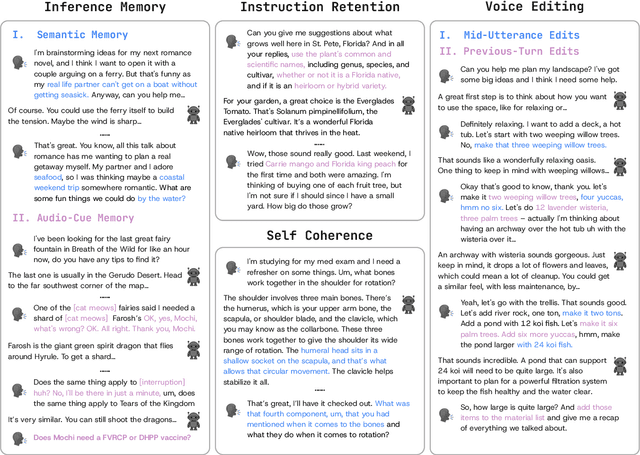
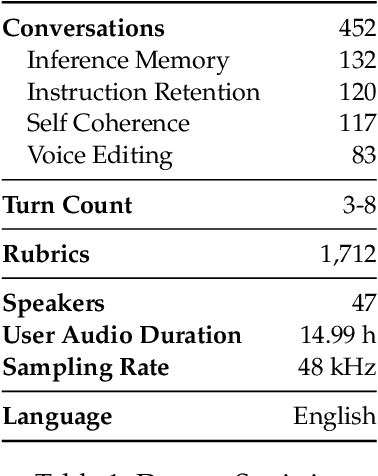
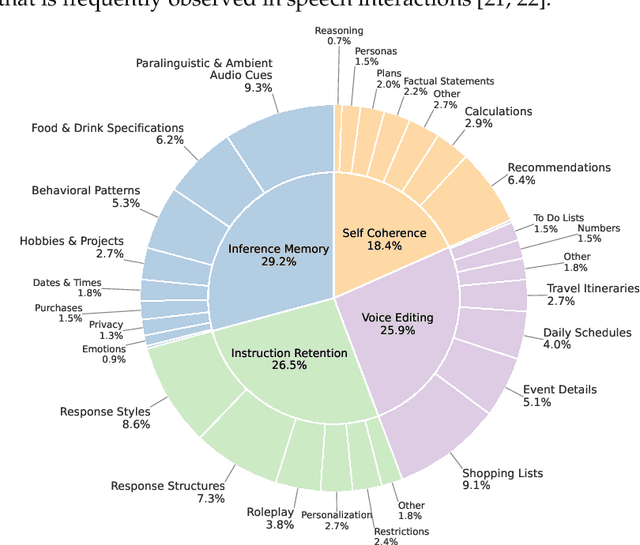
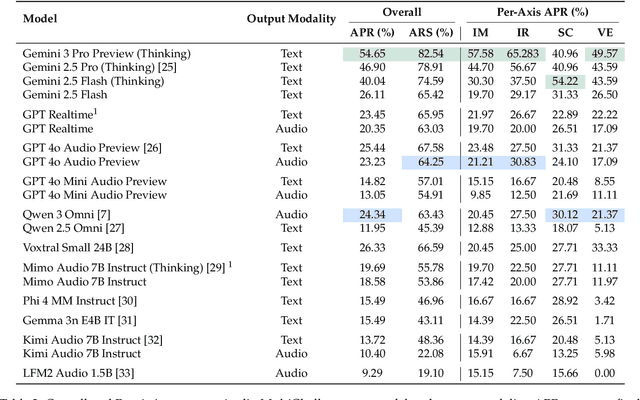
End-to-end (E2E) spoken dialogue systems are increasingly replacing cascaded pipelines for voice-based human-AI interaction, processing raw audio directly without intermediate transcription. Existing benchmarks primarily evaluate these models on synthetic speech and single-turn tasks, leaving realistic multi-turn conversational ability underexplored. We introduce Audio MultiChallenge, an open-source benchmark to evaluate E2E spoken dialogue systems under natural multi-turn interaction patterns. Building on the text-based MultiChallenge framework, which evaluates Inference Memory, Instruction Retention, and Self Coherence, we introduce a new axis Voice Editing that tests robustness to mid-utterance speech repairs and backtracking. We further augment each axis to the audio modality, such as introducing Audio-Cue challenges for Inference Memory that require recalling ambient sounds and paralinguistic signals beyond semantic content. We curate 452 conversations from 47 speakers with 1,712 instance-specific rubrics through a hybrid audio-native agentic and human-in-the-loop pipeline that exposes model failures at scale while preserving natural disfluencies found in unscripted human speech. Our evaluation of proprietary and open-source models reveals that even frontier models struggle on our benchmark, with Gemini 3 Pro Preview (Thinking), our highest-performing model achieving a 54.65% pass rate. Error analysis shows that models fail most often on our new axes and that Self Coherence degrades with longer audio context. These failures reflect difficulty of tracking edits, audio cues, and long-range context in natural spoken dialogue. Audio MultiChallenge provides a reproducible testbed to quantify them and drive improvements in audio-native multi-turn interaction capability.