 Add to Chrome
 Add to Firefox
 Add to Edge
Quantized Reasoning Models Think They Need to Think Longer, but They Do Not
May 29, 2026
Post-training quantization (PTQ) is widely used to deploy large language models efficiently, but its effect on reasoning models is not well understood. Across math, coding, and science QA, we find that aggressive PTQ reduces accuracy while increasing chain-of-thought (CoT) length. Surprisingly, we show that in up to 52% of the quantized models' failures, models reach the right answer in intermediate reasoning steps but do not output it as a final answer. To understand why quantization leads to this increase in overthinking errors, we measure the token-level KL divergence between quantized and full-precision output distributions. Positions with high KL divergence correlate strongly with high next-token entropy, and at these positions quantized models disproportionately sample overthinking markers such as "wait", "but", and "alternatively". We show that simply introducing a training-free logit penalty on a curated set of overthinking markers can reduce CoT length by 12--23% while preserving or improving accuracy across 5 models (1.5B-32B parameters), 3 quantization methods, and 5 benchmarks, yielding a favorable Pareto frontier of accuracy against reasoning cost compared to penalizing other token sets. Overthinking errors produced by quantized models are particularly reduced by up to 58%.

JacQuant: STE-Free Quantization-Aware Training via Learned Jacobian Surrogates
May 25, 2026Quantization-aware training (QAT) is widely deployed but typically relies on the Straight-Through Estimator (STE), which passes gradients through non-differentiable quantizers by fiat. This often makes training brittle near bin boundaries and weakly aligned with the actual behavior of the low-precision model. We introduce JacQuant, a QAT framework that learns a lightweight surrogate of the model's local sensitivity to parameter changes and uses it to stabilize and accelerate training within standard variance-reduced optimizers. The surrogate is inexpensive (diagonal or block-diagonal), data-driven, and compatible with common weight and activation quantizers. On code-preserving training phases, we prove convergence for non-convex objectives and obtain linear rates under a PL condition, and we relate the learned sensitivity to end-to-end output fidelity via a simple calibration argument. Across LLM benchmarks at $\leq 2$ bits, JacQuant consistently reaches higher accuracy than STE-based QAT, and the runtime analyses on various models show that the added cost remains negligible under practical group sizes. The method is drop-in and requires no changes to the forward quantizers; our empirical claims are scoped to ultra-low-bit LLM QAT.
Rethinking Model Efficiency: Multi-Agent Inference with Large Models
Apr 06, 2026Most vision-language models (VLMs) apply a large language model (LLM) as the decoder, where the response tokens are generated sequentially through autoregression. Therefore, the number of output tokens can be the bottleneck of the end-to-end latency. However, different models may require vastly different numbers of output tokens to achieve comparable performance. In this work, we conduct a comprehensive analysis of the latency across different components of VLMs on simulated data. The experiment shows that a large model with fewer output tokens can be more efficient than a small model with a long output sequence. The empirical study on diverse real-world benchmarks confirms the observation that a large model can achieve better or comparable performance as a small model with significantly fewer output tokens. To leverage the efficiency of large models, we propose a multi-agent inference framework that keeps large models with short responses but transfers the key reasoning tokens from the small model when necessary. The comparison on benchmark tasks demonstrates that by reusing the reasoning tokens from small models, it can help approach the performance of a large model with its own reasoning, which confirms the effectiveness of our proposal.
MoE-Spec: Expert Budgeting for Efficient Speculative Decoding
Feb 17, 2026Speculative decoding accelerates Large Language Model (LLM) inference by verifying multiple drafted tokens in parallel. However, for Mixture-of-Experts (MoE) models, this parallelism introduces a severe bottleneck: large draft trees activate many unique experts, significantly increasing memory pressure and diminishing speedups from speculative decoding relative to autoregressive decoding. Prior methods reduce speculation depth when MoE verification becomes expensive. We propose MoE-Spec, a training-free verification-time expert budgeting method that decouples speculation depth from memory cost by enforcing a fixed expert capacity limit at each layer, loading only the experts that contribute most to verification and dropping the long tail of rarely used experts that drive bandwidth overhead. Experiments across multiple model scales and datasets show that this method yields 10--30\% higher throughput than state-of-the-art speculative decoding baselines (EAGLE-3) at comparable quality, with flexibility to trade accuracy for further latency reductions through tighter budgets.
CLAA: Cross-Layer Attention Aggregation for Accelerating LLM Prefill
Feb 17, 2026The prefill stage in long-context LLM inference remains a computational bottleneck. Recent token-ranking heuristics accelerate inference by selectively processing a subset of semantically relevant tokens. However, existing methods suffer from unstable token importance estimation, often varying between layers. Evaluating token-ranking quality independently from heuristic-specific architectures is challenging. To address this, we introduce an Answer-Informed Oracle, which defines ground-truth token importance by measuring attention from generated answers back to the prompt. This oracle reveals that existing heuristics exhibit high variance across layers: rankings can degrade sharply at specific layers, a failure mode invisible to end-to-end benchmarks. The diagnosis suggests a simple fix: aggregate scores across layers rather than relying on any single one. We implement this as Cross-Layer Attention Aggregation (CLAA), which closes the gap to the oracle upper bound and reduces Time-to-First-Token (TTFT) by up to 39\% compared to the Full KV Cache baseline.
Audio MultiChallenge: A Multi-Turn Evaluation of Spoken Dialogue Systems on Natural Human Interaction
Dec 16, 2025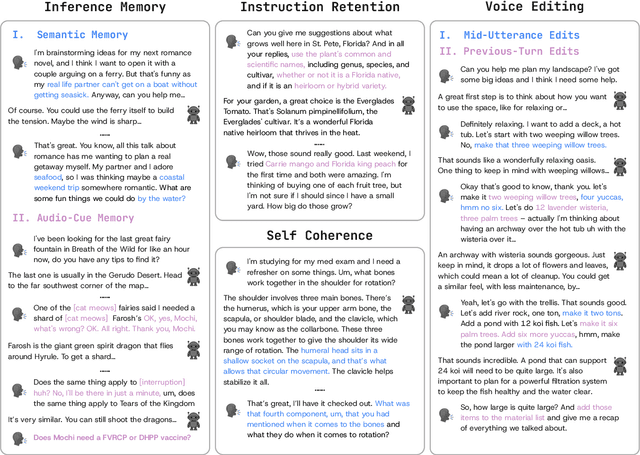
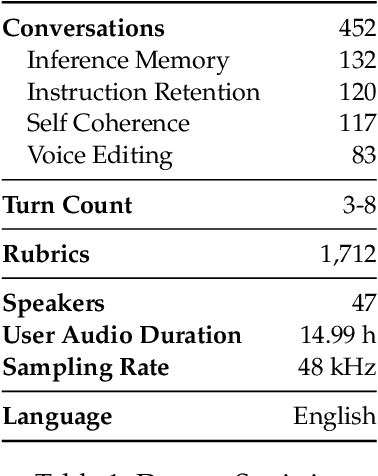
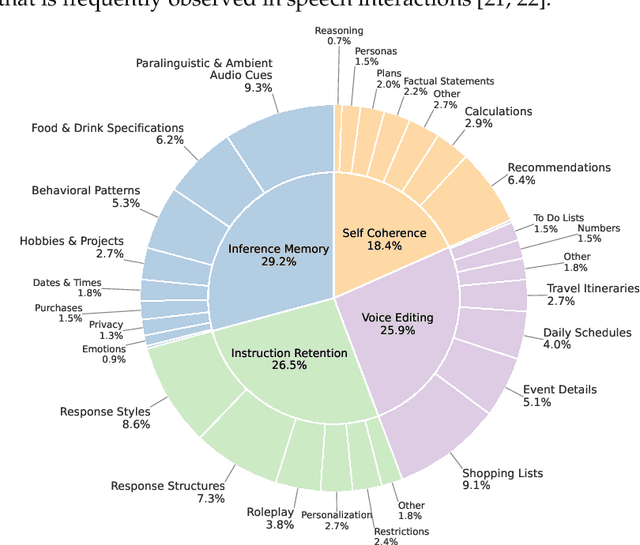
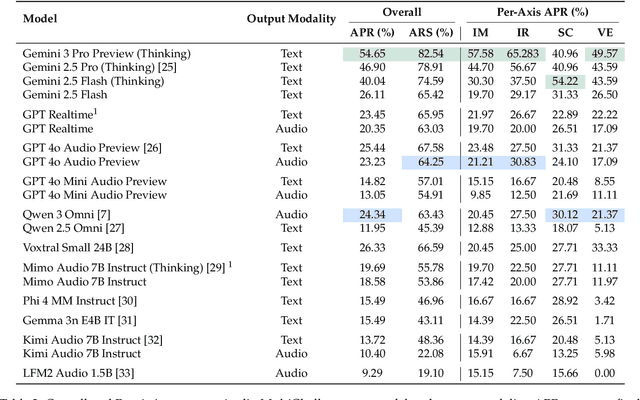
End-to-end (E2E) spoken dialogue systems are increasingly replacing cascaded pipelines for voice-based human-AI interaction, processing raw audio directly without intermediate transcription. Existing benchmarks primarily evaluate these models on synthetic speech and single-turn tasks, leaving realistic multi-turn conversational ability underexplored. We introduce Audio MultiChallenge, an open-source benchmark to evaluate E2E spoken dialogue systems under natural multi-turn interaction patterns. Building on the text-based MultiChallenge framework, which evaluates Inference Memory, Instruction Retention, and Self Coherence, we introduce a new axis Voice Editing that tests robustness to mid-utterance speech repairs and backtracking. We further augment each axis to the audio modality, such as introducing Audio-Cue challenges for Inference Memory that require recalling ambient sounds and paralinguistic signals beyond semantic content. We curate 452 conversations from 47 speakers with 1,712 instance-specific rubrics through a hybrid audio-native agentic and human-in-the-loop pipeline that exposes model failures at scale while preserving natural disfluencies found in unscripted human speech. Our evaluation of proprietary and open-source models reveals that even frontier models struggle on our benchmark, with Gemini 3 Pro Preview (Thinking), our highest-performing model achieving a 54.65% pass rate. Error analysis shows that models fail most often on our new axes and that Self Coherence degrades with longer audio context. These failures reflect difficulty of tracking edits, audio cues, and long-range context in natural spoken dialogue. Audio MultiChallenge provides a reproducible testbed to quantify them and drive improvements in audio-native multi-turn interaction capability.
R-Sparse: Rank-Aware Activation Sparsity for Efficient LLM Inference
Apr 28, 2025Large Language Models (LLMs), while demonstrating remarkable capabilities across various applications, present significant challenges during inference due to their substantial model size, especially when deployed on edge devices. Activation sparsity offers a promising solution to reduce computation and memory movement, enabling more efficient inference, particularly for small-batch on-device applications. However, current approaches face limitations with non-ReLU activation function, which are foundational to most advanced LLMs, or require heavy continual training. Additionally, the difficulty in predicting active channels and limited achievable sparsity ratios constrain the effectiveness of activation sparsity-based methods. In this paper, we introduce R-Sparse, a training-free activation sparsity approach capable of achieving high sparsity levels in advanced LLMs. We conducted two preliminary investigations into how different components contribute to the output within a single linear layer and found two key observations: (i) the non-sparse components of the input function can be regarded as a few bias terms, and (ii) The full computation can be effectively approximated by an appropriate combination of input channels and weight singular values. Building on this, we replace the linear layers in LLMs with a rank-aware sparse inference method that leverages the sparsity of input channels and singular value components, eliminating the need for active channel prediction like the output sparsity based approaches. Experiments on Llama-2/3 and Mistral models across ten diverse tasks demonstrate that R-Sparse achieves comparable performance at 50% model-level sparsity, resulting in a significant 43% end-to-end efficient improvements with customized kernels.