 Add to Chrome
 Add to Firefox
 Add to Edge
Module-wise Adaptive Distillation for Multimodality Foundation Models
Oct 06, 2023
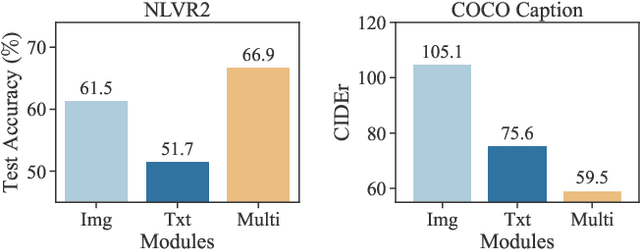
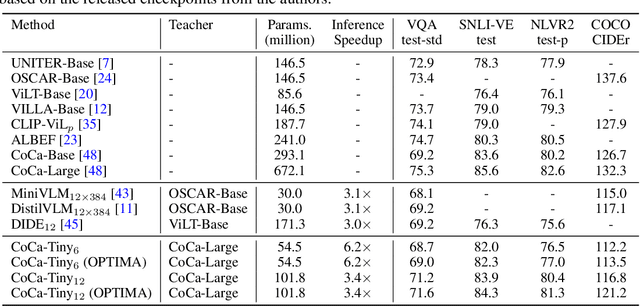
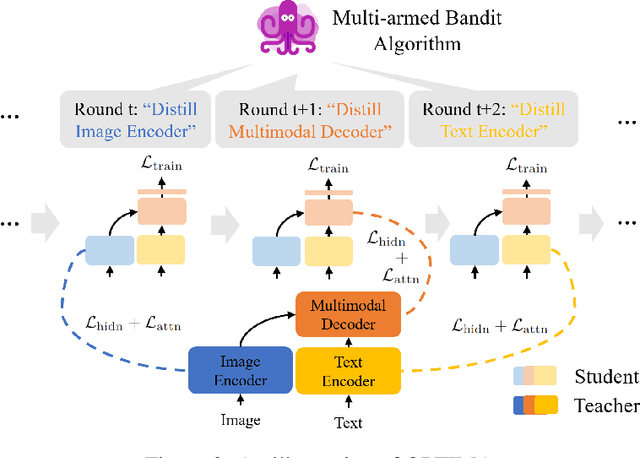
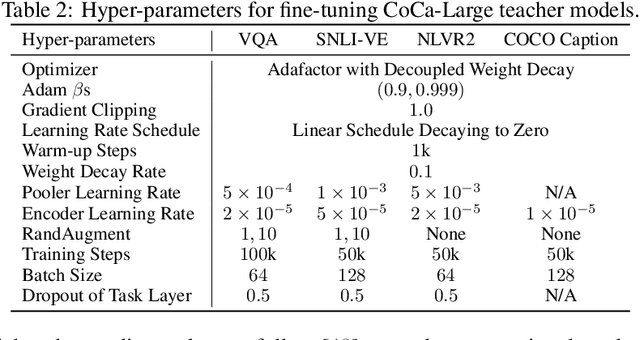
Pre-trained multimodal foundation models have demonstrated remarkable generalizability but pose challenges for deployment due to their large sizes. One effective approach to reducing their sizes is layerwise distillation, wherein small student models are trained to match the hidden representations of large teacher models at each layer. Motivated by our observation that certain architecture components, referred to as modules, contribute more significantly to the student's performance than others, we propose to track the contributions of individual modules by recording the loss decrement after distillation each module and choose the module with a greater contribution to distill more frequently. Such an approach can be naturally formulated as a multi-armed bandit (MAB) problem, where modules and loss decrements are considered as arms and rewards, respectively. We then develop a modified-Thompson sampling algorithm named OPTIMA to address the nonstationarity of module contributions resulting from model updating. Specifically, we leverage the observed contributions in recent history to estimate the changing contribution of each module and select modules based on these estimations to maximize the cumulative contribution. We evaluate the effectiveness of OPTIMA through distillation experiments on various multimodal understanding and image captioning tasks, using the CoCa-Large model (Yu et al., 2022) as the teacher model.

Sample Complexity of Neural Policy Mirror Descent for Policy Optimization on Low-Dimensional Manifolds
Sep 25, 2023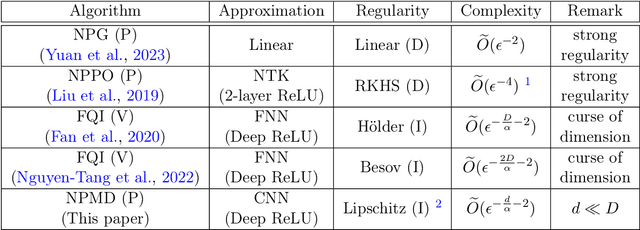
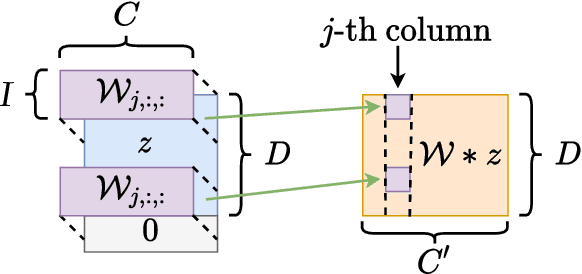
Policy-based algorithms equipped with deep neural networks have achieved great success in solving high-dimensional policy optimization problems in reinforcement learning. However, current analyses cannot explain why they are resistant to the curse of dimensionality. In this work, we study the sample complexity of the neural policy mirror descent (NPMD) algorithm with convolutional neural networks (CNN) as function approximators. Motivated by the empirical observation that many high-dimensional environments have state spaces possessing low-dimensional structures, such as those taking images as states, we consider the state space to be a $d$-dimensional manifold embedded in the $D$-dimensional Euclidean space with intrinsic dimension $d\ll D$. We show that in each iteration of NPMD, both the value function and the policy can be well approximated by CNNs. The approximation errors are controlled by the size of the networks, and the smoothness of the previous networks can be inherited. As a result, by properly choosing the network size and hyperparameters, NPMD can find an $\epsilon$-optimal policy with $\widetilde{O}(\epsilon^{-\frac{d}{\alpha}-2})$ samples in expectation, where $\alpha\in(0,1]$ indicates the smoothness of environment. Compared to previous work, our result exhibits that NPMD can leverage the low-dimensional structure of state space to escape from the curse of dimensionality, providing an explanation for the efficacy of deep policy-based algorithms.
Pivotal Estimation of Linear Discriminant Analysis in High Dimensions
Sep 18, 2023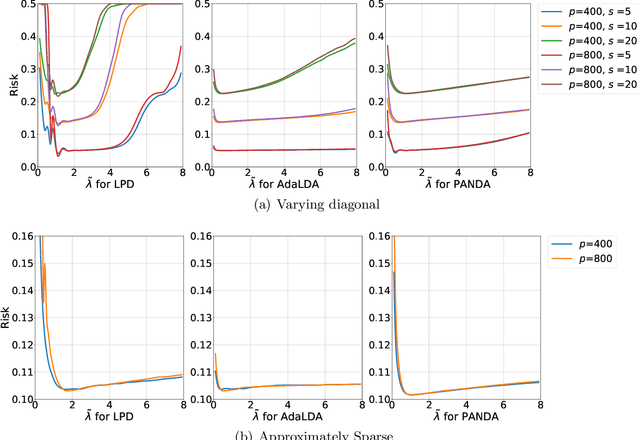

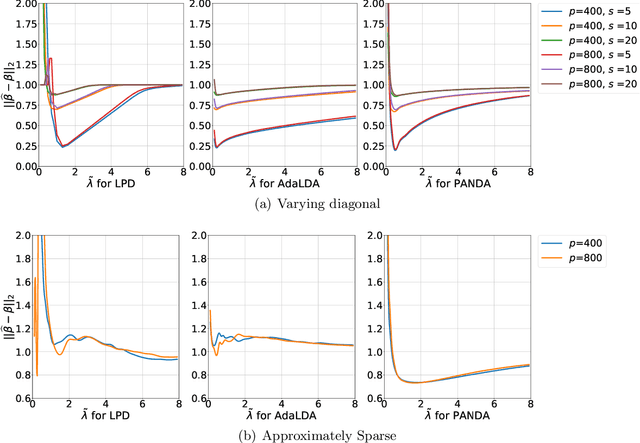
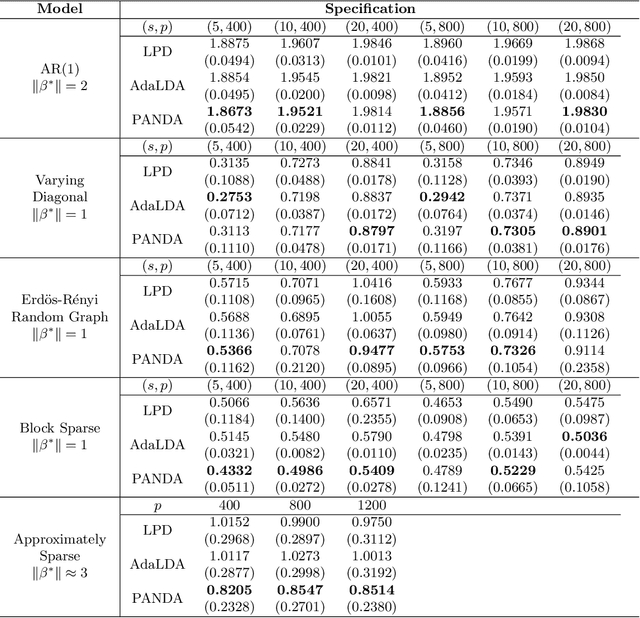
We consider the linear discriminant analysis problem in the high-dimensional settings. In this work, we propose PANDA(PivotAl liNear Discriminant Analysis), a tuning-insensitive method in the sense that it requires very little effort to tune the parameters. Moreover, we prove that PANDA achieves the optimal convergence rate in terms of both the estimation error and misclassification rate. Our theoretical results are backed up by thorough numerical studies using both simulated and real datasets. In comparison with the existing methods, we observe that our proposed PANDA yields equal or better performance, and requires substantially less effort in parameter tuning.
Deep Reinforcement Learning from Hierarchical Weak Preference Feedback
Sep 06, 2023Reward design is a fundamental, yet challenging aspect of practical reinforcement learning (RL). For simple tasks, researchers typically handcraft the reward function, e.g., using a linear combination of several reward factors. However, such reward engineering is subject to approximation bias, incurs large tuning cost, and often cannot provide the granularity required for complex tasks. To avoid these difficulties, researchers have turned to reinforcement learning from human feedback (RLHF), which learns a reward function from human preferences between pairs of trajectory sequences. By leveraging preference-based reward modeling, RLHF learns complex rewards that are well aligned with human preferences, allowing RL to tackle increasingly difficult problems. Unfortunately, the applicability of RLHF is limited due to the high cost and difficulty of obtaining human preference data. In light of this cost, we investigate learning reward functions for complex tasks with less human effort; simply by ranking the importance of the reward factors. More specifically, we propose a new RL framework -- HERON, which compares trajectories using a hierarchical decision tree induced by the given ranking. These comparisons are used to train a preference-based reward model, which is then used for policy learning. We find that our framework can not only train high performing agents on a variety of difficult tasks, but also provide additional benefits such as improved sample efficiency and robustness. Our code is available at https://github.com/abukharin3/HERON.
Provable Benefits of Policy Learning from Human Preferences in Contextual Bandit Problems
Jul 24, 2023A crucial task in decision-making problems is reward engineering. It is common in practice that no obvious choice of reward function exists. Thus, a popular approach is to introduce human feedback during training and leverage such feedback to learn a reward function. Among all policy learning methods that use human feedback, preference-based methods have demonstrated substantial success in recent empirical applications such as InstructGPT. In this work, we develop a theory that provably shows the benefits of preference-based methods in offline contextual bandits. In particular, we improve the modeling and suboptimality analysis for running policy learning methods on human-scored samples directly. Then, we compare it with the suboptimality guarantees of preference-based methods and show that preference-based methods enjoy lower suboptimality.
Nonparametric Classification on Low Dimensional Manifolds using Overparameterized Convolutional Residual Networks
Jul 04, 2023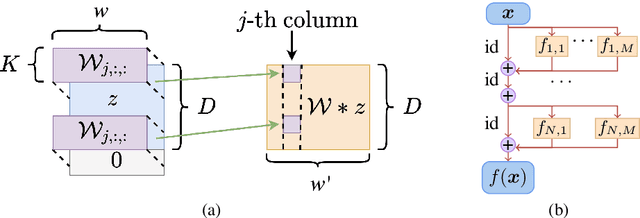
Convolutional residual neural networks (ConvResNets), though overparameterized, can achieve remarkable prediction performance in practice, which cannot be well explained by conventional wisdom. To bridge this gap, we study the performance of ConvResNeXts, which cover ConvResNets as a special case, trained with weight decay from the perspective of nonparametric classification. Our analysis allows for infinitely many building blocks in ConvResNeXts, and shows that weight decay implicitly enforces sparsity on these blocks. Specifically, we consider a smooth target function supported on a low-dimensional manifold, then prove that ConvResNeXts can adapt to the function smoothness and low-dimensional structures and efficiently learn the function without suffering from the curse of dimensionality. Our findings partially justify the advantage of overparameterized ConvResNeXts over conventional machine learning models.
Effective Minkowski Dimension of Deep Nonparametric Regression: Function Approximation and Statistical Theories
Jun 26, 2023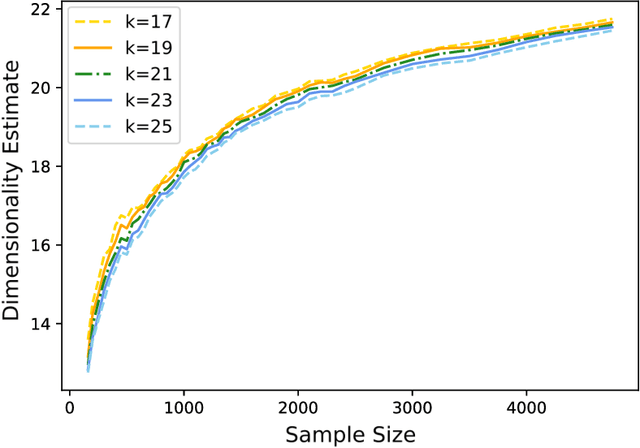
Existing theories on deep nonparametric regression have shown that when the input data lie on a low-dimensional manifold, deep neural networks can adapt to the intrinsic data structures. In real world applications, such an assumption of data lying exactly on a low dimensional manifold is stringent. This paper introduces a relaxed assumption that the input data are concentrated around a subset of $\mathbb{R}^d$ denoted by $\mathcal{S}$, and the intrinsic dimension of $\mathcal{S}$ can be characterized by a new complexity notation -- effective Minkowski dimension. We prove that, the sample complexity of deep nonparametric regression only depends on the effective Minkowski dimension of $\mathcal{S}$ denoted by $p$. We further illustrate our theoretical findings by considering nonparametric regression with an anisotropic Gaussian random design $N(0,\Sigma)$, where $\Sigma$ is full rank. When the eigenvalues of $\Sigma$ have an exponential or polynomial decay, the effective Minkowski dimension of such an Gaussian random design is $p=\mathcal{O}(\sqrt{\log n})$ or $p=\mathcal{O}(n^\gamma)$, respectively, where $n$ is the sample size and $\gamma\in(0,1)$ is a small constant depending on the polynomial decay rate. Our theory shows that, when the manifold assumption does not hold, deep neural networks can still adapt to the effective Minkowski dimension of the data, and circumvent the curse of the ambient dimensionality for moderate sample sizes.
LoSparse: Structured Compression of Large Language Models based on Low-Rank and Sparse Approximation
Jun 26, 2023Transformer models have achieved remarkable results in various natural language tasks, but they are often prohibitively large, requiring massive memories and computational resources. To reduce the size and complexity of these models, we propose LoSparse (Low-Rank and Sparse approximation), a novel model compression technique that approximates a weight matrix by the sum of a low-rank matrix and a sparse matrix. Our method combines the advantages of both low-rank approximations and pruning, while avoiding their limitations. Low-rank approximation compresses the coherent and expressive parts in neurons, while pruning removes the incoherent and non-expressive parts in neurons. Pruning enhances the diversity of low-rank approximations, and low-rank approximation prevents pruning from losing too many expressive neurons. We evaluate our method on natural language understanding, question answering, and natural language generation tasks. We show that it significantly outperforms existing compression methods.
Machine Learning Force Fields with Data Cost Aware Training
Jun 05, 2023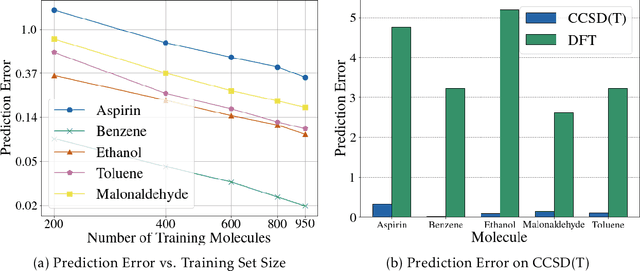


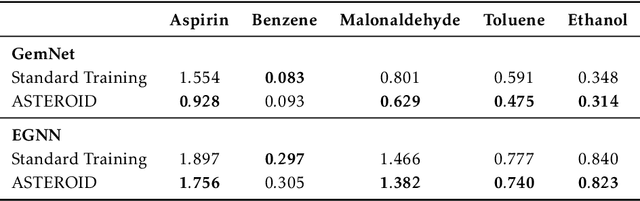
Machine learning force fields (MLFF) have been proposed to accelerate molecular dynamics (MD) simulation, which finds widespread applications in chemistry and biomedical research. Even for the most data-efficient MLFFs, reaching chemical accuracy can require hundreds of frames of force and energy labels generated by expensive quantum mechanical algorithms, which may scale as $O(n^3)$ to $O(n^7)$, with $n$ proportional to the number of basis functions. To address this issue, we propose a multi-stage computational framework -- ASTEROID, which lowers the data cost of MLFFs by leveraging a combination of cheap inaccurate data and expensive accurate data. The motivation behind ASTEROID is that inaccurate data, though incurring large bias, can help capture the sophisticated structures of the underlying force field. Therefore, we first train a MLFF model on a large amount of inaccurate training data, employing a bias-aware loss function to prevent the model from overfitting tahe potential bias of this data. We then fine-tune the obtained model using a small amount of accurate training data, which preserves the knowledge learned from the inaccurate training data while significantly improving the model's accuracy. Moreover, we propose a variant of ASTEROID based on score matching for the setting where the inaccurate training data are unlabeled. Extensive experiments on MD datasets and downstream tasks validate the efficacy of ASTEROID. Our code and data are available at https://github.com/abukharin3/asteroid.
Adaptive Budget Allocation for Parameter-Efficient Fine-Tuning
Mar 18, 2023Fine-tuning large pre-trained language models on downstream tasks has become an important paradigm in NLP. However, common practice fine-tunes all of the parameters in a pre-trained model, which becomes prohibitive when a large number of downstream tasks are present. Therefore, many fine-tuning methods are proposed to learn incremental updates of pre-trained weights in a parameter efficient way, e.g., low-rank increments. These methods often evenly distribute the budget of incremental updates across all pre-trained weight matrices, and overlook the varying importance of different weight parameters. As a consequence, the fine-tuning performance is suboptimal. To bridge this gap, we propose AdaLoRA, which adaptively allocates the parameter budget among weight matrices according to their importance score. In particular, AdaLoRA parameterizes the incremental updates in the form of singular value decomposition. Such a novel approach allows us to effectively prune the singular values of unimportant updates, which is essentially to reduce their parameter budget but circumvent intensive exact SVD computations. We conduct extensive experiments with several pre-trained models on natural language processing, question answering, and natural language generation to validate the effectiveness of AdaLoRA. Results demonstrate that AdaLoRA manifests notable improvement over baselines, especially in the low budget settings. Our code is publicly available at https://github.com/QingruZhang/AdaLoRA .