 Add to Chrome
 Add to Firefox
 Add to Edge
BlendFilter: Advancing Retrieval-Augmented Large Language Models via Query Generation Blending and Knowledge Filtering
Feb 16, 2024
Retrieval-augmented Large Language Models (LLMs) offer substantial benefits in enhancing performance across knowledge-intensive scenarios. However, these methods often face challenges with complex inputs and encounter difficulties due to noisy knowledge retrieval, notably hindering model effectiveness. To address this issue, we introduce BlendFilter, a novel approach that elevates retrieval-augmented LLMs by integrating query generation blending with knowledge filtering. BlendFilter proposes the blending process through its query generation method, which integrates both external and internal knowledge augmentation with the original query, ensuring comprehensive information gathering. Additionally, our distinctive knowledge filtering module capitalizes on the intrinsic capabilities of the LLM, effectively eliminating extraneous data. We conduct extensive experiments on three open-domain question answering benchmarks, and the findings clearly indicate that our innovative BlendFilter surpasses state-of-the-art baselines significantly.

Data Diversity Matters for Robust Instruction Tuning
Nov 21, 2023Instruction tuning has emerged as a key step in aligning large language models. One of the central challenges of instruction tuning is dataset selection, as the composition of the instruction tuning dataset can significantly impact downstream performance. In particular, researchers have hypothesized that dataset diversity and dataset quality are important indicators of downstream performance. However, it is not clear how to automatically select high quality and diverse data or how exactly quality and diversity affect instruction following ability. To resolve these issues, we propose a new algorithm, Quality-Diversity Instruction Tuning (QDIT). QDIT provides a principled algorithm to control dataset diversity and quality, allowing us to conduct an in depth study on the effect of diversity and quality on instruction tuning performance. From this study we draw two key insights (1) there is a natural tradeoff between dataset diversity and quality and (2) increasing dataset diversity significantly improves the worst case instruction following performance, therefore improving robustness. We validate the performance of QDIT on several large scale instruction tuning datasets, where we find it can improve worst case performance by 18% while maintaining or improving average performance compared to quality driven baselines.
Tell Your Model Where to Attend: Post-hoc Attention Steering for LLMs
Nov 03, 2023In human-written articles, we often leverage the subtleties of text style, such as bold and italics, to guide the attention of readers. These textual emphases are vital for the readers to grasp the conveyed information. When interacting with large language models (LLMs), we have a similar need - steering the model to pay closer attention to user-specified information, e.g., an instruction. Existing methods, however, are constrained to process plain text and do not support such a mechanism. This motivates us to introduce PASTA - Post-hoc Attention STeering Approach, a method that allows LLMs to read text with user-specified emphasis marks. To this end, PASTA identifies a small subset of attention heads and applies precise attention reweighting on them, directing the model attention to user-specified parts. Like prompting, PASTA is applied at inference time and does not require changing any model parameters. Experiments demonstrate that PASTA can substantially enhance an LLM's ability to follow user instructions or integrate new knowledge from user inputs, leading to a significant performance improvement on a variety of tasks, e.g., an average accuracy improvement of 22% for LLAMA-7B. Our code is publicly available at https://github.com/QingruZhang/PASTA .
Model-Based Reparameterization Policy Gradient Methods: Theory and Practical Algorithms
Oct 30, 2023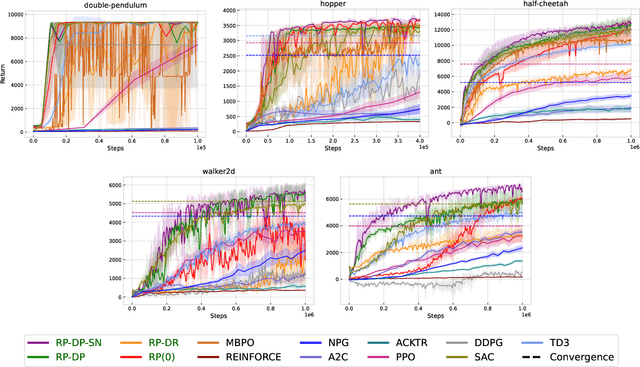
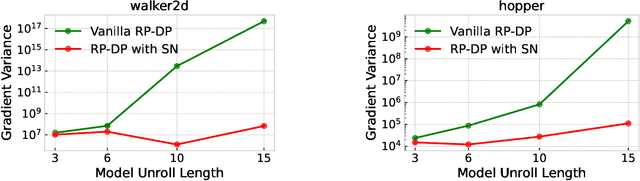
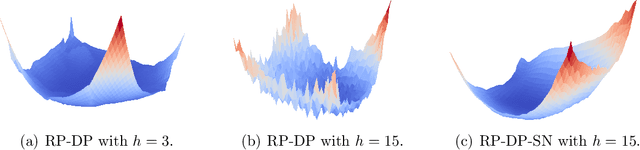
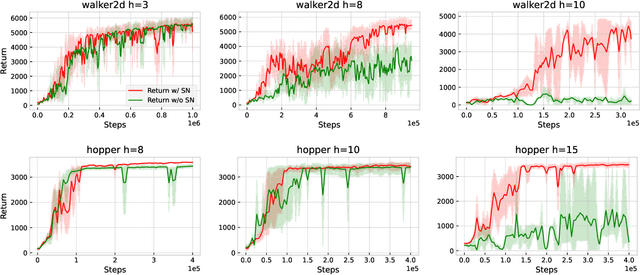
ReParameterization (RP) Policy Gradient Methods (PGMs) have been widely adopted for continuous control tasks in robotics and computer graphics. However, recent studies have revealed that, when applied to long-term reinforcement learning problems, model-based RP PGMs may experience chaotic and non-smooth optimization landscapes with exploding gradient variance, which leads to slow convergence. This is in contrast to the conventional belief that reparameterization methods have low gradient estimation variance in problems such as training deep generative models. To comprehend this phenomenon, we conduct a theoretical examination of model-based RP PGMs and search for solutions to the optimization difficulties. Specifically, we analyze the convergence of the model-based RP PGMs and pinpoint the smoothness of function approximators as a major factor that affects the quality of gradient estimation. Based on our analysis, we propose a spectral normalization method to mitigate the exploding variance issue caused by long model unrolls. Our experimental results demonstrate that proper normalization significantly reduces the gradient variance of model-based RP PGMs. As a result, the performance of the proposed method is comparable or superior to other gradient estimators, such as the Likelihood Ratio (LR) gradient estimator. Our code is available at https://github.com/agentification/RP_PGM.
Good regularity creates large learning rate implicit biases: edge of stability, balancing, and catapult
Oct 26, 2023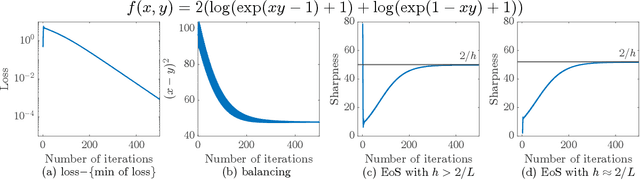

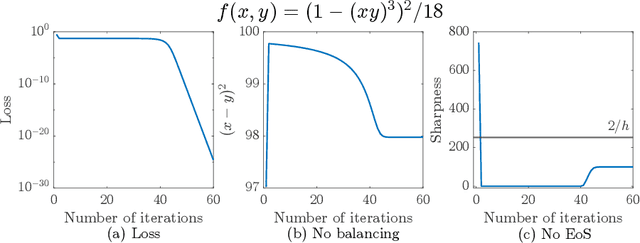
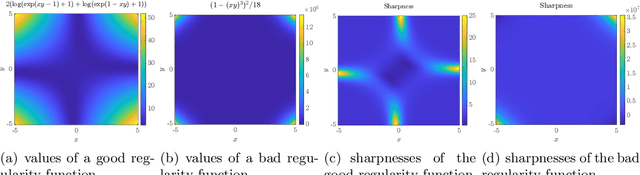
Large learning rates, when applied to gradient descent for nonconvex optimization, yield various implicit biases including the edge of stability (Cohen et al., 2021), balancing (Wang et al., 2022), and catapult (Lewkowycz et al., 2020). These phenomena cannot be well explained by classical optimization theory. Though significant theoretical progress has been made in understanding these implicit biases, it remains unclear for which objective functions would they occur. This paper provides an initial step in answering this question, namely that these implicit biases are in fact various tips of the same iceberg. They occur when the objective function of optimization has some good regularity, which, in combination with a provable preference of large learning rate gradient descent for moving toward flatter regions, results in these nontrivial dynamical phenomena. To establish this result, we develop a new global convergence theory under large learning rates, for a family of nonconvex functions without globally Lipschitz continuous gradient, which was typically assumed in existing convergence analysis. A byproduct is the first non-asymptotic convergence rate bound for large-learning-rate gradient descent optimization of nonconvex functions. We also validate our theory with experiments on neural networks, where different losses, activation functions, and batch normalization all can significantly affect regularity and lead to very different training dynamics.
Score Matching-based Pseudolikelihood Estimation of Neural Marked Spatio-Temporal Point Process with Uncertainty Quantification
Oct 25, 2023


Spatio-temporal point processes (STPPs) are potent mathematical tools for modeling and predicting events with both temporal and spatial features. Despite their versatility, most existing methods for learning STPPs either assume a restricted form of the spatio-temporal distribution, or suffer from inaccurate approximations of the intractable integral in the likelihood training objective. These issues typically arise from the normalization term of the probability density function. Moreover, current techniques fail to provide uncertainty quantification for model predictions, such as confidence intervals for the predicted event's arrival time and confidence regions for the event's location, which is crucial given the considerable randomness of the data. To tackle these challenges, we introduce SMASH: a Score MAtching-based pSeudolikeliHood estimator for learning marked STPPs with uncertainty quantification. Specifically, our framework adopts a normalization-free objective by estimating the pseudolikelihood of marked STPPs through score-matching and offers uncertainty quantification for the predicted event time, location and mark by computing confidence regions over the generated samples. The superior performance of our proposed framework is demonstrated through extensive experiments in both event prediction and uncertainty quantification.
SMURF-THP: Score Matching-based UnceRtainty quantiFication for Transformer Hawkes Process
Oct 25, 2023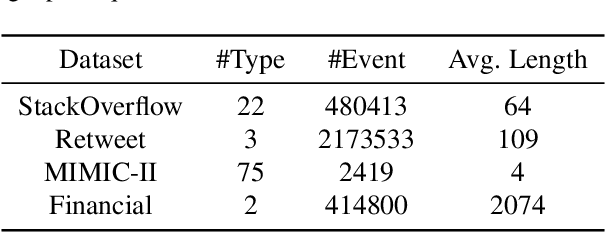
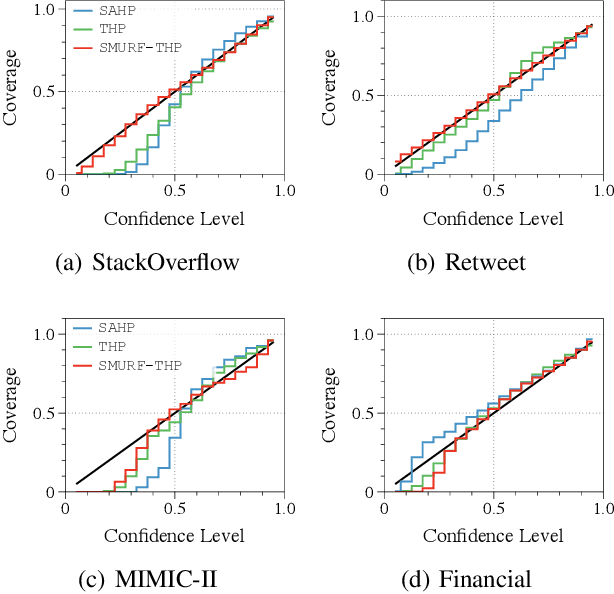
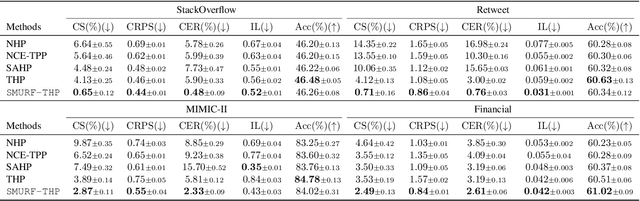

Transformer Hawkes process models have shown to be successful in modeling event sequence data. However, most of the existing training methods rely on maximizing the likelihood of event sequences, which involves calculating some intractable integral. Moreover, the existing methods fail to provide uncertainty quantification for model predictions, e.g., confidence intervals for the predicted event's arrival time. To address these issues, we propose SMURF-THP, a score-based method for learning Transformer Hawkes process and quantifying prediction uncertainty. Specifically, SMURF-THP learns the score function of events' arrival time based on a score-matching objective that avoids the intractable computation. With such a learned score function, we can sample arrival time of events from the predictive distribution. This naturally allows for the quantification of uncertainty by computing confidence intervals over the generated samples. We conduct extensive experiments in both event type prediction and uncertainty quantification of arrival time. In all the experiments, SMURF-THP outperforms existing likelihood-based methods in confidence calibration while exhibiting comparable prediction accuracy.
LoftQ: LoRA-Fine-Tuning-Aware Quantization for Large Language Models
Oct 23, 2023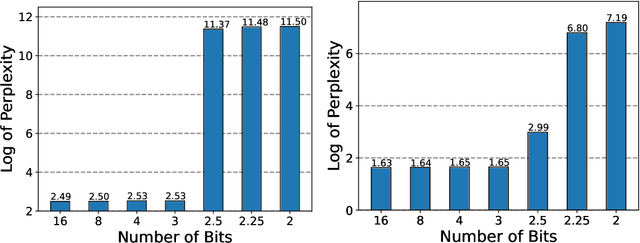
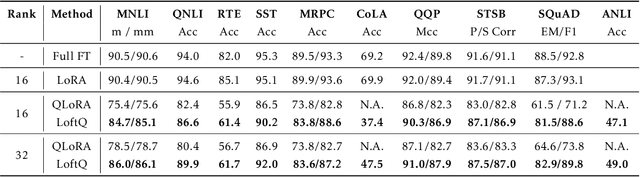
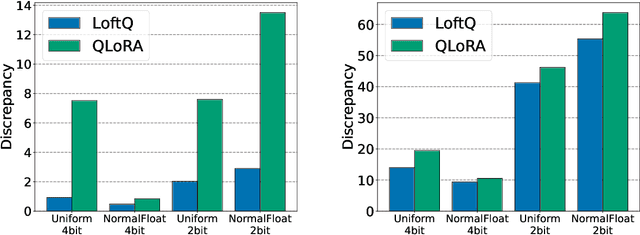
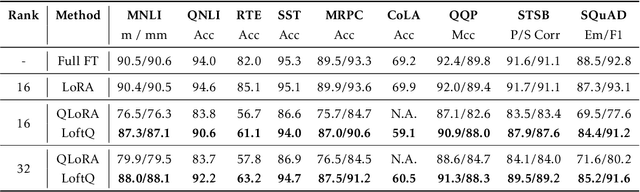
Quantization is an indispensable technique for serving Large Language Models (LLMs) and has recently found its way into LoRA fine-tuning. In this work we focus on the scenario where quantization and LoRA fine-tuning are applied together on a pre-trained model. In such cases it is common to observe a consistent gap in the performance on downstream tasks between full fine-tuning and quantization plus LoRA fine-tuning approach. In response, we propose LoftQ (LoRA-Fine-Tuning-aware Quantization), a novel quantization framework that simultaneously quantizes an LLM and finds a proper low-rank initialization for LoRA fine-tuning. Such an initialization alleviates the discrepancy between the quantized and full-precision model and significantly improves the generalization in downstream tasks. We evaluate our method on natural language understanding, question answering, summarization, and natural language generation tasks. Experiments show that our method is highly effective and outperforms existing quantization methods, especially in the challenging 2-bit and 2/4-bit mixed precision regimes. We will release our code.
Efficient Long-Range Transformers: You Need to Attend More, but Not Necessarily at Every Layer
Oct 19, 2023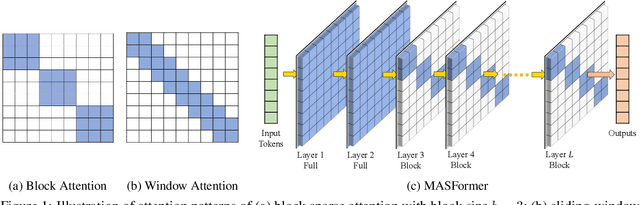
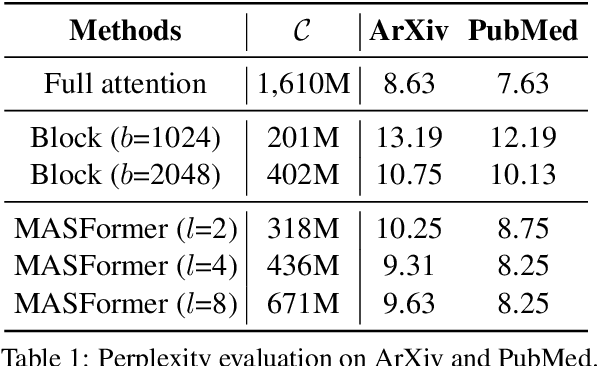
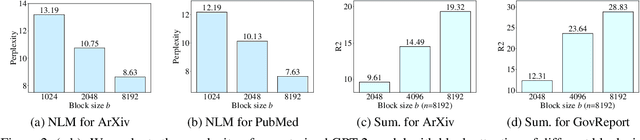
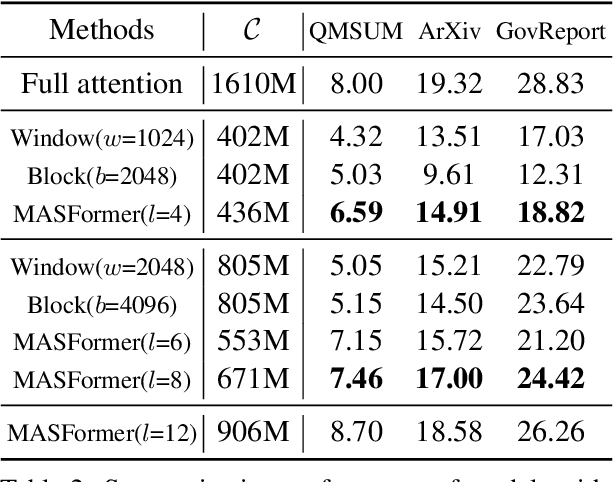
Pretrained transformer models have demonstrated remarkable performance across various natural language processing tasks. These models leverage the attention mechanism to capture long- and short-range dependencies in the sequence. However, the (full) attention mechanism incurs high computational cost - quadratic in the sequence length, which is not affordable in tasks with long sequences, e.g., inputs with 8k tokens. Although sparse attention can be used to improve computational efficiency, as suggested in existing work, it has limited modeling capacity and often fails to capture complicated dependencies in long sequences. To tackle this challenge, we propose MASFormer, an easy-to-implement transformer variant with Mixed Attention Spans. Specifically, MASFormer is equipped with full attention to capture long-range dependencies, but only at a small number of layers. For the remaining layers, MASformer only employs sparse attention to capture short-range dependencies. Our experiments on natural language modeling and generation tasks show that a decoder-only MASFormer model of 1.3B parameters can achieve competitive performance to vanilla transformers with full attention while significantly reducing computational cost (up to 75%). Additionally, we investigate the effectiveness of continual training with long sequence data and how sequence length impacts downstream generation performance, which may be of independent interest.
Robust Multi-Agent Reinforcement Learning via Adversarial Regularization: Theoretical Foundation and Stable Algorithms
Oct 16, 2023Multi-Agent Reinforcement Learning (MARL) has shown promising results across several domains. Despite this promise, MARL policies often lack robustness and are therefore sensitive to small changes in their environment. This presents a serious concern for the real world deployment of MARL algorithms, where the testing environment may slightly differ from the training environment. In this work we show that we can gain robustness by controlling a policy's Lipschitz constant, and under mild conditions, establish the existence of a Lipschitz and close-to-optimal policy. Based on these insights, we propose a new robust MARL framework, ERNIE, that promotes the Lipschitz continuity of the policies with respect to the state observations and actions by adversarial regularization. The ERNIE framework provides robustness against noisy observations, changing transition dynamics, and malicious actions of agents. However, ERNIE's adversarial regularization may introduce some training instability. To reduce this instability, we reformulate adversarial regularization as a Stackelberg game. We demonstrate the effectiveness of the proposed framework with extensive experiments in traffic light control and particle environments. In addition, we extend ERNIE to mean-field MARL with a formulation based on distributionally robust optimization that outperforms its non-robust counterpart and is of independent interest. Our code is available at https://github.com/abukharin3/ERNIE.