 Add to Chrome
 Add to Firefox
 Add to Edge
How LLMs See Creativity: Zero-Shot Scoring of Visual Creativity with Interpretable Reasoning
Jun 30, 2026
Evaluating the originality of visual images poses enduring challenges for creativity assessment. Automated scoring using AI models has proven effective in the verbal domain, yet key questions remain about evaluating visual creativity and understanding how models arrive at their ratings. The present research asks whether multimodal large language models (LLMs) can serve as judges of visual creativity zero-shot (without any fine-tuning or examples of human ratings) and whether their "reasoning" output offers an interpretable window into their evaluation process. We tested six multimodal LLMs (Gemini 3 Flash, Gemma 4 31B IT, GPT-5.4 Mini, GLM-5v Turbo, Kimi K2.5, and Qwen 3.6 Plus) on 992 AI-generated images (based on human-written prompts) and 1,500 hand-drawn sketches scored for creativity by human raters. In Study 1, all models showed substantial alignment with human creativity ratings on both datasets (r = .57-.68 on AI-generated images; r = .29-68 on sketches). In Study 2, we analyzed the step-by-step reasoning processes of three LLMs evaluating the same images and drawings. Although reasoning made model evaluations interpretable -- showing what they attend to, how they balance originality vs. quality, and how they justify their ratings -- reasoning did not improve alignment with human ratings. In sum, our findings indicate that multimodal LLMs can match human judgments of visual creativity without any additional training, and that their reasoning reveals how AI models evaluate creativity. An open scoring app implementing this pipeline is available at https://review-visual-eval-scoring.hf.space.

Introducing multiplex semantic networks as multifaceted representations of creative associative knowledge across multilingual samples
Jun 08, 2026Creativity is a complex cognitive ability that relies on knowledge organisation and retrieval from semantic memory. Yet most research uses a single task to measure it, capturing only a fraction of this complexity. This study investigates multiplex networks - layered semantic networks obtained from six cognitive tasks - as a more comprehensive approach to modelling the associative knowledge underlying creativity. We collected data from N=518 individuals from four countries (Austria, USA, Singapore, Italy). From their responses to verbal fluency, sentence-chain, free association, and narrative writing tasks, we constructed semantic networks and assembled them in a multiplex structure. AI persona-based responses provided a comparison baseline. Structural reducibility analyses showed that different task layers captured distinct, non-redundant information about semantic organisation, supporting the use of multiple tasks over any single one. The networks from high- and low-creative groups remained structurally distinct, while AI-generated networks showed near-identical structures regardless of creativity group. Finally, we used 12 features (network measures, emotional scores, and spreading activation simulations) in a machine learning model using ridge regression to predict individual creativity scores. The combination of structurally similar layers, as identified in the previous stage, improved a proof-of-concept prediction accuracy by 50%. Structural measures showed the highest feature importance, with spreading activation dynamics providing additional predictive power. Together, these findings indicate that multiplex semantic networks capture a richer, cross-cultural picture of associative knowledge underlying creativity. We also release our diverse dataset and code to foster diverse computational approaches within the creativity community.
Large Language Models Align with the Human Brain during Creative Thinking
Apr 03, 2026Creative thinking is a fundamental aspect of human cognition, and divergent thinking-the capacity to generate novel and varied ideas-is widely regarded as its core generative engine. Large language models (LLMs) have recently demonstrated impressive performance on divergent thinking tests and prior work has shown that models with higher task performance tend to be more aligned to human brain activity. However, existing brain-LLM alignment studies have focused on passive, non-creative tasks. Here, we explore brain alignment during creative thinking using fMRI data from 170 participants performing the Alternate Uses Task (AUT). We extract representations from LLMs varying in size (270M-72B) and measure alignment to brain responses via Representational Similarity Analysis (RSA), targeting the creativity-related default mode and frontoparietal networks. We find that brain-LLM alignment scales with model size (default mode network only) and idea originality (both networks), with effects strongest early in the creative process. We further show that post-training objectives shape alignment in functionally selective ways: a creativity-optimized \texttt{Llama-3.1-8B-Instruct} preserves alignment with high-creativity neural responses while reducing alignment with low-creativity ones; a human behavior fine-tuned model elevates alignment with both; and a reasoning-trained variant shows the opposite pattern, suggesting chain-of-thought training steers representations away from creative neural geometry toward analytical processing. These results demonstrate that post-training objectives selectively reshape LLM representations relative to the neural geometry of human creative thought.
How do Humans and Language Models Reason About Creativity? A Comparative Analysis
Feb 05, 2025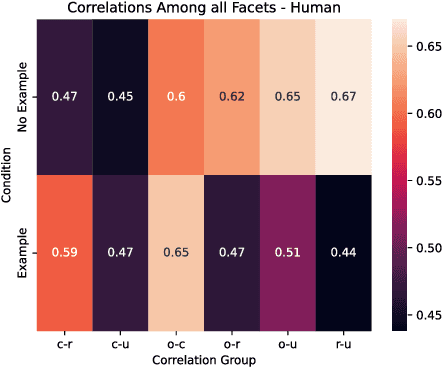
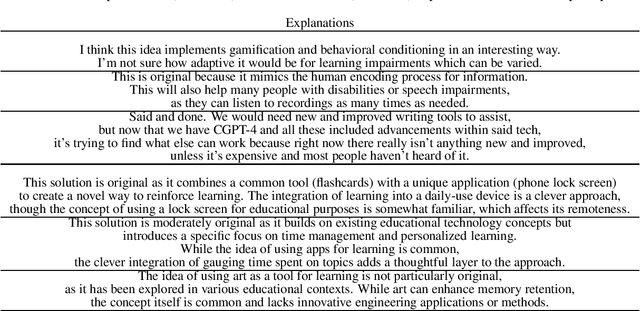
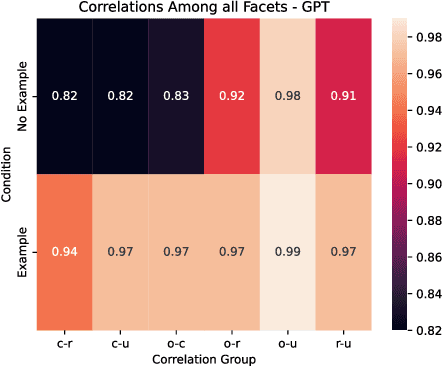
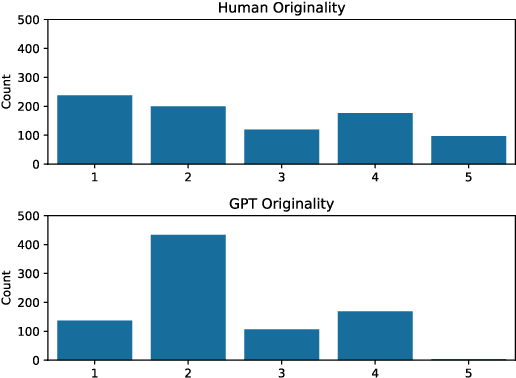
Creativity assessment in science and engineering is increasingly based on both human and AI judgment, but the cognitive processes and biases behind these evaluations remain poorly understood. We conducted two experiments examining how including example solutions with ratings impact creativity evaluation, using a finegrained annotation protocol where raters were tasked with explaining their originality scores and rating for the facets of remoteness (whether the response is "far" from everyday ideas), uncommonness (whether the response is rare), and cleverness. In Study 1, we analyzed creativity ratings from 72 experts with formal science or engineering training, comparing those who received example solutions with ratings (example) to those who did not (no example). Computational text analysis revealed that, compared to experts with examples, no-example experts used more comparative language (e.g., "better/worse") and emphasized solution uncommonness, suggesting they may have relied more on memory retrieval for comparisons. In Study 2, parallel analyses with state-of-the-art LLMs revealed that models prioritized uncommonness and remoteness of ideas when rating originality, suggesting an evaluative process rooted around the semantic similarity of ideas. In the example condition, while LLM accuracy in predicting the true originality scores improved, the correlations of remoteness, uncommonness, and cleverness with originality also increased substantially - to upwards of 0.99 - suggesting a homogenization in the LLMs evaluation of the individual facets. These findings highlight important implications for how humans and AI reason about creativity and suggest diverging preferences for what different populations prioritize when rating.