 Add to Chrome
 Add to Firefox
 Add to Edge
Sci-VBench: Evaluating Knowledge- and Reasoning-Intensive Video Generation in Science Domains
Aug 10, 2026
We introduce Sci-VBench, a comprehensive benchmark for evaluating knowledge- and reasoning-intensive video generation across scientific domains. It contains 1,253 expert-annotated examples spanning 60 subjects across four core disciplines: Natural Science, Healthcare, Humanities & Social Sciences, and Engineering. Each example requires models to generate temporally rich videos that demand scientific reasoning and knowledge-grounded synthesis, going beyond surface-level visual plausibility. We further establish a rubric-based evaluation protocol. Our analysis shows that, under this protocol, both non-expert human evaluators and MLLM-as-Judge systems can achieve relatively high agreement with expert judgments, supporting reproducible evaluation at scale. We benchmark 16 frontier proprietary and open-source models and find that, while automatic perceptual-quality scores cluster tightly across systems, performance on Prompt Grounding and Scientific and Causal Correctness varies substantially, with a pronounced proprietary-open-source gap. These findings show that advances in visual realism have not yet translated into reliable modeling of scientific and causal dynamics.

VideoKR: Towards Knowledge- and Reasoning-Intensive Video Understanding
Jun 03, 2026We introduce VideoKR, the first large-scale training corpus specifically designed to strengthen knowledge- and reasoning-intensive video understanding. It comprises 315K video reasoning examples over 145K newly collected, CC-licensed, expert-domain videos. We develop a human-in-the-loop, skill-oriented example generation pipeline that targets progressively deeper video reasoning capabilities while ensuring the difficulty, diversity, and reliability of both the examples and their CoT rationales. We also curate VideoKR-Eval, a new expert-annotated benchmark where questions require genuine video understanding and knowledge-intensive reasoning rather than textual shortcuts. Our experiments show that, under a standard SFT$\rightarrow$GRPO pipeline, models post-trained on VideoKR outperform prior post-training approaches on knowledge-intensive video reasoning while remaining competitive on general video reasoning, highlighting data design as a key driver of progress in video reasoning. We further conduct comprehensive ablations to isolate the contributions of VideoKR, providing actionable insights for future work.
TexOCR: Advancing Document OCR Models for Compilable Page-to-LaTeX Reconstruction
Apr 24, 2026Existing document OCR largely targets plain text or Markdown, discarding the structural and executable properties that make LaTeX essential for scientific publishing. We study page-level reconstruction of scientific PDFs into compilable LaTeX and introduce TexOCR-Bench, a benchmark, and TexOCR-Train, a large-scale training corpus, for this task. TexOCR-Bench features a multi-dimensional evaluation suite that jointly assesses transcription fidelity, structural faithfulness, and end-to-end compilability. Leveraging TexOCR-Train, we train a 2B-parameter model, TexOCR, using supervised fine-tuning (SFT) and reinforcement learning (RL) with verifiable rewards derived from LaTeX unit tests that directly enforce compilability and referential integrity. Experiments across 21 frontier models on TexOCR-Bench show that existing systems frequently violate key document invariants, including consistent section structure, correct float placement, and valid label-reference links, which undermines compilation reliability and downstream usability. Our analysis further reveals that RL with verifiable rewards yields consistent improvements over SFT alone, particularly on structural and compilation metrics.
Multiscale Cross-Modal Mapping of Molecular, Pathologic, and Radiologic Phenotypes in Lipid-Deficient Clear Cell Renal CellCarcinoma
Dec 13, 2025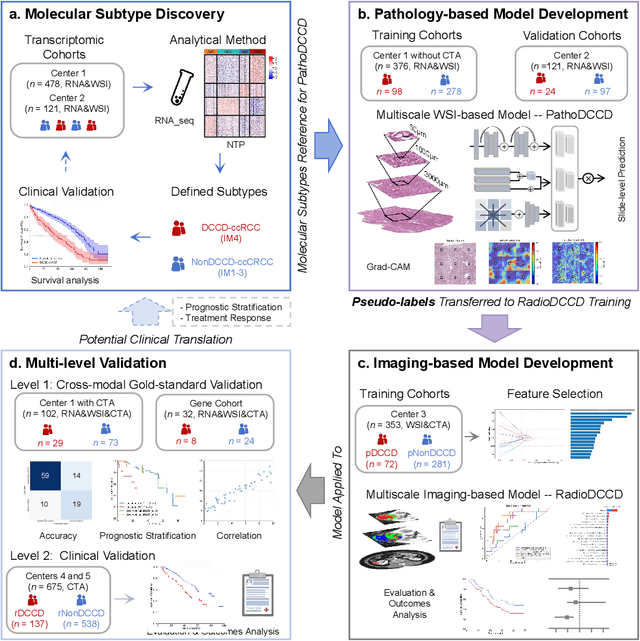
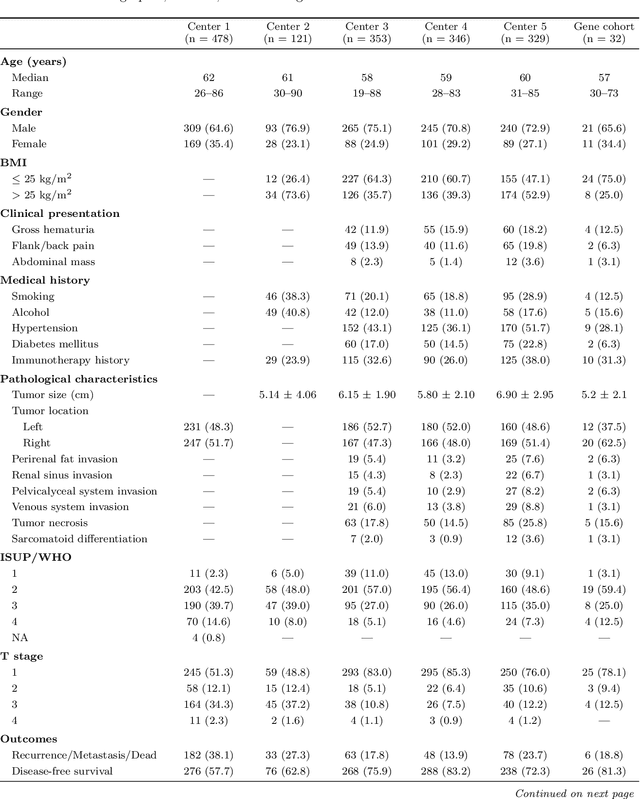
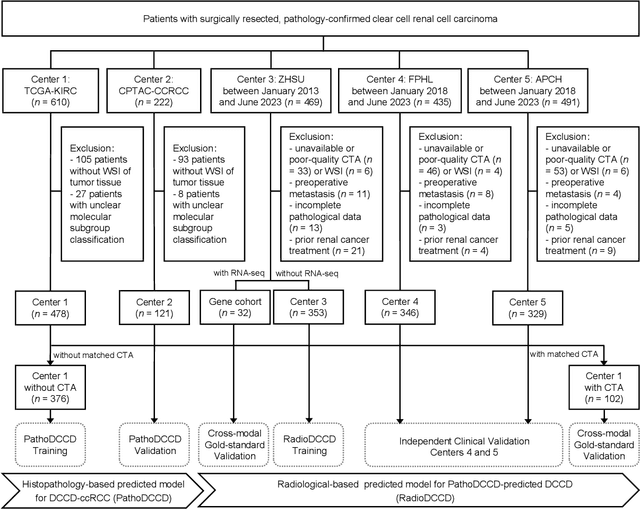
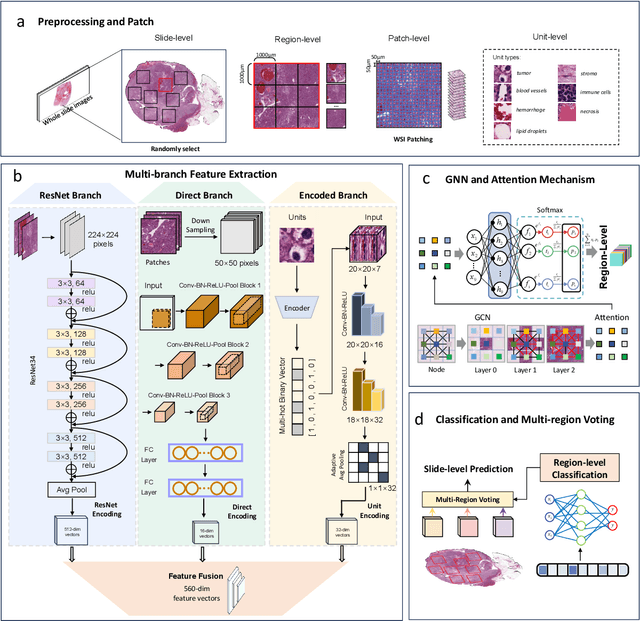
Clear cell renal cell carcinoma (ccRCC) exhibits extensive intratumoral heterogeneity on multiple biological scales, contributing to variable clinical outcomes and limiting the effectiveness of conventional TNM staging, which highlights the urgent need for multiscale integrative analytic frameworks. The lipid-deficient de-clear cell differentiated (DCCD) ccRCC subtype, defined by multi-omics analyses, is associated with adverse outcomes even in early-stage disease. Here, we establish a hierarchical cross-scale framework for the preoperative identification of DCCD-ccRCC. At the highest layer, cross-modal mapping transferred molecular signatures to histological and CT phenotypes, establishing a molecular-to-pathology-to-radiology supervisory bridge. Within this framework, each modality-specific model is designed to mirror the inherent hierarchical structure of tumor biology. PathoDCCD captured multi-scale microscopic features, from cellular morphology and tissue architecture to meso-regional organization. RadioDCCD integrated complementary macroscopic information by combining whole-tumor and its habitat-subregions radiomics with a 2D maximal-section heterogeneity metric. These nested models enabled integrated molecular subtype prediction and clinical risk stratification. Across five cohorts totaling 1,659 patients, PathoDCCD reliably recapitulated molecular subtypes, while RadioDCCD provided reliable preoperative prediction. The consistent predictions identified patients with the poorest clinical outcomes. This cross-scale paradigm unifies molecular biology, computational pathology, and quantitative radiology into a biologically grounded strategy for preoperative noninvasive molecular phenotyping of ccRCC.
A hierarchical approach to deep learning and its application to tomographic reconstruction
Dec 16, 2019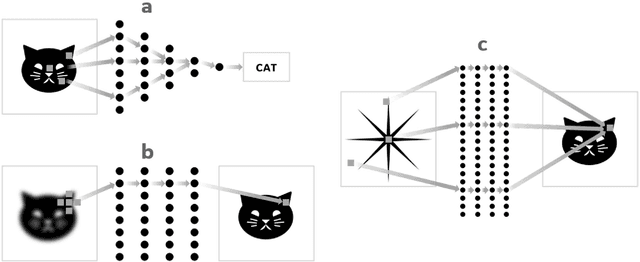
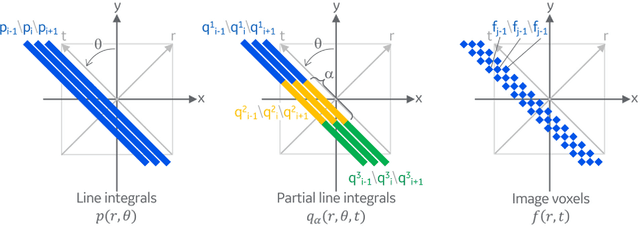
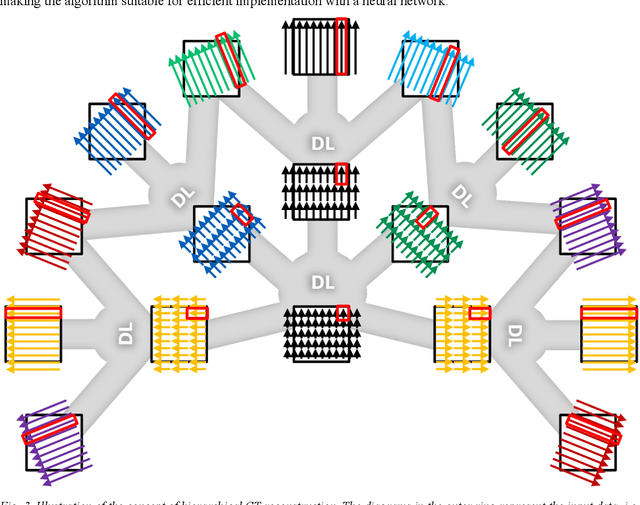
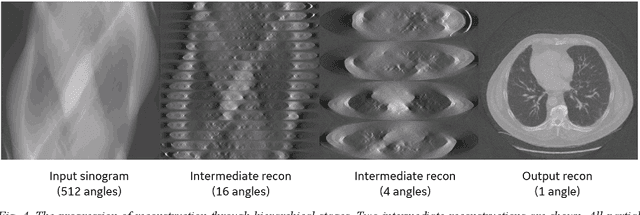
Deep learning (DL) has shown unprecedented performance for many image analysis and image enhancement tasks. Yet, solving large-scale inverse problems like tomographic reconstruction remains challenging for DL. These problems involve non-local and space-variant integral transforms between the input and output domains, for which no efficient neural network models have been found. A prior attempt to solve such problems with supervised learning relied on a brute-force fully connected network and applied it to reconstruction for a $128^4$ system matrix size. This cannot practically scale to realistic data sizes such as $512^4$ and $512^6$ for three-dimensional data sets. Here we present a novel framework to solve such problems with deep learning by casting the original problem as a continuum of intermediate representations between the input and output data. The original problem is broken down into a sequence of simpler transformations that can be well mapped onto an efficient hierarchical network architecture, with exponentially fewer parameters than a generic network would need. We applied the approach to computed tomography (CT) image reconstruction for a $512^4$ system matrix size. To our knowledge, this enabled the first data-driven DL solver for full-size CT reconstruction without relying on the structure of direct (analytical) or iterative (numerical) inversion techniques. The proposed approach is applicable to other imaging problems such as emission and magnetic resonance reconstruction. More broadly, hierarchical DL opens the door to a new class of solvers for general inverse problems, which could potentially lead to improved signal-to-noise ratio, spatial resolution and computational efficiency in various areas.