 Add to Chrome
 Add to Firefox
 Add to Edge
Gradually Compacting Large Language Models for Reasoning Like a Boiling Frog
Feb 04, 2026
Large Language Models (LLMs) have demonstrated impressive reasoning capabilities, but their substantial size often demands significant computational resources. To reduce resource consumption and accelerate inference, it is essential to eliminate redundant parameters without compromising performance. However, conventional pruning methods that directly remove such parameters often lead to a dramatic drop in model performance in reasoning tasks, and require extensive post-training to recover the lost capabilities. In this work, we propose a gradual compacting method that divides the compression process into multiple fine-grained iterations, applying a Prune-Tune Loop (PTL) at each stage to incrementally reduce model size while restoring performance with finetuning. This iterative approach-reminiscent of the "boiling frog" effect-enables the model to be progressively compressed without abrupt performance loss. Experimental results show that PTL can compress LLMs to nearly half their original size with only lightweight post-training, while maintaining performance comparable to the original model on reasoning tasks. Moreover, PTL is flexible and can be applied to various pruning strategies, such as neuron pruning and layer pruning, as well as different post-training methods, including continual pre-training and reinforcement learning. Additionally, experimental results confirm the effectiveness of PTL on a variety of tasks beyond mathematical reasoning, such as code generation, demonstrating its broad applicability.

VF-Eval: Evaluating Multimodal LLMs for Generating Feedback on AIGC Videos
May 29, 2025MLLMs have been widely studied for video question answering recently. However, most existing assessments focus on natural videos, overlooking synthetic videos, such as AI-generated content (AIGC). Meanwhile, some works in video generation rely on MLLMs to evaluate the quality of generated videos, but the capabilities of MLLMs on interpreting AIGC videos remain largely underexplored. To address this, we propose a new benchmark, VF-Eval, which introduces four tasks-coherence validation, error awareness, error type detection, and reasoning evaluation-to comprehensively evaluate the abilities of MLLMs on AIGC videos. We evaluate 13 frontier MLLMs on VF-Eval and find that even the best-performing model, GPT-4.1, struggles to achieve consistently good performance across all tasks. This highlights the challenging nature of our benchmark. Additionally, to investigate the practical applications of VF-Eval in improving video generation, we conduct an experiment, RePrompt, demonstrating that aligning MLLMs more closely with human feedback can benefit video generation.
MMVU: Measuring Expert-Level Multi-Discipline Video Understanding
Jan 21, 2025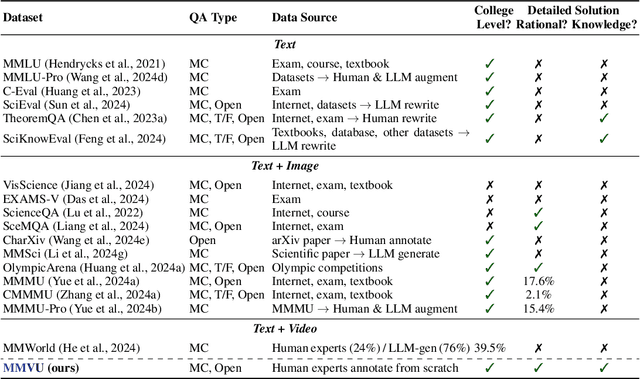


We introduce MMVU, a comprehensive expert-level, multi-discipline benchmark for evaluating foundation models in video understanding. MMVU includes 3,000 expert-annotated questions spanning 27 subjects across four core disciplines: Science, Healthcare, Humanities & Social Sciences, and Engineering. Compared to prior benchmarks, MMVU features three key advancements. First, it challenges models to apply domain-specific knowledge and perform expert-level reasoning to analyze specialized-domain videos, moving beyond the basic visual perception typically assessed in current video benchmarks. Second, each example is annotated by human experts from scratch. We implement strict data quality controls to ensure the high quality of the dataset. Finally, each example is enriched with expert-annotated reasoning rationals and relevant domain knowledge, facilitating in-depth analysis. We conduct an extensive evaluation of 32 frontier multimodal foundation models on MMVU. The latest System-2-capable models, o1 and Gemini 2.0 Flash Thinking, achieve the highest performance among the tested models. However, they still fall short of matching human expertise. Through in-depth error analyses and case studies, we offer actionable insights for future advancements in expert-level, knowledge-intensive video understanding for specialized domains.