 Add to Chrome
 Add to Firefox
 Add to Edge
Disentangling Multi-View Scanning in Mamba for Network Traffic Anomaly Detection
Jul 24, 2026
Network Traffic Anomaly Detection (NTAD) is a critical task in cybersecurity, yet timely and accurate anomaly detection remains challenging. Mamba has emerged as a particularly promising backbone for NTAD due to its linear-time complexity for long-sequence modeling. It further incorporates a dedicated multi-view scanning mechanism to enhance detection precision through complementary contextual cues. However, we identify a previously overlooked structural deficiency in multi-view Mamba scanning for NTAD: redundancy accumulation. Specifically, distinct scanning branches capture substantial view-invariant information, which is repeatedly amplified during multi-view fusion; conversely, view-specific information is diluted or even suppressed, leading to representation homogenization and multi-view degradation. To address this problem, we propose DisenMamba, a novel disentangled multi-view Mamba framework. DisenMamba reformulates multi-view scanning as a two-stage disentangle-then-fuse process that explicitly separates view-invariant and view-specific components prior to fusion. This design prevents the invariant information accumulation while preserving complementary multi-view cues, yielding more discriminative representations for subtle traffic anomalies. Extensive experiments demonstrate the effectiveness of DisenMamba, establishing a new disentangled multi-view Mamba paradigm. Code is available at https://github.com/ikun0124/DisenMamba.

AOEPT: Breaking the Implicit Modality-Reduction Bottleneck in Modality-Missing Prompt Tuning
May 24, 2026Deploying multimodal systems in real-world environments often entails handling modality-missing scenarios, where one or more modalities are unavailable. While recent studies address this challenge for the general Multimodal Transformer (MT) architecture via prompt tuning, we identify a fundamental limitation in these methods: the Implicit Modality-Reduction bottleneck. By conditioning prompts solely on the observed modalities, they inadvertently restrict the reasoning scope of MTs to the modality-reduced subspace, cutting off access to the latent information sources of the missing modalities. To overcome this limitation, we propose AOEPT, which pioneers a novel modal-contextualized prompting fashion. Specifically, we introduce lightweight Modal-Contextualized Prompts (MCPs) that distill global modality-wise priors from training data, serving as latent repositories of the information sources for missing modalities. Conditioned on the remaining modalities, these MCPs are instantiated into instance-aware prompts that selectively augment missing-modality information for each sample, thereby restoring the reasoning scope of MTs beyond the observed-modality-only subspace. Experiments across various multimodal benchmarks and backbones confirm the strong performance of AOEPT, with minimal computational overhead.
Decompose to Understand, Fuse to Detect: Frequency-Decoupled Anomaly Detection for Encrypted Network Traffic
May 03, 2026Network traffic anomaly detection represents a critical cybersecurity task, yet widespread encryption makes this task increasingly challenging. In response, image-based methods that model traffic as visual patterns have emerged as the dominant approach. However, this work pioneers the identification of a pervasive ``full-frequency'' characteristic and an associated limitation termed ``spectral mismatch'' within this paradigm. Specifically, while encrypted traffic exhibits prominent high-frequency components, mainstream reconstruction methods demonstrate an inherent bias toward learning low-frequency information. This fundamental mismatch results in incomplete representations that consequently degrade anomaly detection performance. To address this challenge, we propose FreeUp, a novel frequency-decoupled framework designed explicitly for encrypted traffic analysis. FreeUp decomposes traffic data into distinct low- and high-frequency bands, processing them through separate, dedicated branches along with a customized training strategy that ensures stable and independent frequency-specific learning. Furthermore, recognizing that simple reconstruction error proves inadequate for evaluating dual-branch architectures, we introduce an uncertainty-inspired fusion scoring mechanism. This mechanism quantifies the reconstruction uncertainty of the frequency-specific branches and dynamically integrates their outputs, yielding a more comprehensive and reliable anomaly score. Extensive experiments across multiple benchmarks demonstrate that FreeUp consistently outperforms state-of-the-art baselines. The code is available at https://github.com/ikun0124/FreeUp.
Shedding the Facades, Connecting the Domains: Detecting Shifting Multimodal Hate Video with Test-Time Adaptation
Jan 28, 2026Hate Video Detection (HVD) is crucial for online ecosystems. Existing methods assume identical distributions between training (source) and inference (target) data. However, hateful content often evolves into irregular and ambiguous forms to evade censorship, resulting in substantial semantic drift and rendering previously trained models ineffective. Test-Time Adaptation (TTA) offers a solution by adapting models during inference to narrow the cross-domain gap, while conventional TTA methods target mild distribution shifts and struggle with the severe semantic drift in HVD. To tackle these challenges, we propose SCANNER, the first TTA framework tailored for HVD. Motivated by the insight that, despite the evolving nature of hateful manifestations, their underlying cores remain largely invariant (i.e., targeting is still based on characteristics like gender, race, etc), we leverage these stable cores as a bridge to connect the source and target domains. Specifically, SCANNER initially reveals the stable cores from the ambiguous layout in evolving hateful content via a principled centroid-guided alignment mechanism. To alleviate the impact of outlier-like samples that are weakly correlated with centroids during the alignment process, SCANNER enhances the prior by incorporating a sample-level adaptive centroid alignment strategy, promoting more stable adaptation. Furthermore, to mitigate semantic collapse from overly uniform outputs within clusters, SCANNER introduces an intra-cluster diversity regularization that encourages the cluster-wise semantic richness. Experiments show that SCANNER outperforms all baselines, with an average gain of 4.69% in Macro-F1 over the best.
Nip Rumors in the Bud: Retrieval-Guided Topic-Level Adaptation for Test-Time Fake News Video Detection
Jan 17, 2026Fake News Video Detection (FNVD) is critical for social stability. Existing methods typically assume consistent news topic distribution between training and test phases, failing to detect fake news videos tied to emerging events and unseen topics. To bridge this gap, we introduce RADAR, the first framework that enables test-time adaptation to unseen news videos. RADAR pioneers a new retrieval-guided adaptation paradigm that leverages stable (source-close) videos from the target domain to guide robust adaptation of semantically related but unstable instances. Specifically, we propose an Entropy Selection-Based Retrieval mechanism that provides videos with stable (low-entropy), relevant references for adaptation. We also introduce a Stable Anchor-Guided Alignment module that explicitly aligns unstable instances' representations to the source domain via distribution-level matching with their stable references, mitigating severe domain discrepancies. Finally, our novel Target-Domain Aware Self-Training paradigm can generate informative pseudo-labels augmented by stable references, capturing varying and imbalanced category distributions in the target domain and enabling RADAR to adapt to the fast-changing label distributions. Extensive experiments demonstrate that RADAR achieves superior performance for test-time FNVD, enabling strong on-the-fly adaptation to unseen fake news video topics.
TAMEing Long Contexts in Personalization: Towards Training-Free and State-Aware MLLM Personalized Assistant
Dec 25, 2025Multimodal Large Language Model (MLLM) Personalization is a critical research problem that facilitates personalized dialogues with MLLMs targeting specific entities (known as personalized concepts). However, existing methods and benchmarks focus on the simple, context-agnostic visual identification and textual replacement of the personalized concept (e.g., "A yellow puppy" -> "Your puppy Mochi"), overlooking the ability to support long-context conversations. An ideal personalized MLLM assistant is capable of engaging in long-context dialogues with humans and continually improving its experience quality by learning from past dialogue histories. To bridge this gap, we propose LCMP, the first Long-Context MLLM Personalization evaluation benchmark. LCMP assesses the capability of MLLMs in perceiving variations of personalized concepts and generating contextually appropriate personalized responses that reflect these variations. As a strong baseline for LCMP, we introduce a novel training-free and state-aware framework TAME. TAME endows MLLMs with double memories to manage the temporal and persistent variations of each personalized concept in a differentiated manner. In addition, TAME incorporates a new training-free Retrieve-then-Align Augmented Generation (RA2G) paradigm. RA2G introduces an alignment step to extract the contextually fitted information from the multi-memory retrieved knowledge to the current questions, enabling better interactions for complex real-world user queries. Experiments on LCMP demonstrate that TAME achieves the best performance, showcasing remarkable and evolving interaction experiences in long-context scenarios.
From Shallow Humor to Metaphor: Towards Label-Free Harmful Meme Detection via LMM Agent Self-Improvement
Dec 25, 2025The proliferation of harmful memes on online media poses significant risks to public health and stability. Existing detection methods heavily rely on large-scale labeled data for training, which necessitates substantial manual annotation efforts and limits their adaptability to the continually evolving nature of harmful content. To address these challenges, we present ALARM, the first lAbeL-free hARmful Meme detection framework powered by Large Multimodal Model (LMM) agent self-improvement. The core innovation of ALARM lies in exploiting the expressive information from "shallow" memes to iteratively enhance its ability to tackle more complex and subtle ones. ALARM consists of a novel Confidence-based Explicit Meme Identification mechanism that isolates the explicit memes from the original dataset and assigns them pseudo-labels. Besides, a new Pairwise Learning Guided Agent Self-Improvement paradigm is introduced, where the explicit memes are reorganized into contrastive pairs (positive vs. negative) to refine a learner LMM agent. This agent autonomously derives high-level detection cues from these pairs, which in turn empower the agent itself to handle complex and challenging memes effectively. Experiments on three diverse datasets demonstrate the superior performance and strong adaptability of ALARM to newly evolved memes. Notably, our method even outperforms label-driven methods. These results highlight the potential of label-free frameworks as a scalable and promising solution for adapting to novel forms and topics of harmful memes in dynamic online environments.
Compose Yourself: Average-Velocity Flow Matching for One-Step Speech Enhancement
Sep 19, 2025Diffusion and flow matching (FM) models have achieved remarkable progress in speech enhancement (SE), yet their dependence on multi-step generation is computationally expensive and vulnerable to discretization errors. Recent advances in one-step generative modeling, particularly MeanFlow, provide a promising alternative by reformulating dynamics through average velocity fields. In this work, we present COSE, a one-step FM framework tailored for SE. To address the high training overhead of Jacobian-vector product (JVP) computations in MeanFlow, we introduce a velocity composition identity to compute average velocity efficiently, eliminating expensive computation while preserving theoretical consistency and achieving competitive enhancement quality. Extensive experiments on standard benchmarks show that COSE delivers up to 5x faster sampling and reduces training cost by 40%, all without compromising speech quality. Code is available at https://github.com/ICDM-UESTC/COSE.
Retrieval-Augmented Dynamic Prompt Tuning for Incomplete Multimodal Learning
Jan 02, 2025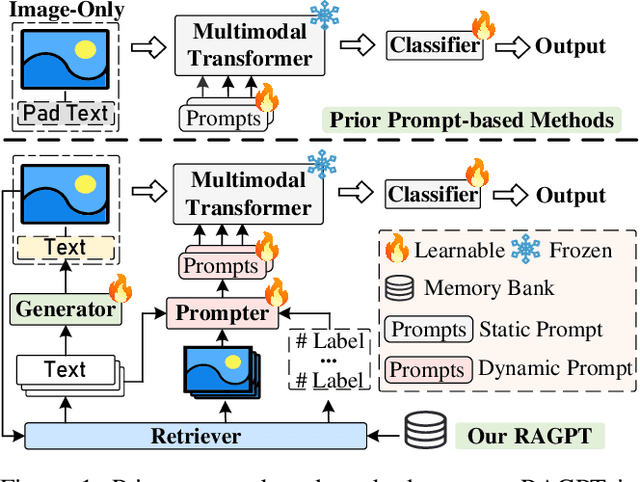
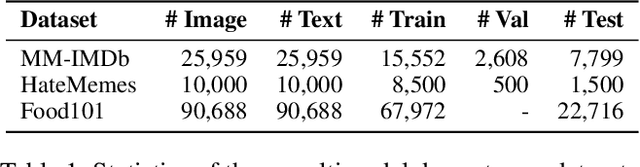
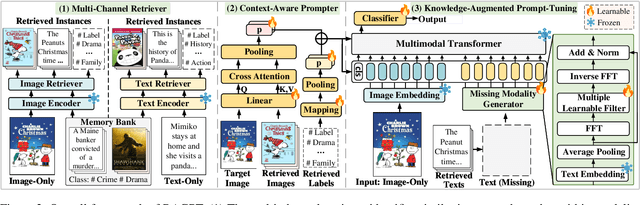
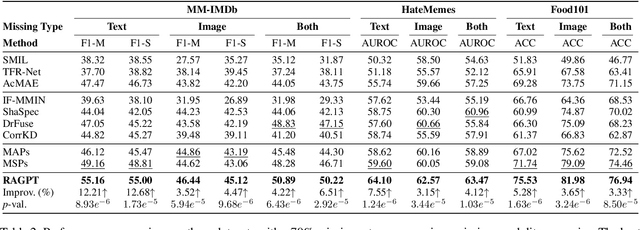
Multimodal learning with incomplete modality is practical and challenging. Recently, researchers have focused on enhancing the robustness of pre-trained MultiModal Transformers (MMTs) under missing modality conditions by applying learnable prompts. However, these prompt-based methods face several limitations: (1) incomplete modalities provide restricted modal cues for task-specific inference, (2) dummy imputation for missing content causes information loss and introduces noise, and (3) static prompts are instance-agnostic, offering limited knowledge for instances with various missing conditions. To address these issues, we propose RAGPT, a novel Retrieval-AuGmented dynamic Prompt Tuning framework. RAGPT comprises three modules: (I) the multi-channel retriever, which identifies similar instances through a within-modality retrieval strategy, (II) the missing modality generator, which recovers missing information using retrieved contexts, and (III) the context-aware prompter, which captures contextual knowledge from relevant instances and generates dynamic prompts to largely enhance the MMT's robustness. Extensive experiments conducted on three real-world datasets show that RAGPT consistently outperforms all competitive baselines in handling incomplete modality problems. The code of our work and prompt-based baselines is available at https://github.com/Jian-Lang/RAGPT.
An optical biomimetic eyes with interested object imaging
Aug 08, 2021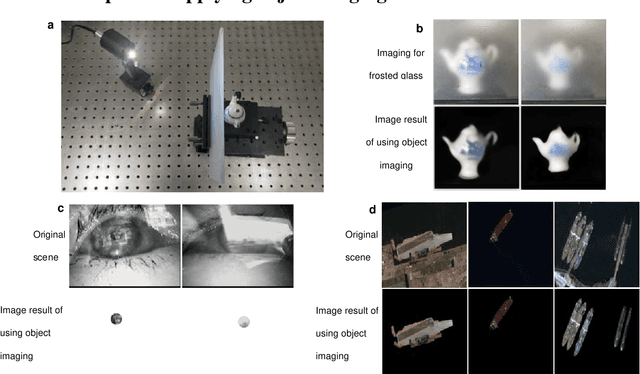
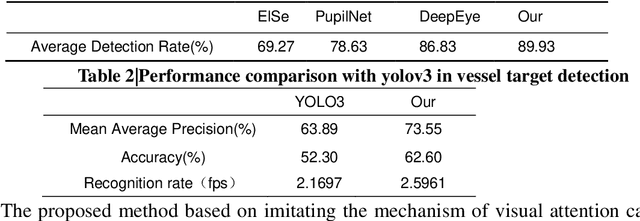
We presented an optical system to perform imaging interested objects in complex scenes, like the creature easy see the interested prey in the hunt for complex environments. It utilized Deep-learning network to learn the interested objects's vision features and designed the corresponding "imaging matrices", furthermore the learned matrixes act as the measurement matrix to complete compressive imaging with a single-pixel camera, finally we can using the compressed image data to only image the interested objects without the rest objects and backgrounds of the scenes with the previous Deep-learning network. Our results demonstrate that no matter interested object is single feature or rich details, the interference can be successfully filtered out and this idea can be applied in some common applications that effectively improve the performance. This bio-inspired optical system can act as the creature eye to achieve success on interested-based object imaging, object detection, object recognition and object tracking, etc.