 Add to Chrome
 Add to Firefox
 Add to Edge
A Tale of Two Temperatures: Simple, Efficient, and Diverse Sampling from Diffusion Language Models
Apr 10, 2026
Much work has been done on designing fast and accurate sampling for diffusion language models (dLLMs). However, these efforts have largely focused on the tradeoff between speed and quality of individual samples; how to additionally ensure diversity across samples remains less well understood. In this work, we show that diversity can be increased by using softened, tempered versions of familiar confidence-based remasking heuristics, retaining their computational benefits and offering simple implementations. We motivate this approach by introducing an idealized formal model of fork tokens and studying the impact of remasking on the expected entropy at the forks. Empirically, the proposed tempered heuristics close the exploration gap (pass@k) between existing confidence-based and autoregressive sampling, hence outperforming both when controlling for cost (pass@NFE). We further study how the increase in diversity translates to downstream post-training and test-time compute scaling. Overall, our findings demonstrate that simple, efficient, and diverse sampling from dLLMs is possible.

Amortizing Maximum Inner Product Search with Learned Support Functions
Mar 09, 2026Maximum inner product search (MIPS) is a crucial subroutine in machine learning, requiring the identification of key vectors that align best with a given query. We propose amortized MIPS: a learning-based approach that trains neural networks to directly predict MIPS solutions, amortizing the computational cost of matching queries (drawn from a fixed distribution) to a fixed set of keys. Our key insight is that the MIPS value function, the maximal inner product between a query and keys, is also known as the support function of the set of keys. Support functions are convex, 1-homogeneous and their gradient w.r.t. the query is exactly the optimal key in the database. We approximate the support function using two complementary approaches: (1) we train an input-convex neural network (SupportNet) to model the support function directly; the optimal key can be recovered via (autodiff) gradient computation, and (2) we regress directly the optimal key from the query using a vector valued network (KeyNet), bypassing gradient computation entirely at inference time. To learn a SupportNet, we combine score regression with gradient matching losses, and propose homogenization wrappers that enforce the positive 1-homogeneity of a neural network, theoretically linking function values to gradients. To train a KeyNet, we introduce a score consistency loss derived from the Euler theorem for homogeneous functions. Our experiments show that learned SupportNet or KeyNet achieve high match rates and open up new directions to compress databases with a specific query distribution in mind.
The Design Space of Tri-Modal Masked Diffusion Models
Feb 25, 2026Discrete diffusion models have emerged as strong alternatives to autoregressive language models, with recent work initializing and fine-tuning a base unimodal model for bimodal generation. Diverging from previous approaches, we introduce the first tri-modal masked diffusion model pretrained from scratch on text, image-text, and audio-text data. We systematically analyze multimodal scaling laws, modality mixing ratios, noise schedules, and batch-size effects, and we provide optimized inference sampling defaults. Our batch-size analysis yields a novel stochastic differential equation (SDE)-based reparameterization that eliminates the need for tuning the optimal batch size as reported in recent work. This reparameterization decouples the physical batch size, often chosen based on compute constraints (GPU saturation, FLOP efficiency, wall-clock time), from the logical batch size, chosen to balance gradient variance during stochastic optimization. Finally, we pretrain a preliminary 3B-parameter tri-modal model on 6.4T tokens, demonstrating the capabilities of a unified design and achieving strong results in text generation, text-to-image tasks, and text-to-speech tasks. Our work represents the largest-scale systematic open study of multimodal discrete diffusion models conducted to date, providing insights into scaling behaviors across multiple modalities.
Learning Unmasking Policies for Diffusion Language Models
Dec 12, 2025Diffusion (Large) Language Models (dLLMs) now match the downstream performance of their autoregressive counterparts on many tasks, while holding the promise of being more efficient during inference. One particularly successful variant is masked discrete diffusion, in which a buffer filled with special mask tokens is progressively replaced with tokens sampled from the model's vocabulary. Efficiency can be gained by unmasking several tokens in parallel, but doing too many at once risks degrading the generation quality. Thus, one critical design aspect of dLLMs is the sampling procedure that selects, at each step of the diffusion process, which tokens to replace. Indeed, recent work has found that heuristic strategies such as confidence thresholding lead to both higher quality and token throughput compared to random unmasking. However, such heuristics have downsides: they require manual tuning, and we observe that their performance degrades with larger buffer sizes. In this work, we instead propose to train sampling procedures using reinforcement learning. Specifically, we formalize masked diffusion sampling as a Markov decision process in which the dLLM serves as the environment, and propose a lightweight policy architecture based on a single-layer transformer that maps dLLM token confidences to unmasking decisions. Our experiments show that these trained policies match the performance of state-of-the-art heuristics when combined with semi-autoregressive generation, while outperforming them in the full diffusion setting. We also examine the transferability of these policies, finding that they can generalize to new underlying dLLMs and longer sequence lengths. However, we also observe that their performance degrades when applied to out-of-domain data, and that fine-grained tuning of the accuracy-efficiency trade-off can be challenging with our approach.
The Counterfeit Conundrum: Can Code Language Models Grasp the Nuances of Their Incorrect Generations?
Feb 29, 2024While language models are increasingly more proficient at code generation, they still frequently generate incorrect programs. Many of these programs are obviously wrong, but others are more subtle and pass weaker correctness checks such as being able to compile. In this work, we focus on these counterfeit samples: programs sampled from a language model that 1) have a high enough log-probability to be generated at a moderate temperature and 2) pass weak correctness checks. Overall, we discover that most models have a very shallow understanding of counterfeits through three clear failure modes. First, models mistakenly classify them as correct. Second, models are worse at reasoning about the execution behaviour of counterfeits and often predict their execution results as if they were correct. Third, when asking models to fix counterfeits, the likelihood of a model successfully repairing a counterfeit is often even lower than that of sampling a correct program from scratch. Counterfeits also have very unexpected properties: first, counterfeit programs for problems that are easier for a model to solve are not necessarily easier to detect and only slightly easier to execute and repair. Second, counterfeits from a given model are just as confusing to the model itself as they are to other models. Finally, both strong and weak models are able to generate counterfeit samples that equally challenge all models. In light of our findings, we recommend that care and caution be taken when relying on models to understand their own samples, especially when no external feedback is incorporated.
LILO: Learning Interpretable Libraries by Compressing and Documenting Code
Oct 30, 2023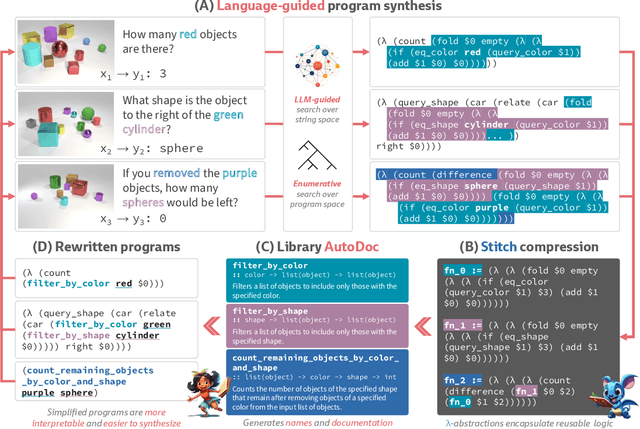
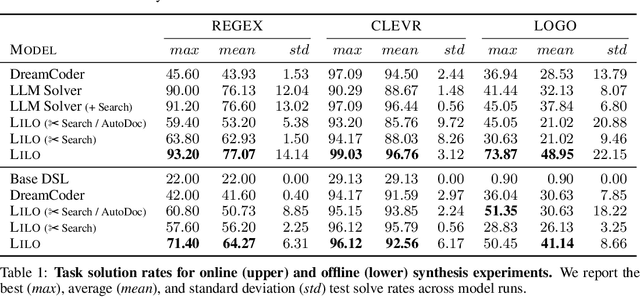
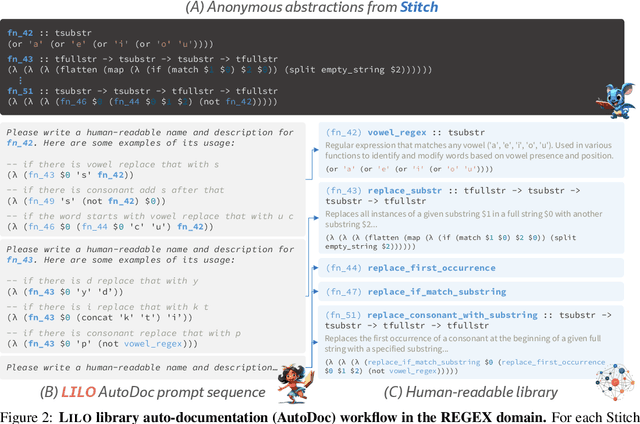
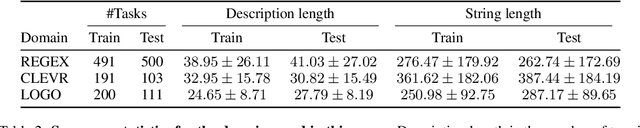
While large language models (LLMs) now excel at code generation, a key aspect of software development is the art of refactoring: consolidating code into libraries of reusable and readable programs. In this paper, we introduce LILO, a neurosymbolic framework that iteratively synthesizes, compresses, and documents code to build libraries tailored to particular problem domains. LILO combines LLM-guided program synthesis with recent algorithmic advances in automated refactoring from Stitch: a symbolic compression system that efficiently identifies optimal lambda abstractions across large code corpora. To make these abstractions interpretable, we introduce an auto-documentation (AutoDoc) procedure that infers natural language names and docstrings based on contextual examples of usage. In addition to improving human readability, we find that AutoDoc boosts performance by helping LILO's synthesizer to interpret and deploy learned abstractions. We evaluate LILO on three inductive program synthesis benchmarks for string editing, scene reasoning, and graphics composition. Compared to existing neural and symbolic methods - including the state-of-the-art library learning algorithm DreamCoder - LILO solves more complex tasks and learns richer libraries that are grounded in linguistic knowledge.
LINC: A Neurosymbolic Approach for Logical Reasoning by Combining Language Models with First-Order Logic Provers
Oct 23, 2023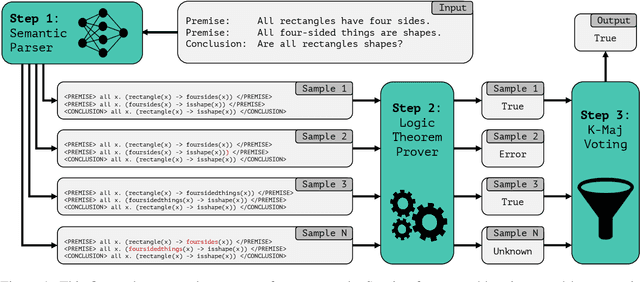
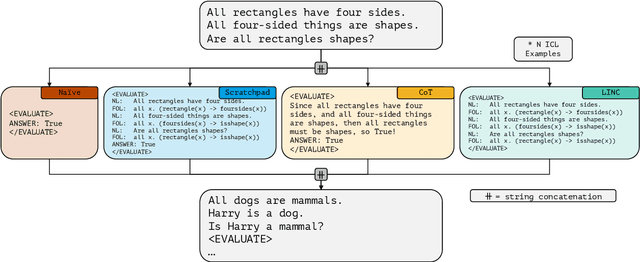
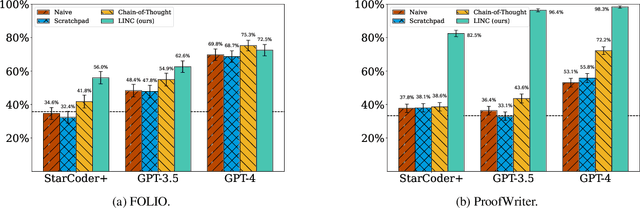
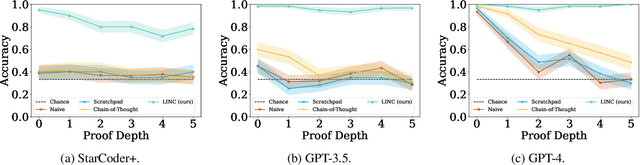
Logical reasoning, i.e., deductively inferring the truth value of a conclusion from a set of premises, is an important task for artificial intelligence with wide potential impacts on science, mathematics, and society. While many prompting-based strategies have been proposed to enable Large Language Models (LLMs) to do such reasoning more effectively, they still appear unsatisfactory, often failing in subtle and unpredictable ways. In this work, we investigate the validity of instead reformulating such tasks as modular neurosymbolic programming, which we call LINC: Logical Inference via Neurosymbolic Computation. In LINC, the LLM acts as a semantic parser, translating premises and conclusions from natural language to expressions in first-order logic. These expressions are then offloaded to an external theorem prover, which symbolically performs deductive inference. Leveraging this approach, we observe significant performance gains on FOLIO and a balanced subset of ProofWriter for three different models in nearly all experimental conditions we evaluate. On ProofWriter, augmenting the comparatively small open-source StarCoder+ (15.5B parameters) with LINC even outperforms GPT-3.5 and GPT-4 with Chain-of-Thought (CoT) prompting by an absolute 38% and 10%, respectively. When used with GPT-4, LINC scores 26% higher than CoT on ProofWriter while performing comparatively on FOLIO. Further analysis reveals that although both methods on average succeed roughly equally often on this dataset, they exhibit distinct and complementary failure modes. We thus provide promising evidence for how logical reasoning over natural language can be tackled through jointly leveraging LLMs alongside symbolic provers. All corresponding code is publicly available at https://github.com/benlipkin/linc
Demystifying GPT Self-Repair for Code Generation
Jun 22, 2023Large Language Models (LLMs) have shown remarkable aptitude in code generation but still struggle on challenging programming tasks. Self-repair -- in which the model debugs and fixes mistakes in its own code -- has recently become a popular way to boost performance in these settings. However, only very limited studies on how and when self-repair works effectively exist in the literature, and one might wonder to what extent a model is really capable of providing accurate feedback on why the code is wrong when that code was generated by the same model. In this paper, we analyze GPT-3.5 and GPT-4's ability to perform self-repair on APPS, a challenging dataset consisting of diverse coding challenges. To do so, we first establish a new evaluation strategy dubbed pass@t that measures the pass rate of the tasks against the total number of tokens sampled from the model, enabling a fair comparison to purely sampling-based approaches. With this evaluation strategy, we find that the effectiveness of self-repair is only seen in GPT-4. We also observe that self-repair is bottlenecked by the feedback stage; using GPT-4 to give feedback on the programs generated by GPT-3.5 and using expert human programmers to give feedback on the programs generated by GPT-4, we unlock significant performance gains.
Top-Down Synthesis for Library Learning
Nov 29, 2022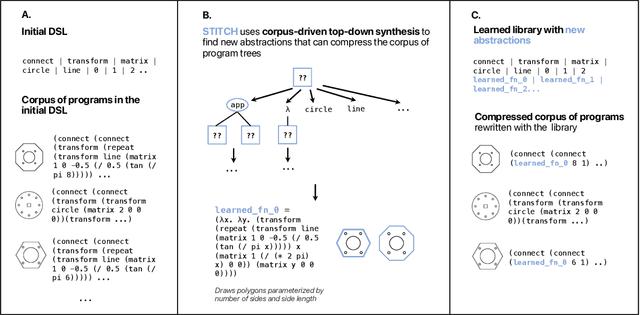
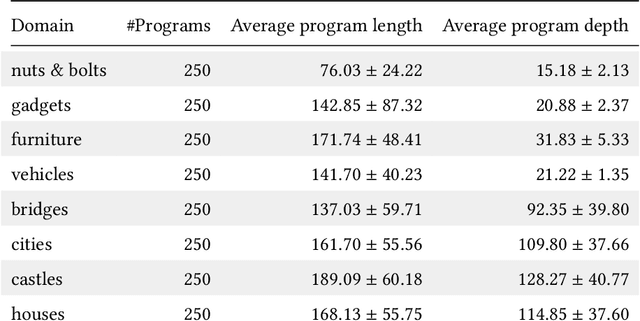
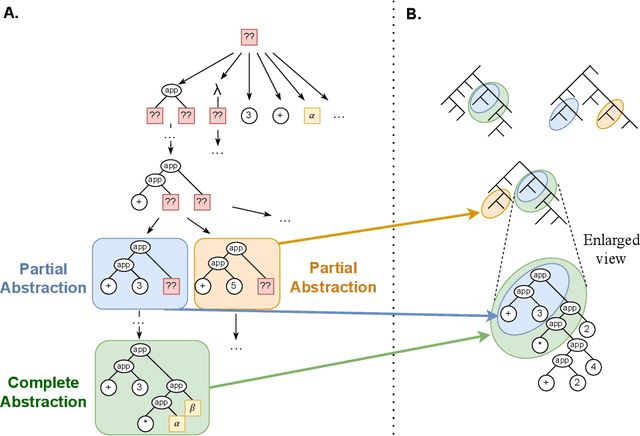
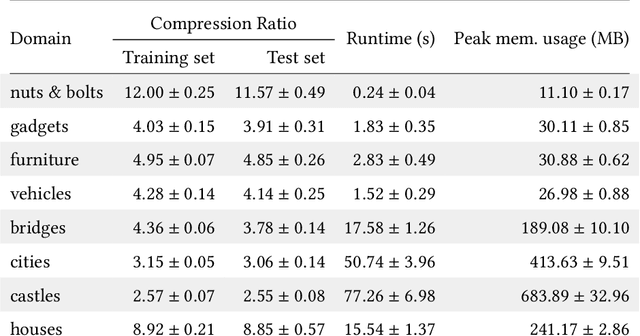
This paper introduces corpus-guided top-down synthesis as a mechanism for synthesizing library functions that capture common functionality from a corpus of programs in a domain specific language (DSL). The algorithm builds abstractions directly from initial DSL primitives, using syntactic pattern matching of intermediate abstractions to intelligently prune the search space and guide the algorithm towards abstractions that maximally capture shared structures in the corpus. We present an implementation of the approach in a tool called Stitch and evaluate it against the state-of-the-art deductive library learning algorithm from DreamCoder. Our evaluation shows that Stitch is 3-4 orders of magnitude faster and uses 2 orders of magnitude less memory while maintaining comparable or better library quality (as measured by compressivity). We also demonstrate Stitch's scalability on corpora containing hundreds of complex programs that are intractable with prior deductive approaches and show empirically that it is robust to terminating the search procedure early -- further allowing it to scale to challenging datasets by means of early stopping.