 Add to Chrome
 Add to Firefox
 Add to Edge
Online Safety Monitoring for LLMs
Jul 02, 2026
Despite alignment training, LLMs remain prone to generating unsafe outputs at deployment time. Monitoring outputs online and raising an alarm when safety can no longer be assumed is therefore critical. We study a simple real-time monitor that turns a verifier signal from an external model into an alarm decision by thresholding, with the threshold calibrated via risk control. In experiments on mathematical reasoning and red teaming datasets, we show that this simple design is competitive with more advanced monitors based on sequential hypothesis testing.

Uncertainty Estimation for Molecular Diffusion Models
Jun 11, 2026Diffusion models have seen wide adoption for 3D molecular generation, yet they offer no principled signal of when a generated molecule is likely to be of low quality. We propose a post-hoc method for estimating per-sample uncertainty in pretrained molecular diffusion models. Building on a Laplace approximation of the denoising network, we measure the variability of the noise prediction across the generation trajectory. Empirically, we show that the resulting uncertainty score is informative of sample quality, exhibiting a negative correlation with established sample-level quality metrics. We further study how the proposed uncertainty score can be used to filter generated samples, improving model performance via test-time scaling.
Re-evaluating Confidence Remasking in Masked Diffusion Language Models
Jun 10, 2026Masked diffusion language models (dLLMs) have recently emerged as a competitive alternative to autoregressive language models, with the promise of faster inference via parallel token generation. A notable limitation of the masked formulation, however, is that once a token has been unmasked it can no longer be revised, leaving dLLMs vulnerable to early sampling mistakes. To address this, a growing body of work has sought to extend masked dLLMs with self-correcting (remasking) capabilities. One appealing subset of these methods does so in a training-free, post-hoc manner based on token confidences, with encouraging early reported results. In this work, we revisit the empirical evaluation of a representative post-hoc remasking method, WINO [Hong et al., 2026], and find that under standard decoding settings (shorter block lengths) it brings little-to-no benefit over confidence-based unmasking alone [Wu et al., 2025]. Extending the evaluation to non-greedy decoding, we find that while confidence-based remasking can mitigate errors introduced by increased stochasticity to some extent, it also exacerbates the diversity collapse previously reported for confidence-based unmasking. Overall, our results show that the benefits of post-hoc confidence-based remasking are highly setting-dependent, underscoring the need for a more comprehensive evaluation framework.
Efficient and Uncertainty-Aware Diffusion Framework for Offline-to-Online Reinforcement Learning
May 29, 2026Offline-to-Online Reinforcement Learning (O2O-RL) leverages an offline, pre-trained policy to minimize costly online interactions. Although data-efficient, O2O-RL is susceptible to shifts between offline and online distributions. Existing work aims to mitigate the harm of this shift by finetuning the policy on trajectory data sampled from a diffusion model. Inspired by this line of work, we propose DUAL: an efficient \textbf{D}iffusion \textbf{U}ncertainty-\textbf{A}ware framework for offline-to-online reinforcement \textbf{L}earning. DUAL utilizes the prior knowledge of the diffusion model to distill a fast-sampling diffusion actor policy and transition model in the offline phase. DUAL also employs a Laplace approximation and distance transition-state-shift detection, thereby using uncertainty quantification to improve exploration versus exploitation in the online phase. We formally show that our actor loss with the Laplace approximation provides a proxy for a principled estimate of epistemic uncertainty. Empirically, DUAL improves the online expected return over O2O-RL baselines across multiple settings and environments.
A Tale of Two Temperatures: Simple, Efficient, and Diverse Sampling from Diffusion Language Models
Apr 10, 2026Much work has been done on designing fast and accurate sampling for diffusion language models (dLLMs). However, these efforts have largely focused on the tradeoff between speed and quality of individual samples; how to additionally ensure diversity across samples remains less well understood. In this work, we show that diversity can be increased by using softened, tempered versions of familiar confidence-based remasking heuristics, retaining their computational benefits and offering simple implementations. We motivate this approach by introducing an idealized formal model of fork tokens and studying the impact of remasking on the expected entropy at the forks. Empirically, the proposed tempered heuristics close the exploration gap (pass@k) between existing confidence-based and autoregressive sampling, hence outperforming both when controlling for cost (pass@NFE). We further study how the increase in diversity translates to downstream post-training and test-time compute scaling. Overall, our findings demonstrate that simple, efficient, and diverse sampling from dLLMs is possible.
Learning Unmasking Policies for Diffusion Language Models
Dec 12, 2025Diffusion (Large) Language Models (dLLMs) now match the downstream performance of their autoregressive counterparts on many tasks, while holding the promise of being more efficient during inference. One particularly successful variant is masked discrete diffusion, in which a buffer filled with special mask tokens is progressively replaced with tokens sampled from the model's vocabulary. Efficiency can be gained by unmasking several tokens in parallel, but doing too many at once risks degrading the generation quality. Thus, one critical design aspect of dLLMs is the sampling procedure that selects, at each step of the diffusion process, which tokens to replace. Indeed, recent work has found that heuristic strategies such as confidence thresholding lead to both higher quality and token throughput compared to random unmasking. However, such heuristics have downsides: they require manual tuning, and we observe that their performance degrades with larger buffer sizes. In this work, we instead propose to train sampling procedures using reinforcement learning. Specifically, we formalize masked diffusion sampling as a Markov decision process in which the dLLM serves as the environment, and propose a lightweight policy architecture based on a single-layer transformer that maps dLLM token confidences to unmasking decisions. Our experiments show that these trained policies match the performance of state-of-the-art heuristics when combined with semi-autoregressive generation, while outperforming them in the full diffusion setting. We also examine the transferability of these policies, finding that they can generalize to new underlying dLLMs and longer sequence lengths. However, we also observe that their performance degrades when applied to out-of-domain data, and that fine-grained tuning of the accuracy-efficiency trade-off can be challenging with our approach.
Generative Uncertainty in Diffusion Models
Feb 28, 2025



Diffusion models have recently driven significant breakthroughs in generative modeling. While state-of-the-art models produce high-quality samples on average, individual samples can still be low quality. Detecting such samples without human inspection remains a challenging task. To address this, we propose a Bayesian framework for estimating generative uncertainty of synthetic samples. We outline how to make Bayesian inference practical for large, modern generative models and introduce a new semantic likelihood (evaluated in the latent space of a feature extractor) to address the challenges posed by high-dimensional sample spaces. Through our experiments, we demonstrate that the proposed generative uncertainty effectively identifies poor-quality samples and significantly outperforms existing uncertainty-based methods. Notably, our Bayesian framework can be applied post-hoc to any pretrained diffusion or flow matching model (via the Laplace approximation), and we propose simple yet effective techniques to minimize its computational overhead during sampling.
Dynamic Vocabulary Pruning in Early-Exit LLMs
Oct 24, 2024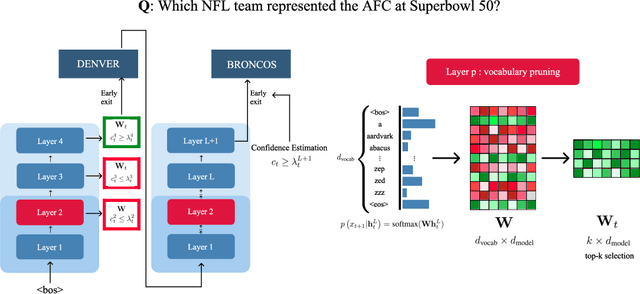
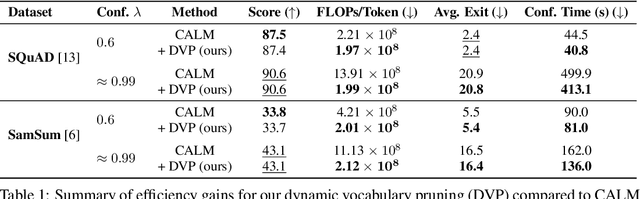
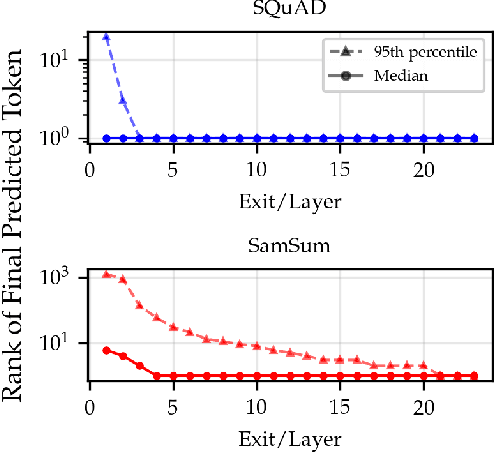
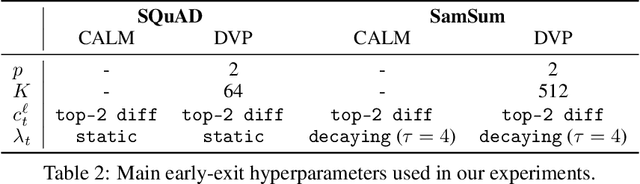
Increasing the size of large language models (LLMs) has been shown to lead to better performance. However, this comes at the cost of slower and more expensive inference. Early-exiting is a promising approach for improving the efficiency of LLM inference by enabling next token prediction at intermediate layers. Yet, the large vocabulary size in modern LLMs makes the confidence estimation required for exit decisions computationally expensive, diminishing the efficiency gains. To address this, we propose dynamically pruning the vocabulary at test time for each token. Specifically, the vocabulary is pruned at one of the initial layers, and the smaller vocabulary is then used throughout the rest of the forward pass. Our experiments demonstrate that such post-hoc dynamic vocabulary pruning improves the efficiency of confidence estimation in early-exit LLMs while maintaining competitive performance.
DuoDiff: Accelerating Diffusion Models with a Dual-Backbone Approach
Oct 12, 2024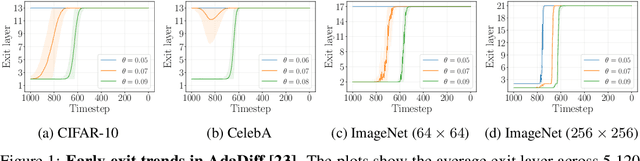

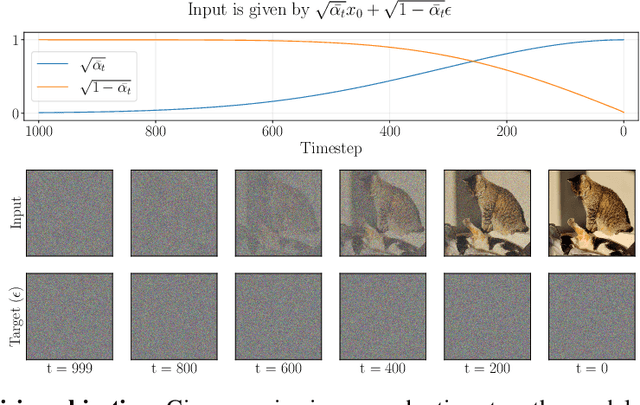
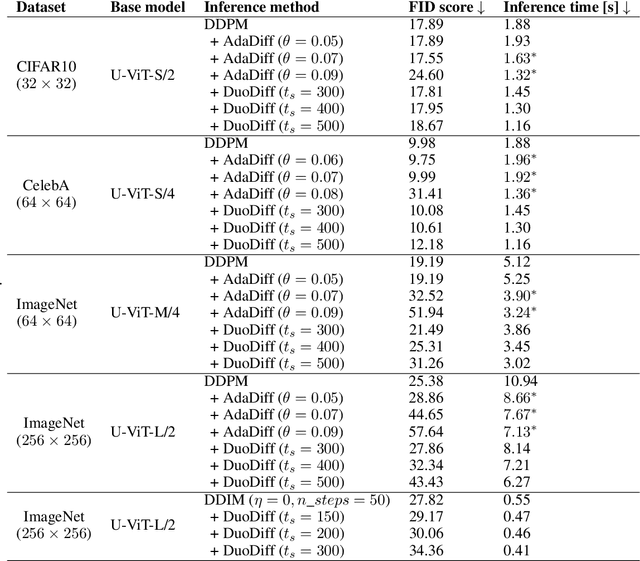
Diffusion models have achieved unprecedented performance in image generation, yet they suffer from slow inference due to their iterative sampling process. To address this, early-exiting has recently been proposed, where the depth of the denoising network is made adaptive based on the (estimated) difficulty of each sampling step. Here, we discover an interesting "phase transition" in the sampling process of current adaptive diffusion models: the denoising network consistently exits early during the initial sampling steps, until it suddenly switches to utilizing the full network. Based on this, we propose accelerating generation by employing a shallower denoising network in the initial sampling steps and a deeper network in the later steps. We demonstrate empirically that our dual-backbone approach, DuoDiff, outperforms existing early-exit diffusion methods in both inference speed and generation quality. Importantly, DuoDiff is easy to implement and complementary to existing approaches for accelerating diffusion.
Fast yet Safe: Early-Exiting with Risk Control
May 31, 2024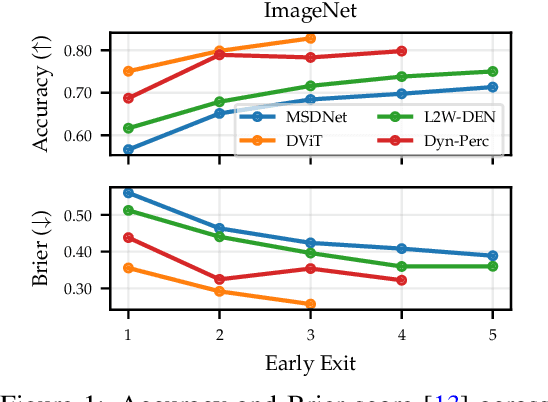
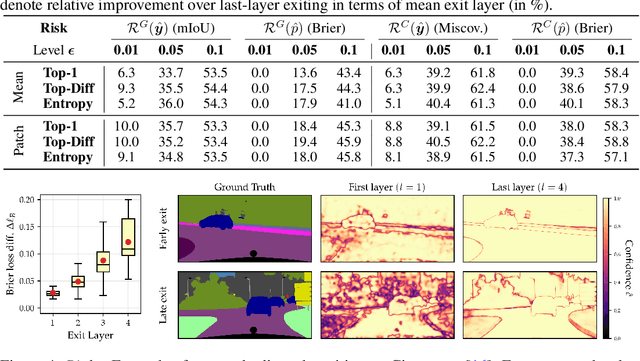
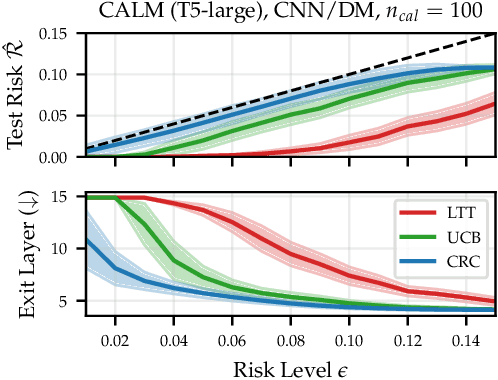
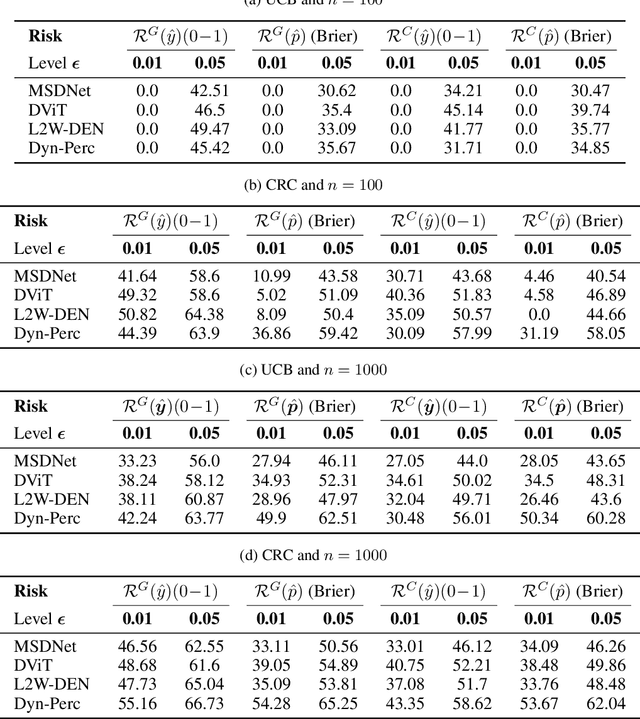
Scaling machine learning models significantly improves their performance. However, such gains come at the cost of inference being slow and resource-intensive. Early-exit neural networks (EENNs) offer a promising solution: they accelerate inference by allowing intermediate layers to exit and produce a prediction early. Yet a fundamental issue with EENNs is how to determine when to exit without severely degrading performance. In other words, when is it 'safe' for an EENN to go 'fast'? To address this issue, we investigate how to adapt frameworks of risk control to EENNs. Risk control offers a distribution-free, post-hoc solution that tunes the EENN's exiting mechanism so that exits only occur when the output is of sufficient quality. We empirically validate our insights on a range of vision and language tasks, demonstrating that risk control can produce substantial computational savings, all the while preserving user-specified performance goals.