 Add to Chrome
 Add to Firefox
 Add to Edge
Neural Structure Embedding for Symbolic Regression via Continuous Structure Search and Coefficient Optimization
Mar 23, 2026
Symbolic regression aims to discover human-interpretable equations that explain observational data. However, existing approaches rely heavily on discrete structure search (e.g., genetic programming), which often leads to high computational cost, unstable performance, and limited scalability to large equation spaces. To address these challenges, we propose SRCO, a unified embedding-driven framework for symbolic regression that transforms symbolic structures into a continuous, optimizable representation space. The framework consists of three key components: (1) structure embedding: we first generate a large pool of exploratory equations using traditional symbolic regression algorithms and train a Transformer model to compress symbolic structures into a continuous embedding space; (2) continuous structure search: the embedding space enables efficient exploration using gradient-based or sampling-based optimization, significantly reducing the cost of navigating the combinatorial structure space; and (3) coefficient optimization: for each discovered structure, we treat symbolic coefficients as learnable parameters and apply gradient optimization to obtain accurate numerical values. Experiments on synthetic and real-world datasets show that our approach consistently outperforms state-of-the-art methods in equation accuracy, robustness, and search efficiency. This work introduces a new paradigm for symbolic regression by bridging symbolic equation discovery with continuous embedding learning and optimization.

AgentOS: From Application Silos to a Natural Language-Driven Data Ecosystem
Mar 11, 2026The rapid emergence of open-source, locally hosted intelligent agents marks a critical inflection point in human-computer interaction. Systems such as OpenClaw demonstrate that Large Language Model (LLM)-based agents can autonomously operate local computing environments, orchestrate workflows, and integrate external tools. However, within the current paradigm, these agents remain conventional applications running on legacy operating systems originally designed for Graphical User Interfaces (GUIs) or Command Line Interfaces (CLIs). This architectural mismatch leads to fragmented interaction models, poorly structured permission management (often described as "Shadow AI"), and severe context fragmentation. This paper proposes a new paradigm: a Personal Agent Operating System (AgentOS). In AgentOS, traditional GUI desktops are replaced by a Natural User Interface (NUI) centered on a unified natural language or voice portal. The system core becomes an Agent Kernel that interprets user intent, decomposes tasks, and coordinates multiple agents, while traditional applications evolve into modular Skills-as-Modules enabling users to compose software through natural language rules. We argue that realizing AgentOS fundamentally becomes a Knowledge Discovery and Data Mining (KDD) problem. The Agent Kernel must operate as a real-time engine for intent mining and knowledge discovery. Viewed through this lens, the operating system becomes a continuous data mining pipeline involving sequential pattern mining for workflow automation, recommender systems for skill retrieval, and dynamically evolving personal knowledge graphs. These challenges define a new research agenda for the KDD community in building the next generation of intelligent computing systems.
Robust and Efficient Tool Orchestration via Layered Execution Structures with Reflective Correction
Feb 21, 2026Tool invocation is a core capability of agentic systems, yet failures often arise not from individual tool calls but from how multiple tools are organized and executed together. Existing approaches tightly couple tool execution with stepwise language reasoning or explicit planning, leading to brittle behavior and high execution overhead. To overcome these limitations, we revisit tool invocation from the perspective of tool orchestration. Our key insight is that effective orchestration does not require precise dependency graphs or fine-grained planning. Instead, a coarse-grained layer structure suffices to provide global guidance, while execution-time errors can be corrected locally. Specifically, we model tool orchestration as learning a layered execution structure that captures high-level tool dependencies, inducing layer-wise execution through context constraints. To handle execution-time failures, we introduce a schema-aware reflective correction mechanism that detects and repairs errors locally. This design confines errors to individual tool calls and avoids re-planning entire execution trajectories. This structured execution paradigm enables a lightweight and reusable orchestration component for agentic systems. Experimental results show that our approach achieves robust tool execution while reducing execution complexity and overhead. Code will be made publicly available.
From Queries to Insights: Agentic LLM Pipelines for Spatio-Temporal Text-to-SQL
Oct 29, 2025Natural-language-to-SQL (NL-to-SQL) systems hold promise for democratizing access to structured data, allowing users to query databases without learning SQL. Yet existing systems struggle with realistic spatio-temporal queries, where success requires aligning vague user phrasing with schema-specific categories, handling temporal reasoning, and choosing appropriate outputs. We present an agentic pipeline that extends a naive text-to-SQL baseline (llama-3-sqlcoder-8b) with orchestration by a Mistral-based ReAct agent. The agent can plan, decompose, and adapt queries through schema inspection, SQL generation, execution, and visualization tools. We evaluate on 35 natural-language queries over the NYC and Tokyo check-in dataset, covering spatial, temporal, and multi-dataset reasoning. The agent achieves substantially higher accuracy than the naive baseline 91.4% vs. 28.6% and enhances usability through maps, plots, and structured natural-language summaries. Crucially, our design enables more natural human-database interaction, supporting users who lack SQL expertise, detailed schema knowledge, or prompting skill. We conclude that agentic orchestration, rather than stronger SQL generators alone, is a promising foundation for interactive geospatial assistants.
Towards Data-Centric AI: A Comprehensive Survey of Traditional, Reinforcement, and Generative Approaches for Tabular Data Transformation
Jan 17, 2025

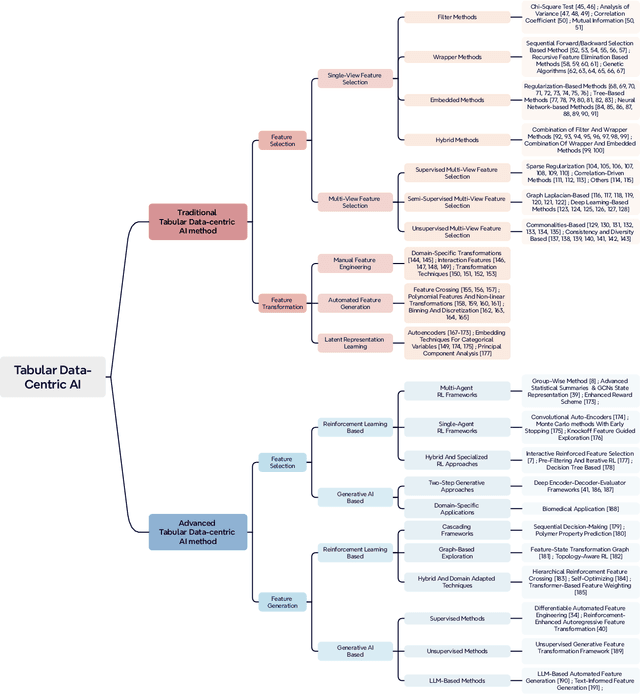

Tabular data is one of the most widely used formats across industries, driving critical applications in areas such as finance, healthcare, and marketing. In the era of data-centric AI, improving data quality and representation has become essential for enhancing model performance, particularly in applications centered around tabular data. This survey examines the key aspects of tabular data-centric AI, emphasizing feature selection and feature generation as essential techniques for data space refinement. We provide a systematic review of feature selection methods, which identify and retain the most relevant data attributes, and feature generation approaches, which create new features to simplify the capture of complex data patterns. This survey offers a comprehensive overview of current methodologies through an analysis of recent advancements, practical applications, and the strengths and limitations of these techniques. Finally, we outline open challenges and suggest future perspectives to inspire continued innovation in this field.