 Add to Chrome
 Add to Firefox
 Add to Edge
BFS: Back-to-Front Layered Image Synthesis via Knowledge Transfer
May 24, 2026
As generative models expand the possibilities of visual content creation, layered image synthesis has emerged as a promising direction for controllable and creative editing. However, existing methods struggle to fully realize this potential. Decomposition-based methods often struggle with clean separation, while generation-based methods suffer from difficulty in training data acquisition, reducing quality and scene diversity. In this paper, we propose BFS, a novel generation-based framework for layered image synthesis. Specifically, given a background image and user guidance, BFS synthesizes a foreground layer that incorporates not only a foreground object but also its associated visual effects, such as shadows and reflections, while seamlessly harmonizing with the background to produce a coherent composite. To enable diverse and high-quality foreground layer synthesis while overcoming data scarcity, we leverage the comparatively easy-to-learn knowledge of unlayered image synthesis for the foreground synthesis. To this end, we adopt a dual-branch diffusion framework in which two interconnected branches generate a composite image and a foreground layer, respectively, enabling bidirectional knowledge transfer. Based on this framework, we propose a two-stage training scheme that utilizes a high-quality unlayered composite image dataset to effectively enhance foreground quality. Extensive experiments, including a user study, show that BFS produces high-quality layered images, consistently outperforming prior methods.

EPIC: Efficient Predicate-Guided Inference-Time Control for Compositional Text-to-Image Generation
May 12, 2026Recent text-to-image (T2I) generators can synthesize realistic images, but still struggle with compositional prompts involving multiple objects, counts, attributes, and relations. We introduce EPIC (Efficient Predicate-Guided Inference-Time Control), a training-free inference-time refinement framework for compositional T2I generation. EPIC casts refinement as predicate-guided search: it parses the original prompt once into a fixed visual program of object variables and typed predicates, covering checkable conditions such as object presence, counts, attributes, and relations. Each generated or edited image is verified against this program using visual evidence extracted from that image. An image is judged to satisfy the prompt only when all predicates are satisfied; otherwise, failed predicates decide the next step, routing local failures to targeted editing and global failures to resampling while the fixed visual program remains unchanged. On GenEval2, EPIC improves prompt-level accuracy from 34.16% for single-pass generation with the base generator to 71.46%. Under the same generator/editor setting and maximum image-model execution budget, EPIC outperforms the strongest prior refinement baseline by 19.23 points while reducing realized cost by 31% in image-model executions, 72% in MLLM calls, and 81% in MLLM tokens per prompt.
POS-ISP: Pipeline Optimization at the Sequence Level for Task-aware ISP
Apr 08, 2026Recent work has explored optimizing image signal processing (ISP) pipelines for various tasks by composing predefined modules and adapting them to task-specific objectives. However, jointly optimizing module sequences and parameters remains challenging. Existing approaches rely on neural architecture search (NAS) or step-wise reinforcement learning (RL), but NAS suffers from a training-inference mismatch, while step-wise RL leads to unstable training and high computational overhead due to stage-wise decision-making. We propose POS-ISP, a sequence-level RL framework that formulates modular ISP optimization as a global sequence prediction problem. Our method predicts the entire module sequence and its parameters in a single forward pass and optimizes the pipeline using a terminal task reward, eliminating the need for intermediate supervision and redundant executions. Experiments across multiple downstream tasks show that POS-ISP improves task performance while reducing computational cost, highlighting sequence-level optimization as a stable and efficient paradigm for task-aware ISP. The project page is available at https://w1jyun.github.io/POS-ISP
DynaVid: Learning to Generate Highly Dynamic Videos using Synthetic Motion Data
Apr 02, 2026Despite recent progress, video diffusion models still struggle to synthesize realistic videos involving highly dynamic motions or requiring fine-grained motion controllability. A central limitation lies in the scarcity of such examples in commonly used training datasets. To address this, we introduce DynaVid, a video synthesis framework that leverages synthetic motion data in training, which is represented as optical flow and rendered using computer graphics pipelines. This approach offers two key advantages. First, synthetic motion offers diverse motion patterns and precise control signals that are difficult to obtain from real data. Second, unlike rendered videos with artificial appearances, rendered optical flow encodes only motion and is decoupled from appearance, thereby preventing models from reproducing the unnatural look of synthetic videos. Building on this idea, DynaVid adopts a two-stage generation framework: a motion generator first synthesizes motion, and then a motion-guided video generator produces video frames conditioned on that motion. This decoupled formulation enables the model to learn dynamic motion patterns from synthetic data while preserving visual realism from real-world videos. We validate our framework on two challenging scenarios, vigorous human motion generation and extreme camera motion control, where existing datasets are particularly limited. Extensive experiments demonstrate that DynaVid improves the realism and controllability in dynamic motion generation and camera motion control.
Dynamic Exposure Burst Image Restoration
Mar 23, 2026Burst image restoration aims to reconstruct a high-quality image from burst images, which are typically captured using manually designed exposure settings. Although these exposure settings significantly influence the final restoration performance, the problem of finding optimal exposure settings has been overlooked. In this paper, we present Dynamic Exposure Burst Image Restoration (DEBIR), a novel burst image restoration pipeline that enhances restoration quality by dynamically predicting exposure times tailored to the shooting environment. In our pipeline, Burst Auto-Exposure Network (BAENet) estimates the optimal exposure time for each burst image based on a preview image, as well as motion magnitude and gain. Subsequently, a burst image restoration network reconstructs a high-quality image from burst images captured using these optimal exposure times. For training, we introduce a differentiable burst simulator and a three-stage training strategy. Our experiments demonstrate that our pipeline achieves state-of-the-art restoration quality. Furthermore, we validate the effectiveness of our approach on a real-world camera system, demonstrating its practicality.
Edge-Aware Image Manipulation via Diffusion Models with a Novel Structure-Preservation Loss
Jan 23, 2026Recent advances in image editing leverage latent diffusion models (LDMs) for versatile, text-prompt-driven edits across diverse tasks. Yet, maintaining pixel-level edge structures-crucial for tasks such as photorealistic style transfer or image tone adjustment-remains as a challenge for latent-diffusion-based editing. To overcome this limitation, we propose a novel Structure Preservation Loss (SPL) that leverages local linear models to quantify structural differences between input and edited images. Our training-free approach integrates SPL directly into the diffusion model's generative process to ensure structural fidelity. This core mechanism is complemented by a post-processing step to mitigate LDM decoding distortions, a masking strategy for precise edit localization, and a color preservation loss to preserve hues in unedited areas. Experiments confirm SPL enhances structural fidelity, delivering state-of-the-art performance in latent-diffusion-based image editing. Our code will be publicly released at https://github.com/gongms00/SPL.
Efficient Real-World Deblurring using Single Images: AIM 2025 Challenge Report
Oct 14, 2025This paper reviews the AIM 2025 Efficient Real-World Deblurring using Single Images Challenge, which aims to advance in efficient real-blur restoration. The challenge is based on a new test set based on the well known RSBlur dataset. Pairs of blur and degraded images in this dataset are captured using a double-camera system. Participant were tasked with developing solutions to effectively deblur these type of images while fulfilling strict efficiency constraints: fewer than 5 million model parameters and a computational budget under 200 GMACs. A total of 71 participants registered, with 4 teams finally submitting valid solutions. The top-performing approach achieved a PSNR of 31.1298 dB, showcasing the potential of efficient methods in this domain. This paper provides a comprehensive overview of the challenge, compares the proposed solutions, and serves as a valuable reference for researchers in efficient real-world image deblurring.
Elevating 3D Models: High-Quality Texture and Geometry Refinement from a Low-Quality Model
Jul 15, 2025
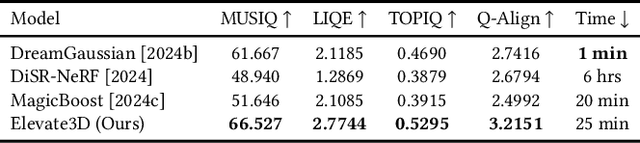
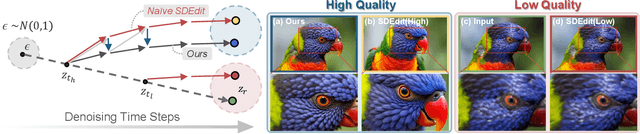
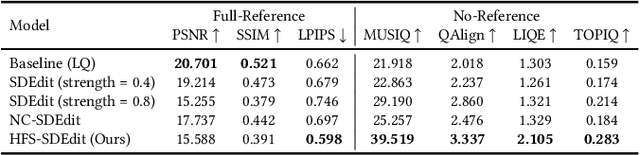
High-quality 3D assets are essential for various applications in computer graphics and 3D vision but remain scarce due to significant acquisition costs. To address this shortage, we introduce Elevate3D, a novel framework that transforms readily accessible low-quality 3D assets into higher quality. At the core of Elevate3D is HFS-SDEdit, a specialized texture enhancement method that significantly improves texture quality while preserving the appearance and geometry while fixing its degradations. Furthermore, Elevate3D operates in a view-by-view manner, alternating between texture and geometry refinement. Unlike previous methods that have largely overlooked geometry refinement, our framework leverages geometric cues from images refined with HFS-SDEdit by employing state-of-the-art monocular geometry predictors. This approach ensures detailed and accurate geometry that aligns seamlessly with the enhanced texture. Elevate3D outperforms recent competitors by achieving state-of-the-art quality in 3D model refinement, effectively addressing the scarcity of high-quality open-source 3D assets.
Subject-driven Video Generation via Disentangled Identity and Motion
Apr 23, 2025We propose to train a subject-driven customized video generation model through decoupling the subject-specific learning from temporal dynamics in zero-shot without additional tuning. A traditional method for video customization that is tuning-free often relies on large, annotated video datasets, which are computationally expensive and require extensive annotation. In contrast to the previous approach, we introduce the use of an image customization dataset directly on training video customization models, factorizing the video customization into two folds: (1) identity injection through image customization dataset and (2) temporal modeling preservation with a small set of unannotated videos through the image-to-video training method. Additionally, we employ random image token dropping with randomized image initialization during image-to-video fine-tuning to mitigate the copy-and-paste issue. To further enhance learning, we introduce stochastic switching during joint optimization of subject-specific and temporal features, mitigating catastrophic forgetting. Our method achieves strong subject consistency and scalability, outperforming existing video customization models in zero-shot settings, demonstrating the effectiveness of our framework.
Exploiting Deblurring Networks for Radiance Fields
Feb 20, 2025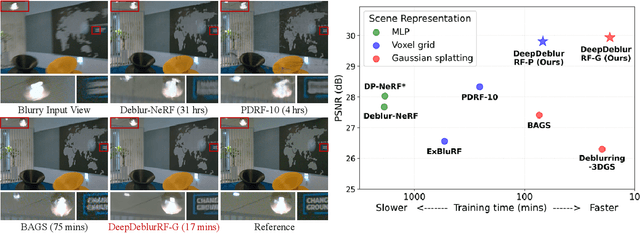
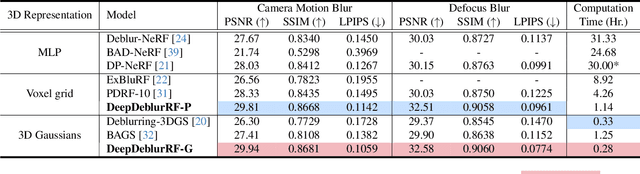
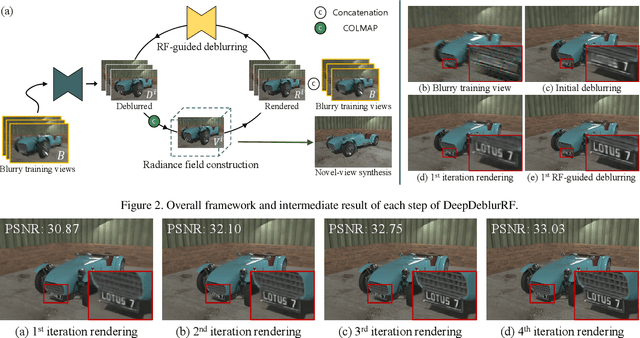
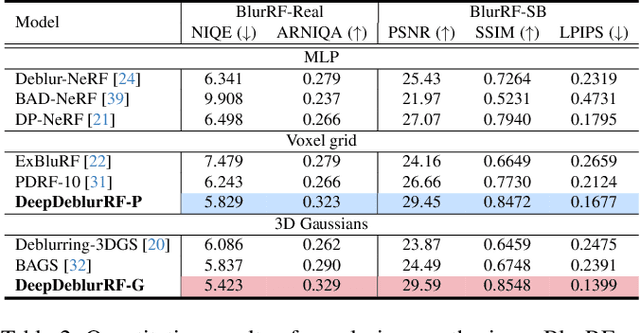
In this paper, we propose DeepDeblurRF, a novel radiance field deblurring approach that can synthesize high-quality novel views from blurred training views with significantly reduced training time. DeepDeblurRF leverages deep neural network (DNN)-based deblurring modules to enjoy their deblurring performance and computational efficiency. To effectively combine DNN-based deblurring and radiance field construction, we propose a novel radiance field (RF)-guided deblurring and an iterative framework that performs RF-guided deblurring and radiance field construction in an alternating manner. Moreover, DeepDeblurRF is compatible with various scene representations, such as voxel grids and 3D Gaussians, expanding its applicability. We also present BlurRF-Synth, the first large-scale synthetic dataset for training radiance field deblurring frameworks. We conduct extensive experiments on both camera motion blur and defocus blur, demonstrating that DeepDeblurRF achieves state-of-the-art novel-view synthesis quality with significantly reduced training time.