 Add to Chrome
 Add to Firefox
 Add to Edge
DynaVid: Learning to Generate Highly Dynamic Videos using Synthetic Motion Data
Apr 02, 2026
Despite recent progress, video diffusion models still struggle to synthesize realistic videos involving highly dynamic motions or requiring fine-grained motion controllability. A central limitation lies in the scarcity of such examples in commonly used training datasets. To address this, we introduce DynaVid, a video synthesis framework that leverages synthetic motion data in training, which is represented as optical flow and rendered using computer graphics pipelines. This approach offers two key advantages. First, synthetic motion offers diverse motion patterns and precise control signals that are difficult to obtain from real data. Second, unlike rendered videos with artificial appearances, rendered optical flow encodes only motion and is decoupled from appearance, thereby preventing models from reproducing the unnatural look of synthetic videos. Building on this idea, DynaVid adopts a two-stage generation framework: a motion generator first synthesizes motion, and then a motion-guided video generator produces video frames conditioned on that motion. This decoupled formulation enables the model to learn dynamic motion patterns from synthetic data while preserving visual realism from real-world videos. We validate our framework on two challenging scenarios, vigorous human motion generation and extreme camera motion control, where existing datasets are particularly limited. Extensive experiments demonstrate that DynaVid improves the realism and controllability in dynamic motion generation and camera motion control.

Exploiting Deblurring Networks for Radiance Fields
Feb 20, 2025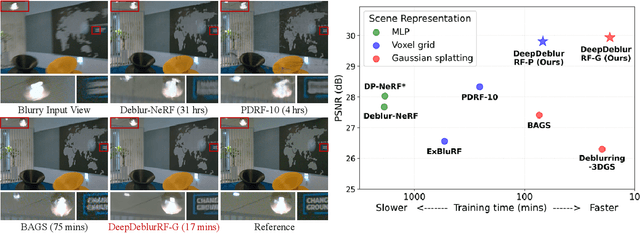
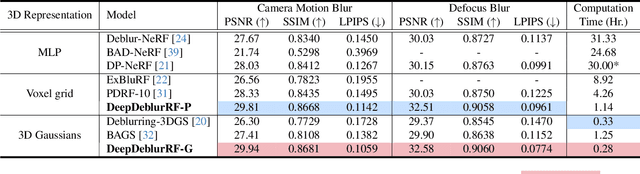
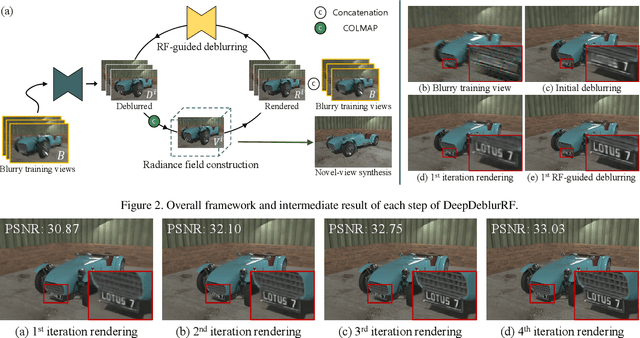
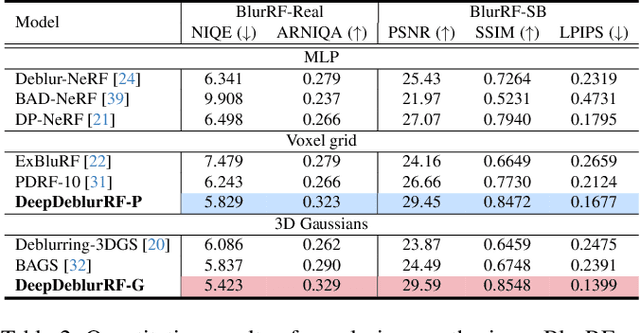
In this paper, we propose DeepDeblurRF, a novel radiance field deblurring approach that can synthesize high-quality novel views from blurred training views with significantly reduced training time. DeepDeblurRF leverages deep neural network (DNN)-based deblurring modules to enjoy their deblurring performance and computational efficiency. To effectively combine DNN-based deblurring and radiance field construction, we propose a novel radiance field (RF)-guided deblurring and an iterative framework that performs RF-guided deblurring and radiance field construction in an alternating manner. Moreover, DeepDeblurRF is compatible with various scene representations, such as voxel grids and 3D Gaussians, expanding its applicability. We also present BlurRF-Synth, the first large-scale synthetic dataset for training radiance field deblurring frameworks. We conduct extensive experiments on both camera motion blur and defocus blur, demonstrating that DeepDeblurRF achieves state-of-the-art novel-view synthesis quality with significantly reduced training time.
DC-VSR: Spatially and Temporally Consistent Video Super-Resolution with Video Diffusion Prior
Feb 05, 2025Video super-resolution (VSR) aims to reconstruct a high-resolution (HR) video from a low-resolution (LR) counterpart. Achieving successful VSR requires producing realistic HR details and ensuring both spatial and temporal consistency. To restore realistic details, diffusion-based VSR approaches have recently been proposed. However, the inherent randomness of diffusion, combined with their tile-based approach, often leads to spatio-temporal inconsistencies. In this paper, we propose DC-VSR, a novel VSR approach to produce spatially and temporally consistent VSR results with realistic textures. To achieve spatial and temporal consistency, DC-VSR adopts a novel Spatial Attention Propagation (SAP) scheme and a Temporal Attention Propagation (TAP) scheme that propagate information across spatio-temporal tiles based on the self-attention mechanism. To enhance high-frequency details, we also introduce Detail-Suppression Self-Attention Guidance (DSSAG), a novel diffusion guidance scheme. Comprehensive experiments demonstrate that DC-VSR achieves spatially and temporally consistent, high-quality VSR results, outperforming previous approaches.