 Add to Chrome
 Add to Firefox
 Add to Edge
StructureGS: Structure-aware Gaussian Splatting for Articulated Object Reconstruction
Jul 29, 2026
Reconstructing articulated objects with multiple movable parts is essential for understanding object structure and enabling physical interaction. However, this reconstruction task poses significant challenges due to the entanglement of geometry, appearance, and motion parameters during optimization. Existing methods rely primarily on photometric supervision, which commonly fails to disentangle these interdependent components, resulting in poor part decomposition with blurred boundaries and geometric artifacts. To address this limitation, we introduce StructureGS, a reconstruction framework for articulated objects that integrates structure-aware guidance into 3D Gaussian Splatting. Our approach leverages oriented bounding boxes of object parts to enforce two key structural properties: spatial coherence, which constrains each part's geometry to remain compact and spatially coherent within its designated region, and structural connectivity, which enforces physically plausible contact relationships between adjacent parts. These properties are realized through structure-aware losses that inject explicit structural constraints into the optimization process. Extensive experiments demonstrate that our method achieves state-of-the-art performance in articulated object reconstruction, producing high-quality results with well-defined part geometries.

Camera Splatting for Continuous View Optimization
Sep 19, 2025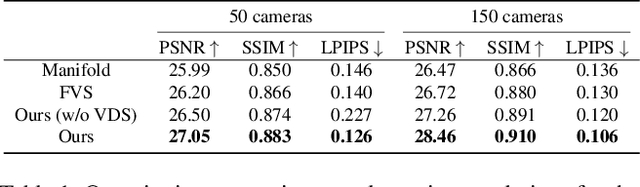
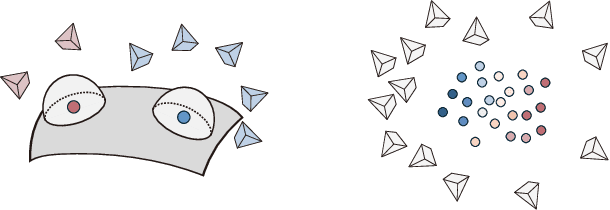
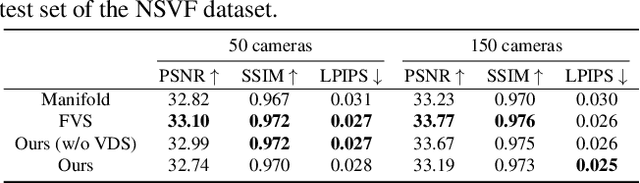
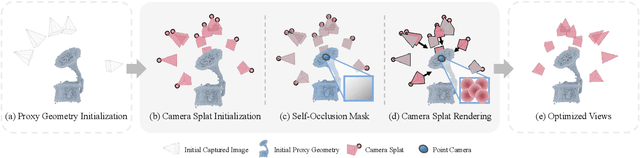
We propose Camera Splatting, a novel view optimization framework for novel view synthesis. Each camera is modeled as a 3D Gaussian, referred to as a camera splat, and virtual cameras, termed point cameras, are placed at 3D points sampled near the surface to observe the distribution of camera splats. View optimization is achieved by continuously and differentiably refining the camera splats so that desirable target distributions are observed from the point cameras, in a manner similar to the original 3D Gaussian splatting. Compared to the Farthest View Sampling (FVS) approach, our optimized views demonstrate superior performance in capturing complex view-dependent phenomena, including intense metallic reflections and intricate textures such as text.
Elevating 3D Models: High-Quality Texture and Geometry Refinement from a Low-Quality Model
Jul 15, 2025
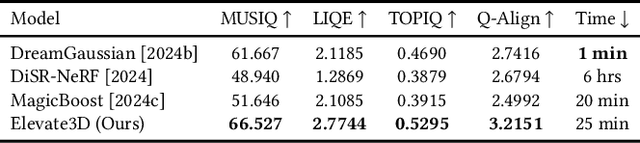
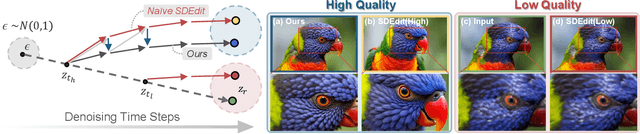
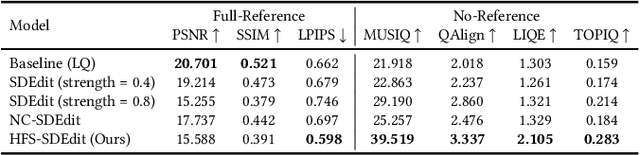
High-quality 3D assets are essential for various applications in computer graphics and 3D vision but remain scarce due to significant acquisition costs. To address this shortage, we introduce Elevate3D, a novel framework that transforms readily accessible low-quality 3D assets into higher quality. At the core of Elevate3D is HFS-SDEdit, a specialized texture enhancement method that significantly improves texture quality while preserving the appearance and geometry while fixing its degradations. Furthermore, Elevate3D operates in a view-by-view manner, alternating between texture and geometry refinement. Unlike previous methods that have largely overlooked geometry refinement, our framework leverages geometric cues from images refined with HFS-SDEdit by employing state-of-the-art monocular geometry predictors. This approach ensures detailed and accurate geometry that aligns seamlessly with the enhanced texture. Elevate3D outperforms recent competitors by achieving state-of-the-art quality in 3D model refinement, effectively addressing the scarcity of high-quality open-source 3D assets.
Controllable Garment Transfer
Apr 05, 2022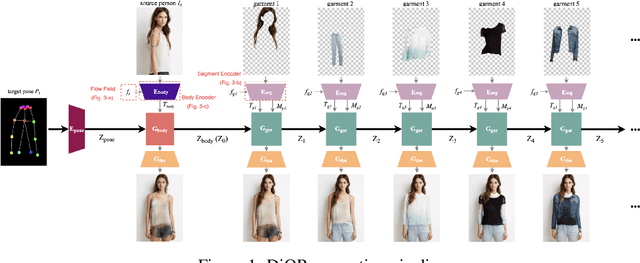
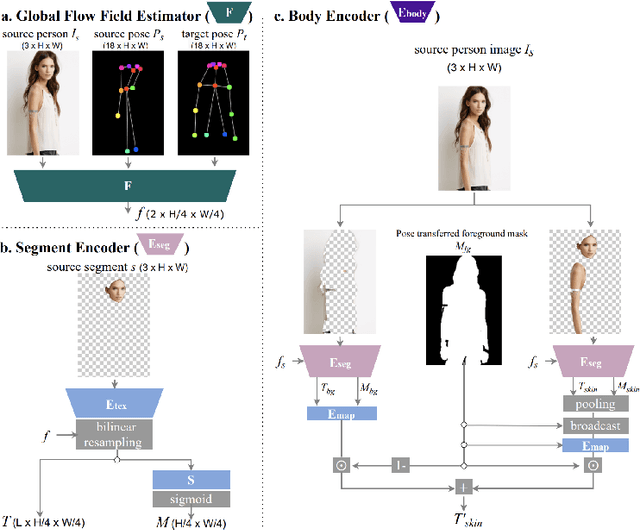
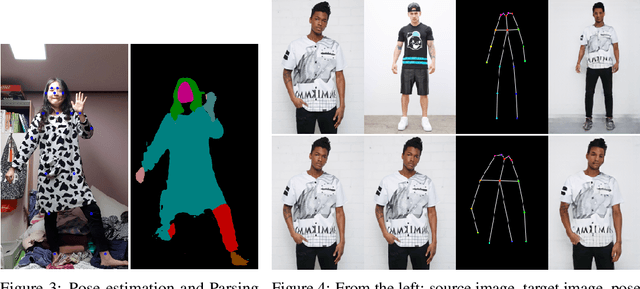
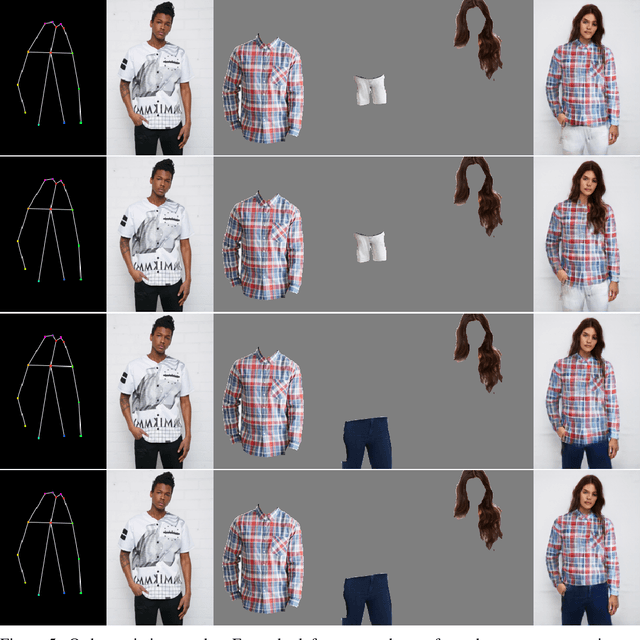
Image-based garment transfer replaces the garment on the target human with the desired garment; this enables users to virtually view themselves in the desired garment. To this end, many approaches have been proposed using the generative model and have shown promising results. However, most fail to provide the user with on the fly garment modification functionality. We aim to add this customizable option of "garment tweaking" to our model to control garment attributes, such as sleeve length, waist width, and garment texture.