 Add to Chrome
 Add to Firefox
 Add to Edge
AdaBoosting Text Prompts for Vision-Language Models
Jul 01, 2026
The classification accuracy of pretrained Vision-Language Models (VLMs) relies on the quality of the text prompts. Handcrafted templates and Large Language Model (LLM)-generated descriptions not only make predictions more interpretable, but also enable reuse of the same prompts across heterogeneous VLMs. Recent works construct task-adapted text prompts with a small number of labeled images. However, existing few-shot text prompting methods do not explicitly focus on misclassified examples during prompt construction, leading to only marginal improvements even as more shots become available. To fully exploit few-shot supervision, we propose Text Prompt Boosting (TPB), an AdaBoost-inspired framework that treats each text-prompt-based classifier as a weak learner and sequentially aggregates them into a strong ensemble by explicitly targeting hard, misclassified examples. Extensive experiments show that TPB preserves task-intrinsic, model-agnostic cues in text space, enabling robust cross-model transfer. Across eleven classification benchmarks, TPB improves accuracy on the source model and preserves shot-driven gains when transferred to larger, more capable VLMs, where existing methods struggle to sustain such improvements.

Towards Faithful Agentic XAI: A Verification Method and an Open-World Benchmark for Better Model Faithfulness
May 27, 2026Explainable AI (XAI) helps users interpret model behavior and identify potential faults. Agentic XAI systems use Large Language Models (LLMs) to make explanations more accessible through natural-language interaction, but they can also produce plausible yet unfaithful explanations. This risk arises because unreliable XAI outputs for complex models can be amplified by LLMs and mislead users. We propose Faithful Agentic XAI (FAX), a framework that improves explanation faithfulness through explicit verification. FAX decomposes draft explanations into claims and cross-checks them against inherently faithful tools, filtering unsupported or contradictory claims before final generation. We also introduce CRAFTER-XAI-Bench, an open-world reinforcement learning benchmark with complex policies, diverse goals, and challenging scenarios for assessing model-specific faithfulness. On CRAFTER-XAI-Bench, FAX improves simulation faithfulness from 0.20 for the strongest baseline to 0.46 while maintaining high informativeness, relevance, and fluency. On three tabular benchmarks, FAX performs competitively with prior Agentic XAI baselines, but our analysis shows that these settings can conflate task accuracy with model-specific faithfulness. These findings show that explicit verification is essential for faithful Agentic XAI and that that faithfulness benchmarks must be designed to test explanations against the behavior of the target model itself.
EPIC: Efficient Predicate-Guided Inference-Time Control for Compositional Text-to-Image Generation
May 12, 2026Recent text-to-image (T2I) generators can synthesize realistic images, but still struggle with compositional prompts involving multiple objects, counts, attributes, and relations. We introduce EPIC (Efficient Predicate-Guided Inference-Time Control), a training-free inference-time refinement framework for compositional T2I generation. EPIC casts refinement as predicate-guided search: it parses the original prompt once into a fixed visual program of object variables and typed predicates, covering checkable conditions such as object presence, counts, attributes, and relations. Each generated or edited image is verified against this program using visual evidence extracted from that image. An image is judged to satisfy the prompt only when all predicates are satisfied; otherwise, failed predicates decide the next step, routing local failures to targeted editing and global failures to resampling while the fixed visual program remains unchanged. On GenEval2, EPIC improves prompt-level accuracy from 34.16% for single-pass generation with the base generator to 71.46%. Under the same generator/editor setting and maximum image-model execution budget, EPIC outperforms the strongest prior refinement baseline by 19.23 points while reducing realized cost by 31% in image-model executions, 72% in MLLM calls, and 81% in MLLM tokens per prompt.
Addressing Attribute Leakages in Diffusion-based Image Editing without Training
Dec 10, 2024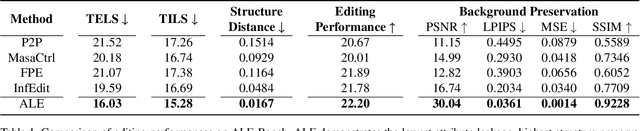
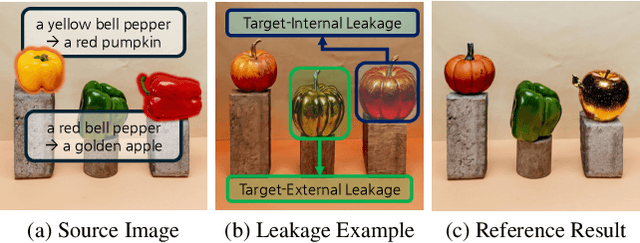

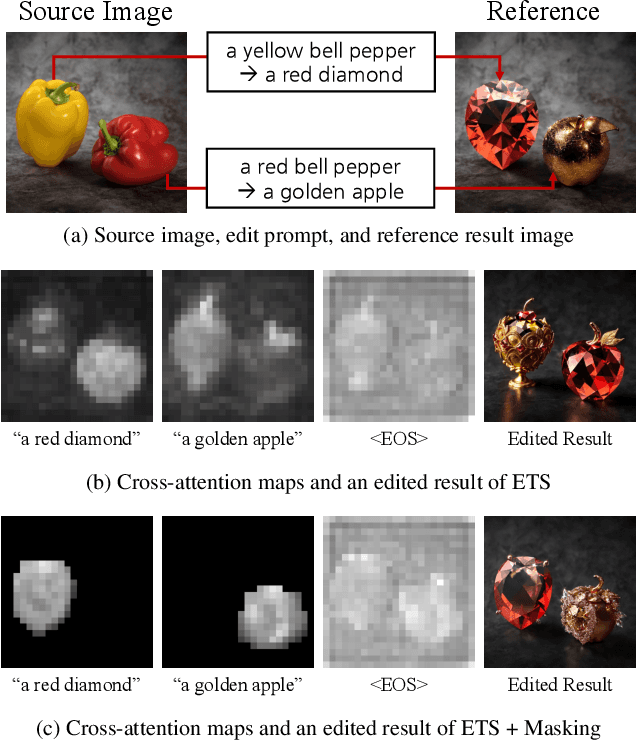
Diffusion models have become a cornerstone in image editing, offering flexibility with language prompts and source images. However, a key challenge is attribute leakage, where unintended modifications occur in non-target regions or within target regions due to attribute interference. Existing methods often suffer from leakage due to naive text embeddings and inadequate handling of End-of-Sequence (EOS) token embeddings. To address this, we propose ALE-Edit (Attribute-leakage-free editing), a novel framework to minimize attribute leakage with three components: (1) Object-Restricted Embeddings (ORE) to localize object-specific attributes in text embeddings, (2) Region-Guided Blending for Cross-Attention Masking (RGB-CAM) to align attention with target regions, and (3) Background Blending (BB) to preserve non-edited regions. Additionally, we introduce ALE-Bench, a benchmark for evaluating attribute leakage with new metrics for target-external and target-internal leakage. Experiments demonstrate that our framework significantly reduces attribute leakage while maintaining high editing quality, providing an efficient and tuning-free solution for multi-object image editing.
MedBN: Robust Test-Time Adaptation against Malicious Test Samples
Mar 28, 2024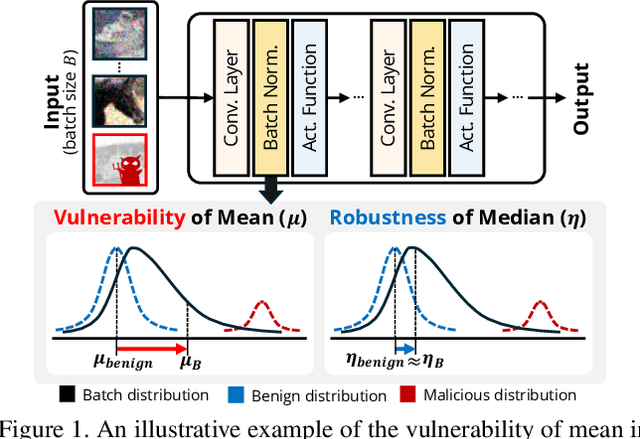
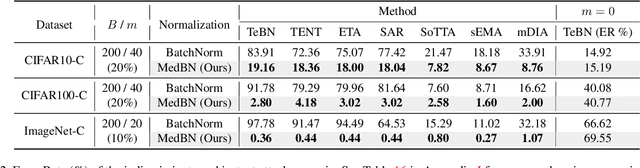
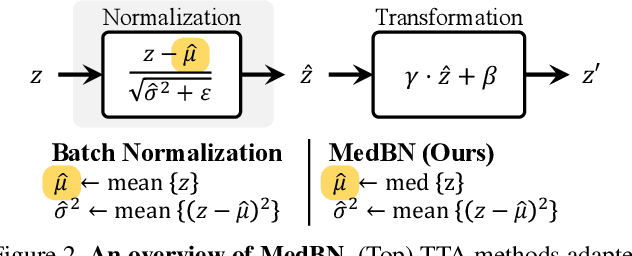
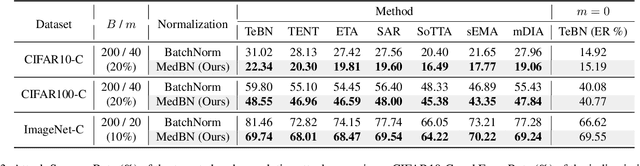
Test-time adaptation (TTA) has emerged as a promising solution to address performance decay due to unforeseen distribution shifts between training and test data. While recent TTA methods excel in adapting to test data variations, such adaptability exposes a model to vulnerability against malicious examples, an aspect that has received limited attention. Previous studies have uncovered security vulnerabilities within TTA even when a small proportion of the test batch is maliciously manipulated. In response to the emerging threat, we propose median batch normalization (MedBN), leveraging the robustness of the median for statistics estimation within the batch normalization layer during test-time inference. Our method is algorithm-agnostic, thus allowing seamless integration with existing TTA frameworks. Our experimental results on benchmark datasets, including CIFAR10-C, CIFAR100-C and ImageNet-C, consistently demonstrate that MedBN outperforms existing approaches in maintaining robust performance across different attack scenarios, encompassing both instant and cumulative attacks. Through extensive experiments, we show that our approach sustains the performance even in the absence of attacks, achieving a practical balance between robustness and performance.