 Add to Chrome
 Add to Firefox
 Add to Edge
BFS: Back-to-Front Layered Image Synthesis via Knowledge Transfer
May 24, 2026
As generative models expand the possibilities of visual content creation, layered image synthesis has emerged as a promising direction for controllable and creative editing. However, existing methods struggle to fully realize this potential. Decomposition-based methods often struggle with clean separation, while generation-based methods suffer from difficulty in training data acquisition, reducing quality and scene diversity. In this paper, we propose BFS, a novel generation-based framework for layered image synthesis. Specifically, given a background image and user guidance, BFS synthesizes a foreground layer that incorporates not only a foreground object but also its associated visual effects, such as shadows and reflections, while seamlessly harmonizing with the background to produce a coherent composite. To enable diverse and high-quality foreground layer synthesis while overcoming data scarcity, we leverage the comparatively easy-to-learn knowledge of unlayered image synthesis for the foreground synthesis. To this end, we adopt a dual-branch diffusion framework in which two interconnected branches generate a composite image and a foreground layer, respectively, enabling bidirectional knowledge transfer. Based on this framework, we propose a two-stage training scheme that utilizes a high-quality unlayered composite image dataset to effectively enhance foreground quality. Extensive experiments, including a user study, show that BFS produces high-quality layered images, consistently outperforming prior methods.

DC-VSR: Spatially and Temporally Consistent Video Super-Resolution with Video Diffusion Prior
Feb 05, 2025Video super-resolution (VSR) aims to reconstruct a high-resolution (HR) video from a low-resolution (LR) counterpart. Achieving successful VSR requires producing realistic HR details and ensuring both spatial and temporal consistency. To restore realistic details, diffusion-based VSR approaches have recently been proposed. However, the inherent randomness of diffusion, combined with their tile-based approach, often leads to spatio-temporal inconsistencies. In this paper, we propose DC-VSR, a novel VSR approach to produce spatially and temporally consistent VSR results with realistic textures. To achieve spatial and temporal consistency, DC-VSR adopts a novel Spatial Attention Propagation (SAP) scheme and a Temporal Attention Propagation (TAP) scheme that propagate information across spatio-temporal tiles based on the self-attention mechanism. To enhance high-frequency details, we also introduce Detail-Suppression Self-Attention Guidance (DSSAG), a novel diffusion guidance scheme. Comprehensive experiments demonstrate that DC-VSR achieves spatially and temporally consistent, high-quality VSR results, outperforming previous approaches.
LayeringDiff: Layered Image Synthesis via Generation, then Disassembly with Generative Knowledge
Jan 02, 2025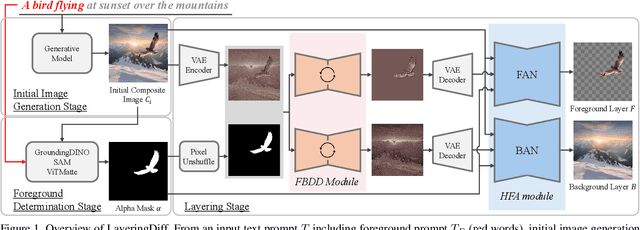

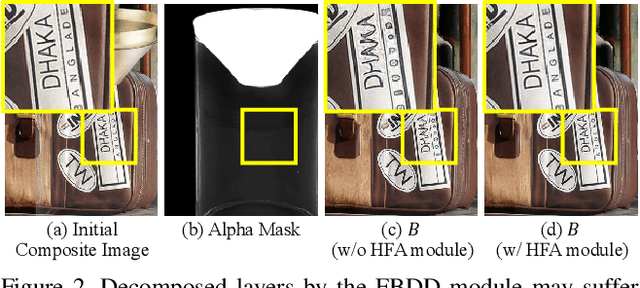
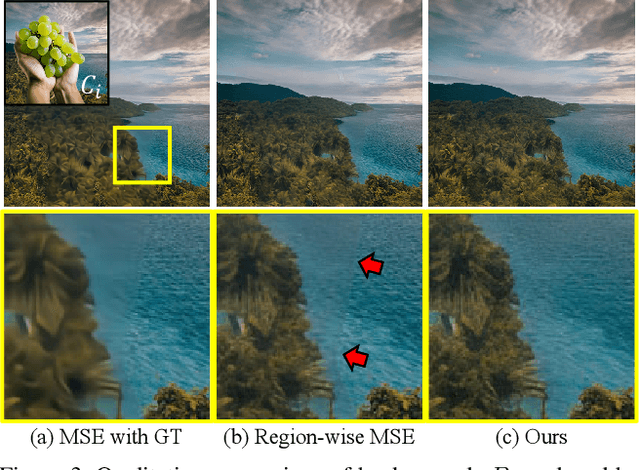
Layers have become indispensable tools for professional artists, allowing them to build a hierarchical structure that enables independent control over individual visual elements. In this paper, we propose LayeringDiff, a novel pipeline for the synthesis of layered images, which begins by generating a composite image using an off-the-shelf image generative model, followed by disassembling the image into its constituent foreground and background layers. By extracting layers from a composite image, rather than generating them from scratch, LayeringDiff bypasses the need for large-scale training to develop generative capabilities for individual layers. Furthermore, by utilizing a pretrained off-the-shelf generative model, our method can produce diverse contents and object scales in synthesized layers. For effective layer decomposition, we adapt a large-scale pretrained generative prior to estimate foreground and background layers. We also propose high-frequency alignment modules to refine the fine-details of the estimated layers. Our comprehensive experiments demonstrate that our approach effectively synthesizes layered images and supports various practical applications.