 Add to Chrome
 Add to Firefox
 Add to Edge
POS-ISP: Pipeline Optimization at the Sequence Level for Task-aware ISP
Apr 08, 2026
Recent work has explored optimizing image signal processing (ISP) pipelines for various tasks by composing predefined modules and adapting them to task-specific objectives. However, jointly optimizing module sequences and parameters remains challenging. Existing approaches rely on neural architecture search (NAS) or step-wise reinforcement learning (RL), but NAS suffers from a training-inference mismatch, while step-wise RL leads to unstable training and high computational overhead due to stage-wise decision-making. We propose POS-ISP, a sequence-level RL framework that formulates modular ISP optimization as a global sequence prediction problem. Our method predicts the entire module sequence and its parameters in a single forward pass and optimizes the pipeline using a terminal task reward, eliminating the need for intermediate supervision and redundant executions. Experiments across multiple downstream tasks show that POS-ISP improves task performance while reducing computational cost, highlighting sequence-level optimization as a stable and efficient paradigm for task-aware ISP. The project page is available at https://w1jyun.github.io/POS-ISP

Exploiting Deblurring Networks for Radiance Fields
Feb 20, 2025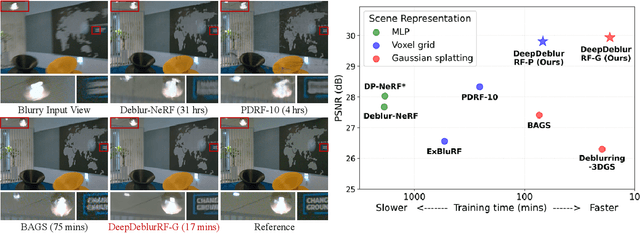
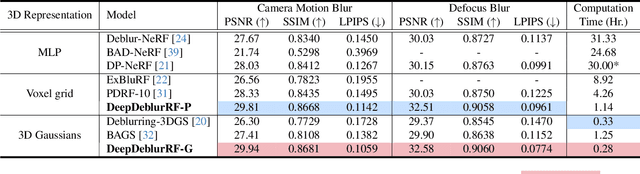
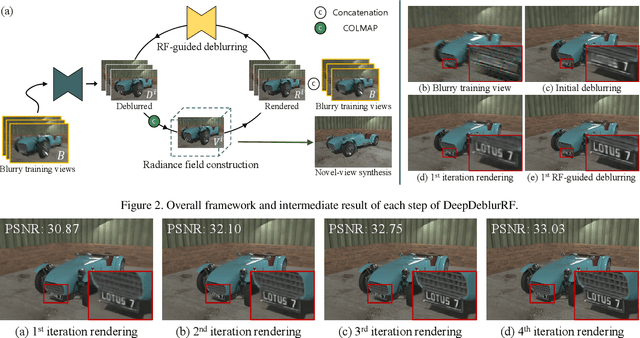
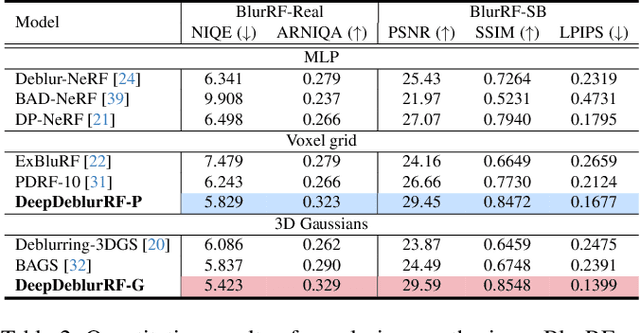
In this paper, we propose DeepDeblurRF, a novel radiance field deblurring approach that can synthesize high-quality novel views from blurred training views with significantly reduced training time. DeepDeblurRF leverages deep neural network (DNN)-based deblurring modules to enjoy their deblurring performance and computational efficiency. To effectively combine DNN-based deblurring and radiance field construction, we propose a novel radiance field (RF)-guided deblurring and an iterative framework that performs RF-guided deblurring and radiance field construction in an alternating manner. Moreover, DeepDeblurRF is compatible with various scene representations, such as voxel grids and 3D Gaussians, expanding its applicability. We also present BlurRF-Synth, the first large-scale synthetic dataset for training radiance field deblurring frameworks. We conduct extensive experiments on both camera motion blur and defocus blur, demonstrating that DeepDeblurRF achieves state-of-the-art novel-view synthesis quality with significantly reduced training time.
Gyro-based Neural Single Image Deblurring
Apr 08, 2024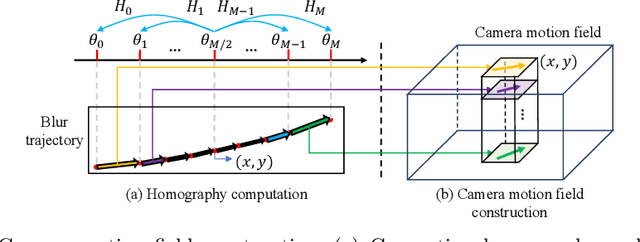
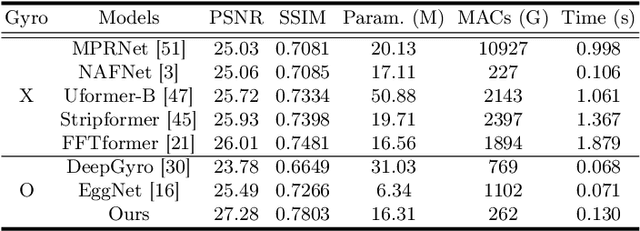
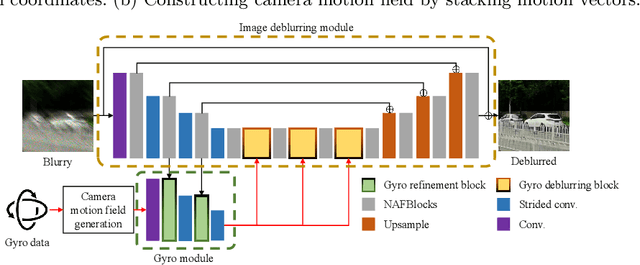
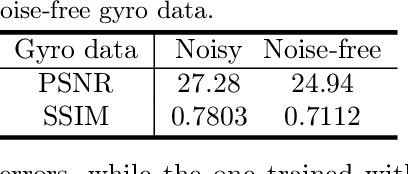
In this paper, we present GyroDeblurNet, a novel single image deblurring method that utilizes a gyro sensor to effectively resolve the ill-posedness of image deblurring. The gyro sensor provides valuable information about camera motion during exposure time that can significantly improve deblurring quality. However, effectively exploiting real-world gyro data is challenging due to significant errors from various sources including sensor noise, the disparity between the positions of a camera module and a gyro sensor, the absence of translational motion information, and moving objects whose motions cannot be captured by a gyro sensor. To handle gyro error, GyroDeblurNet is equipped with two novel neural network blocks: a gyro refinement block and a gyro deblurring block. The gyro refinement block refines the error-ridden gyro data using the blur information from the input image. On the other hand, the gyro deblurring block removes blur from the input image using the refined gyro data and further compensates for gyro error by leveraging the blur information from the input image. For training a neural network with erroneous gyro data, we propose a training strategy based on the curriculum learning. We also introduce a novel gyro data embedding scheme to represent real-world intricate camera shakes. Finally, we present a synthetic dataset and a real dataset for the training and evaluation of gyro-based single image deblurring. Our experiments demonstrate that our approach achieves state-of-the-art deblurring quality by effectively utilizing erroneous gyro data.
Deep Hybrid Camera Deblurring
Dec 20, 2023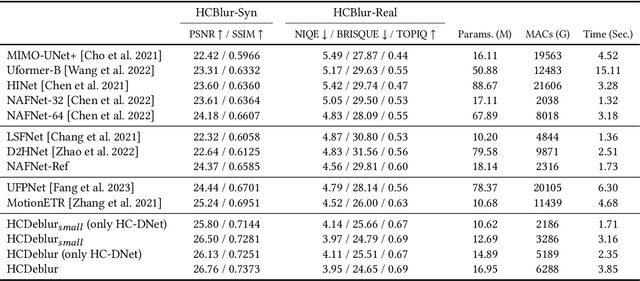
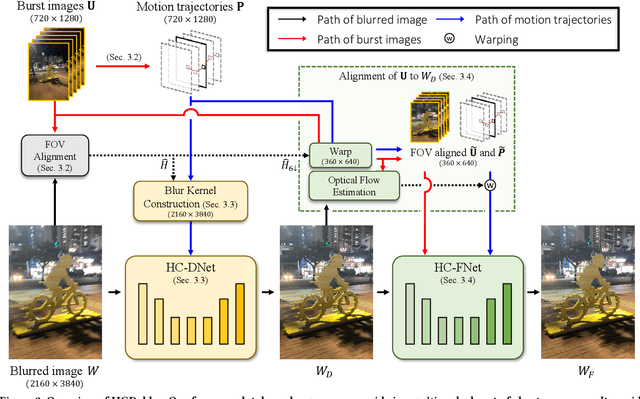
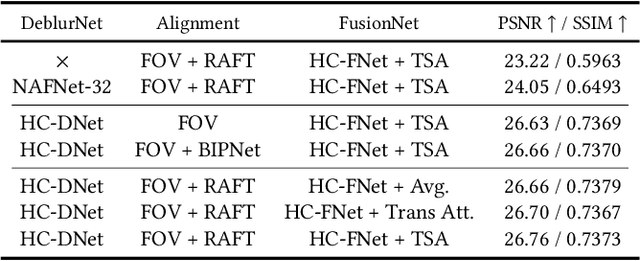
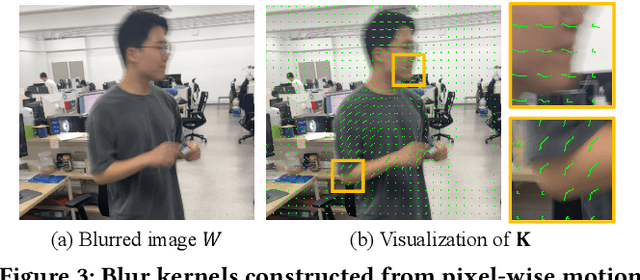
Mobile cameras, despite their significant advancements, still face low-light challenges due to compact sensors and lenses, leading to longer exposures and motion blur. Traditional solutions like blind deconvolution and learning-based methods often fall short in handling ill-posedness of the deblurring problem. To address this, we propose a novel deblurring framework for multi-camera smartphones, utilizing a hybrid imaging technique. We simultaneously capture a long exposure wide-angle image and ultra-wide burst images from a smartphone, and use the sharp burst to estimate blur kernels for deblurring the wide-angle image. For learning and evaluation of our network, we introduce the HCBlur dataset, which includes pairs of blurry wide-angle and sharp ultra-wide burst images, and their sharp wide-angle counterparts. We extensively evaluate our method, and the result shows the state-of-the-art quality.