 Add to Chrome
 Add to Firefox
 Add to Edge
CasDeblurGS: Cascaded 2D-to-3D Multi-View Consistency for 3D Gaussian Splatting from Two Blurry Images
Aug 11, 2026
Free-viewpoint 3D scene media is increasingly important for immersive applications, yet practical capture often suffers from severe view sparsity and motion blur. Although neural rendering has advanced sparse-view synthesis, existing blur-aware methods typically require substantial multi-view redundancy, accurate camera poses, or costly per-scene optimization. We address a stringent yet practical setting: reconstructing a coherent 3D scene from only two motion-blurred images with known intrinsics, without input-view poses, auxiliary sharp images, or per-scene test-time optimization. To this end, we propose CasDeblurGS, a cascaded framework that progressively recovers reliable cross-view information from local 2D correspondences to global 3D guidance. Stage 1 constructs locally reliable guidance through occlusion-aware correspondence filtering, while Stage 2 aggregates the intermediate restorations into a provisional pose-free 3D Gaussian representation whose input-view re-renders provide dense global guidance for final restoration. The resulting views enable a more coherent 3D representation and higher-quality novel-view synthesis. Experiments on real-world and synthetic Deblur-NeRF scenes show consistent gains over strong baselines, improving PSNR by 1.19 dB and 2.11 dB, respectively. Progressive ablations, cross-view correspondence visualization, and camera reprojection analysis further demonstrate improvements in both rendering quality and multi-view geometric consistency.

Exploiting Deblurring Networks for Radiance Fields
Feb 20, 2025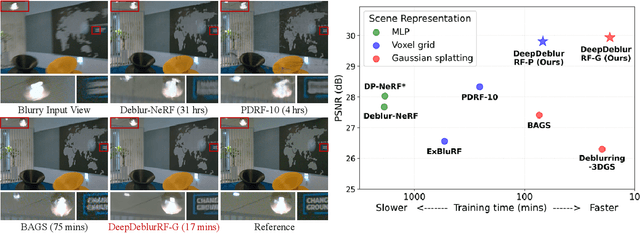
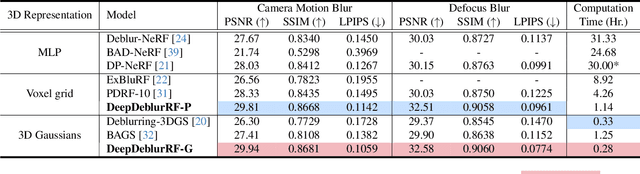
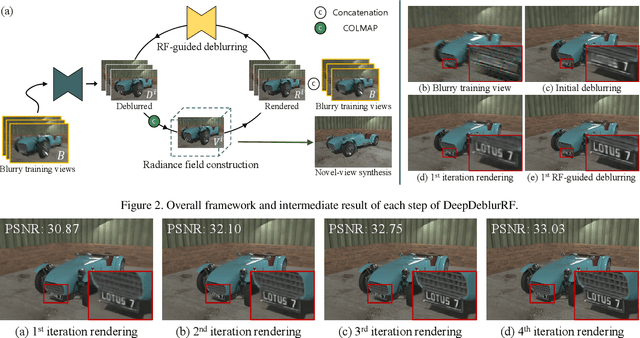
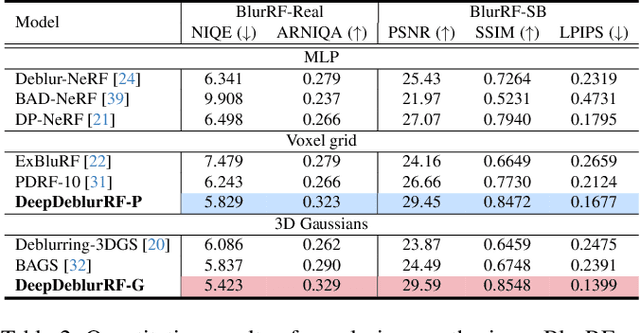
In this paper, we propose DeepDeblurRF, a novel radiance field deblurring approach that can synthesize high-quality novel views from blurred training views with significantly reduced training time. DeepDeblurRF leverages deep neural network (DNN)-based deblurring modules to enjoy their deblurring performance and computational efficiency. To effectively combine DNN-based deblurring and radiance field construction, we propose a novel radiance field (RF)-guided deblurring and an iterative framework that performs RF-guided deblurring and radiance field construction in an alternating manner. Moreover, DeepDeblurRF is compatible with various scene representations, such as voxel grids and 3D Gaussians, expanding its applicability. We also present BlurRF-Synth, the first large-scale synthetic dataset for training radiance field deblurring frameworks. We conduct extensive experiments on both camera motion blur and defocus blur, demonstrating that DeepDeblurRF achieves state-of-the-art novel-view synthesis quality with significantly reduced training time.
AutoCycle-VC: Towards Bottleneck-Independent Zero-Shot Cross-Lingual Voice Conversion
Oct 10, 2023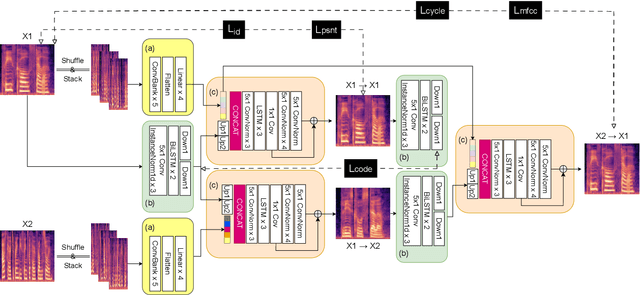
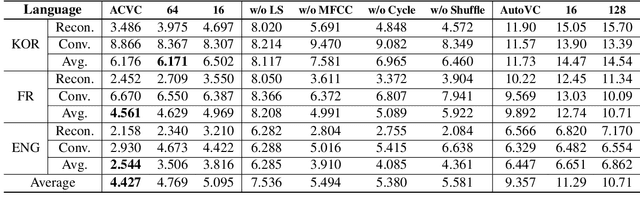
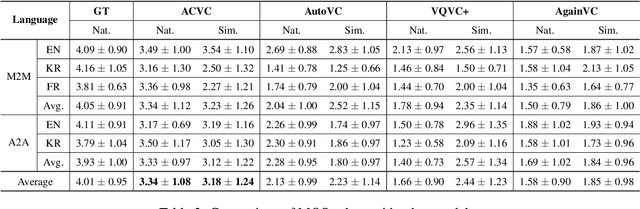

This paper proposes a simple and robust zero-shot voice conversion system with a cycle structure and mel-spectrogram pre-processing. Previous works suffer from information loss and poor synthesis quality due to their reliance on a carefully designed bottleneck structure. Moreover, models relying solely on self-reconstruction loss struggled with reproducing different speakers' voices. To address these issues, we suggested a cycle-consistency loss that considers conversion back and forth between target and source speakers. Additionally, stacked random-shuffled mel-spectrograms and a label smoothing method are utilized during speaker encoder training to extract a time-independent global speaker representation from speech, which is the key to a zero-shot conversion. Our model outperforms existing state-of-the-art results in both subjective and objective evaluations. Furthermore, it facilitates cross-lingual voice conversions and enhances the quality of synthesized speech.