 Add to Chrome
 Add to Firefox
 Add to Edge
Structured Layout Priors for Robust Out-of-Distribution Visual Document Understanding
May 19, 2026
Vision-Language Models (VLMs) parse documents end-to-end but frequently break down on layouts unlike those seen in training. We attribute this to a two-hop bottleneck: before the decoder can extract content (Hop 2), it must first classify and localize the enclosing layout entity (Hop 1), and when the first hop fails the second collapses into omissions, malformed structure, or autoregressive repetition. We pre-resolve Hop 1 outside the decoder by running a lightweight RT-DETR detector, serializing its outputs in the parser's native DocTags vocabulary, and injecting them into the prompt alongside the full page image. Unlike analyze-then-parse approaches that crop the page, or prior prompt-level priors written in plain text, our prior shares the decoder's generation space and leaves the global image in view as a fallback when detections are noisy. On a 10k-page structural out-of-distribution benchmark, markdown F1 rises from $0.37$ to $0.92$; on the Chinese subset of OmniDocBench, table TEDS rises from $0.01$ to $0.36$; and on the 26k-page ViDoRe V3 benchmark, infinite-loop decoding failures drop across every industrial domain tested. These gains cost $15\%$ wall-clock latency and a median of $74$ prompt tokens, with no architectural change to the base VLM. An attention-level analysis further reveals a bimodal phase shift in which the decoder attends to injected layout tokens when emitting structure and to image patches when emitting content, consistent with the two-hop bottleneck being alleviated. Model weights will be released to support reproducibility.

Moving Beyond Sparse Grounding with Complete Screen Parsing Supervision
Feb 15, 2026Modern computer-use agents (CUA) must perceive a screen as a structured state, what elements are visible, where they are, and what text they contain, before they can reliably ground instructions and act. Yet, most available grounding datasets provide sparse supervision, with insufficient and low-diversity labels that annotate only a small subset of task-relevant elements per screen, which limits both coverage and generalization; moreover, practical deployment requires efficiency to enable low-latency, on-device use. We introduce ScreenParse, a large-scale dataset for complete screen parsing, with dense annotations of all visible UI elements (boxes, 55-class types, and text) across 771K web screenshots (21M elements). ScreenParse is generated by Webshot, an automated, scalable pipeline that renders diverse urls, extracts annotations and applies VLM-based relabeling and quality filtering. Using ScreenParse, we train ScreenVLM, a compact, 316M-parameter vision language model (VLM) that decodes a compact ScreenTag markup representation with a structure-aware loss that upweights structure-critical tokens. ScreenVLM substantially outperforms much larger foundation VLMs on dense parsing (e.g., 0.592 vs. 0.294 PageIoU on ScreenParse) and shows strong transfer to public benchmarks. Moreover, finetuning foundation VLMs on ScreenParse consistently improves their grounding performance, suggesting that dense screen supervision provides transferable structural priors for UI understanding. Project page: https://saidgurbuz.github.io/screenparse/.
SmolDocling: An ultra-compact vision-language model for end-to-end multi-modal document conversion
Mar 14, 2025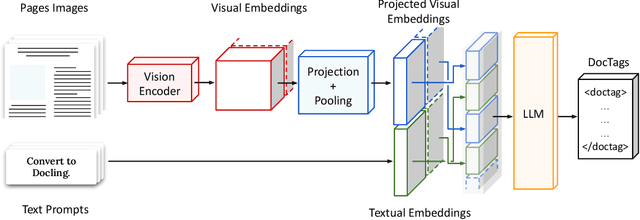
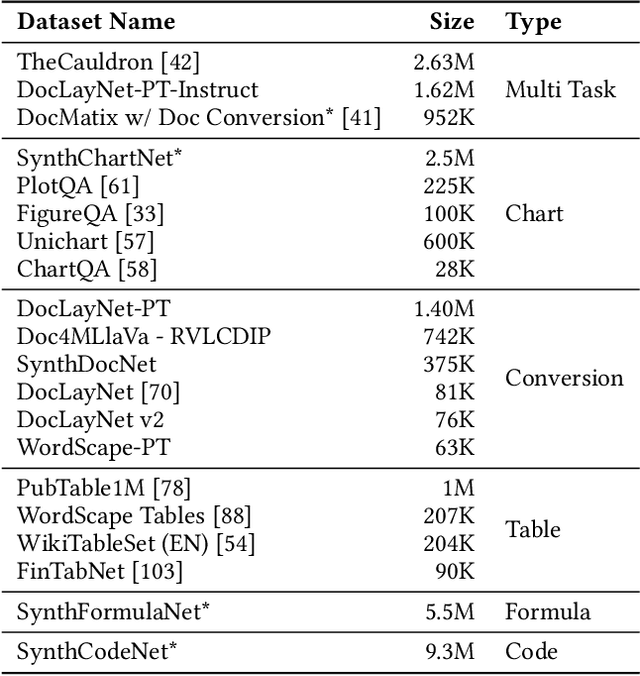
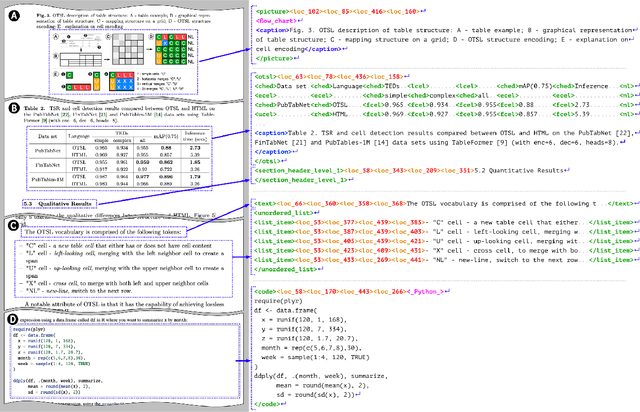
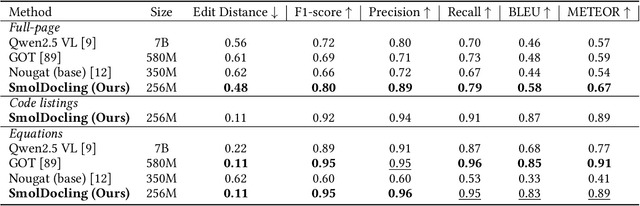
We introduce SmolDocling, an ultra-compact vision-language model targeting end-to-end document conversion. Our model comprehensively processes entire pages by generating DocTags, a new universal markup format that captures all page elements in their full context with location. Unlike existing approaches that rely on large foundational models, or ensemble solutions that rely on handcrafted pipelines of multiple specialized models, SmolDocling offers an end-to-end conversion for accurately capturing content, structure and spatial location of document elements in a 256M parameters vision-language model. SmolDocling exhibits robust performance in correctly reproducing document features such as code listings, tables, equations, charts, lists, and more across a diverse range of document types including business documents, academic papers, technical reports, patents, and forms -- significantly extending beyond the commonly observed focus on scientific papers. Additionally, we contribute novel publicly sourced datasets for charts, tables, equations, and code recognition. Experimental results demonstrate that SmolDocling competes with other Vision Language Models that are up to 27 times larger in size, while reducing computational requirements substantially. The model is currently available, datasets will be publicly available soon.