 Add to Chrome
 Add to Firefox
 Add to Edge
Structured Layout Priors for Robust Out-of-Distribution Visual Document Understanding
May 19, 2026
Vision-Language Models (VLMs) parse documents end-to-end but frequently break down on layouts unlike those seen in training. We attribute this to a two-hop bottleneck: before the decoder can extract content (Hop 2), it must first classify and localize the enclosing layout entity (Hop 1), and when the first hop fails the second collapses into omissions, malformed structure, or autoregressive repetition. We pre-resolve Hop 1 outside the decoder by running a lightweight RT-DETR detector, serializing its outputs in the parser's native DocTags vocabulary, and injecting them into the prompt alongside the full page image. Unlike analyze-then-parse approaches that crop the page, or prior prompt-level priors written in plain text, our prior shares the decoder's generation space and leaves the global image in view as a fallback when detections are noisy. On a 10k-page structural out-of-distribution benchmark, markdown F1 rises from $0.37$ to $0.92$; on the Chinese subset of OmniDocBench, table TEDS rises from $0.01$ to $0.36$; and on the 26k-page ViDoRe V3 benchmark, infinite-loop decoding failures drop across every industrial domain tested. These gains cost $15\%$ wall-clock latency and a median of $74$ prompt tokens, with no architectural change to the base VLM. An attention-level analysis further reveals a bimodal phase shift in which the decoder attends to injected layout tokens when emitting structure and to image patches when emitting content, consistent with the two-hop bottleneck being alleviated. Model weights will be released to support reproducibility.

DocAtlas: Multilingual Document Understanding Across 80+ Languages
May 12, 2026Multilingual document understanding remains limited for low-resource languages due to scarce training data and model-based annotation pipelines that perpetuate existing biases. We introduce DocAtlas, a framework that constructs high-fidelity OCR datasets and benchmarks covering 82 languages and 9 evaluation tasks. Our dual pipelines, differential rendering of native DOCX documents and synthetic LaTeX-based generation for right-to-left scripts produce precise structural annotations in a unified DocTag format encoding layout, text, and component types, without learned models for core annotation. Evaluating 16 state-of-the-art models reveals persistent gaps in low-resource scripts. We show that Direct Preference Optimization (DPO) using rendering-derived ground truth as positive signal achieves stable multilingual adaptation, improving both in-domain (+1.9%) and out-of-domain (+1.8%) accuracy without measurable base-language degradation, where supervised fine-tuning degrades out-of-domain performance by up to 21%. Our best variant, DocAtlas-DeepSeek, improves +1.7% over the strongest baseline.
MarkushGrapher-2: End-to-end Multimodal Recognition of Chemical Structures
Mar 30, 2026Automatically extracting chemical structures from documents is essential for the large-scale analysis of the literature in chemistry. Automatic pipelines have been developed to recognize molecules represented either in figures or in text independently. However, methods for recognizing chemical structures from multimodal descriptions (Markush structures) lag behind in precision and cannot be used for automatic large-scale processing. In this work, we present MarkushGrapher-2, an end-to-end approach for the multimodal recognition of chemical structures in documents. First, our method employs a dedicated OCR model to extract text from chemical images. Second, the text, image, and layout information are jointly encoded through a Vision-Text-Layout encoder and an Optical Chemical Structure Recognition vision encoder. Finally, the resulting encodings are effectively fused through a two-stage training strategy and used to auto-regressively generate a representation of the Markush structure. To address the lack of training data, we introduce an automatic pipeline for constructing a large-scale dataset of real-world Markush structures. In addition, we present IP5-M, a large manually-annotated benchmark of real-world Markush structures, designed to advance research on this challenging task. Extensive experiments show that our approach substantially outperforms state-of-the-art models in multimodal Markush structure recognition, while maintaining strong performance in molecule structure recognition. Code, models, and datasets are released publicly.
Moving Beyond Sparse Grounding with Complete Screen Parsing Supervision
Feb 15, 2026Modern computer-use agents (CUA) must perceive a screen as a structured state, what elements are visible, where they are, and what text they contain, before they can reliably ground instructions and act. Yet, most available grounding datasets provide sparse supervision, with insufficient and low-diversity labels that annotate only a small subset of task-relevant elements per screen, which limits both coverage and generalization; moreover, practical deployment requires efficiency to enable low-latency, on-device use. We introduce ScreenParse, a large-scale dataset for complete screen parsing, with dense annotations of all visible UI elements (boxes, 55-class types, and text) across 771K web screenshots (21M elements). ScreenParse is generated by Webshot, an automated, scalable pipeline that renders diverse urls, extracts annotations and applies VLM-based relabeling and quality filtering. Using ScreenParse, we train ScreenVLM, a compact, 316M-parameter vision language model (VLM) that decodes a compact ScreenTag markup representation with a structure-aware loss that upweights structure-critical tokens. ScreenVLM substantially outperforms much larger foundation VLMs on dense parsing (e.g., 0.592 vs. 0.294 PageIoU on ScreenParse) and shows strong transfer to public benchmarks. Moreover, finetuning foundation VLMs on ScreenParse consistently improves their grounding performance, suggesting that dense screen supervision provides transferable structural priors for UI understanding. Project page: https://saidgurbuz.github.io/screenparse/.
MarkushGrapher: Joint Visual and Textual Recognition of Markush Structures
Mar 20, 2025The automated analysis of chemical literature holds promise to accelerate discovery in fields such as material science and drug development. In particular, search capabilities for chemical structures and Markush structures (chemical structure templates) within patent documents are valuable, e.g., for prior-art search. Advancements have been made in the automatic extraction of chemical structures from text and images, yet the Markush structures remain largely unexplored due to their complex multi-modal nature. In this work, we present MarkushGrapher, a multi-modal approach for recognizing Markush structures in documents. Our method jointly encodes text, image, and layout information through a Vision-Text-Layout encoder and an Optical Chemical Structure Recognition vision encoder. These representations are merged and used to auto-regressively generate a sequential graph representation of the Markush structure along with a table defining its variable groups. To overcome the lack of real-world training data, we propose a synthetic data generation pipeline that produces a wide range of realistic Markush structures. Additionally, we present M2S, the first annotated benchmark of real-world Markush structures, to advance research on this challenging task. Extensive experiments demonstrate that our approach outperforms state-of-the-art chemistry-specific and general-purpose vision-language models in most evaluation settings. Code, models, and datasets will be available.
SmolDocling: An ultra-compact vision-language model for end-to-end multi-modal document conversion
Mar 14, 2025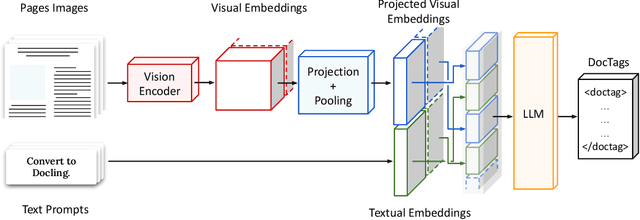
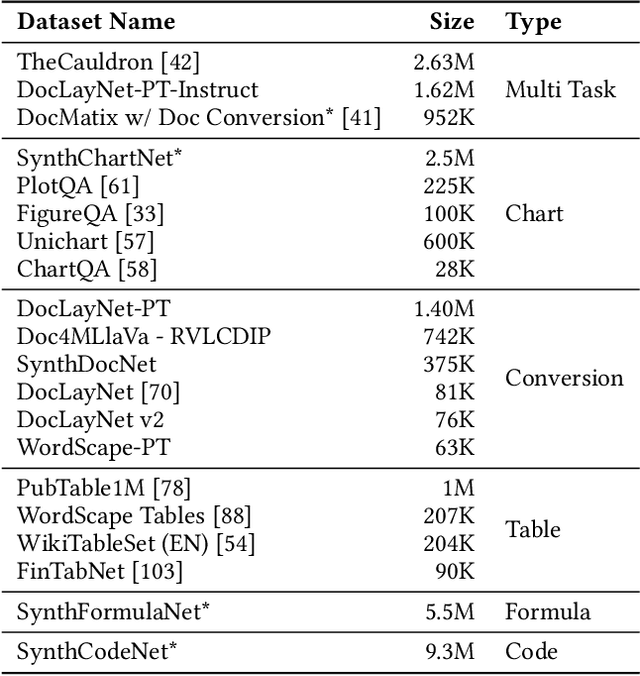
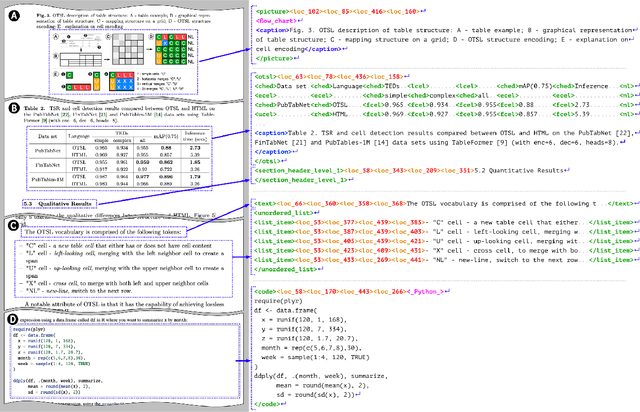
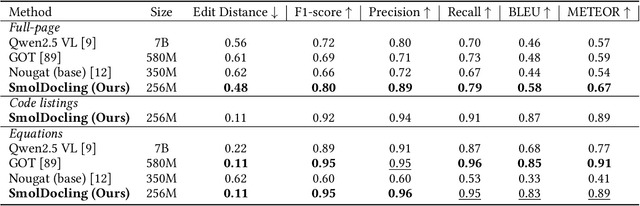
We introduce SmolDocling, an ultra-compact vision-language model targeting end-to-end document conversion. Our model comprehensively processes entire pages by generating DocTags, a new universal markup format that captures all page elements in their full context with location. Unlike existing approaches that rely on large foundational models, or ensemble solutions that rely on handcrafted pipelines of multiple specialized models, SmolDocling offers an end-to-end conversion for accurately capturing content, structure and spatial location of document elements in a 256M parameters vision-language model. SmolDocling exhibits robust performance in correctly reproducing document features such as code listings, tables, equations, charts, lists, and more across a diverse range of document types including business documents, academic papers, technical reports, patents, and forms -- significantly extending beyond the commonly observed focus on scientific papers. Additionally, we contribute novel publicly sourced datasets for charts, tables, equations, and code recognition. Experimental results demonstrate that SmolDocling competes with other Vision Language Models that are up to 27 times larger in size, while reducing computational requirements substantially. The model is currently available, datasets will be publicly available soon.
Docling: An Efficient Open-Source Toolkit for AI-driven Document Conversion
Jan 27, 2025


We introduce Docling, an easy-to-use, self-contained, MIT-licensed, open-source toolkit for document conversion, that can parse several types of popular document formats into a unified, richly structured representation. It is powered by state-of-the-art specialized AI models for layout analysis (DocLayNet) and table structure recognition (TableFormer), and runs efficiently on commodity hardware in a small resource budget. Docling is released as a Python package and can be used as a Python API or as a CLI tool. Docling's modular architecture and efficient document representation make it easy to implement extensions, new features, models, and customizations. Docling has been already integrated in other popular open-source frameworks (e.g., LangChain, LlamaIndex, spaCy), making it a natural fit for the processing of documents and the development of high-end applications. The open-source community has fully engaged in using, promoting, and developing for Docling, which gathered 10k stars on GitHub in less than a month and was reported as the No. 1 trending repository in GitHub worldwide in November 2024.
Docling Technical Report
Aug 19, 2024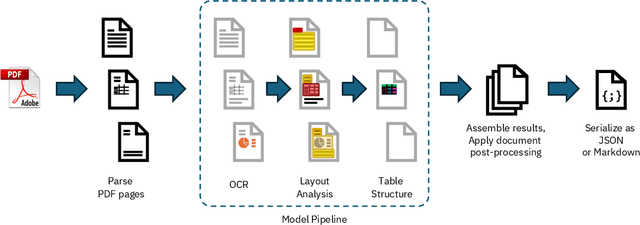


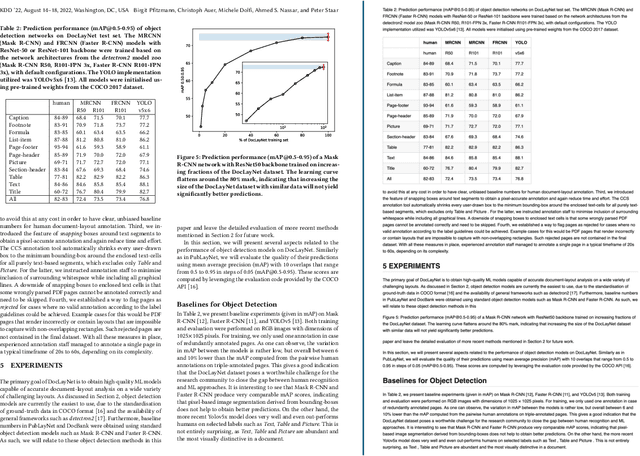
This technical report introduces Docling, an easy to use, self-contained, MIT-licensed open-source package for PDF document conversion. It is powered by state-of-the-art specialized AI models for layout analysis (DocLayNet) and table structure recognition (TableFormer), and runs efficiently on commodity hardware in a small resource budget. The code interface allows for easy extensibility and addition of new features and models.
KVP10k : A Comprehensive Dataset for Key-Value Pair Extraction in Business Documents
May 01, 2024
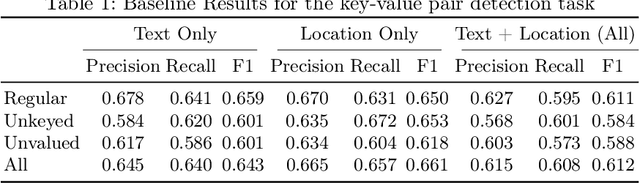

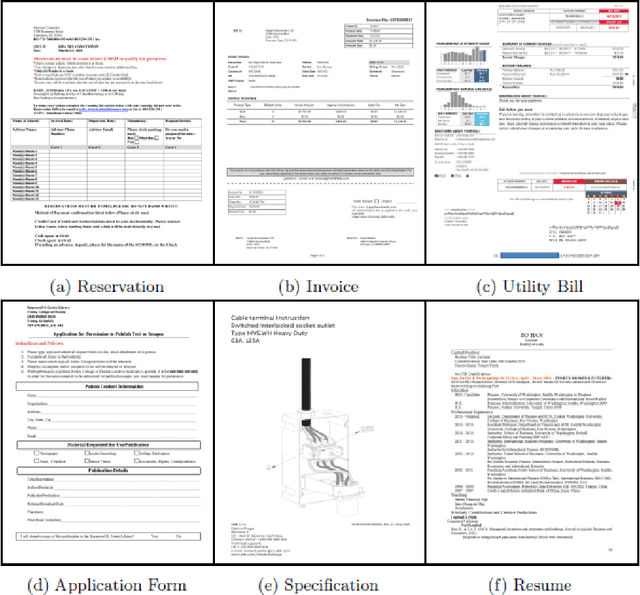
In recent years, the challenge of extracting information from business documents has emerged as a critical task, finding applications across numerous domains. This effort has attracted substantial interest from both industry and academy, highlighting its significance in the current technological landscape. Most datasets in this area are primarily focused on Key Information Extraction (KIE), where the extraction process revolves around extracting information using a specific, predefined set of keys. Unlike most existing datasets and benchmarks, our focus is on discovering key-value pairs (KVPs) without relying on predefined keys, navigating through an array of diverse templates and complex layouts. This task presents unique challenges, primarily due to the absence of comprehensive datasets and benchmarks tailored for non-predetermined KVP extraction. To address this gap, we introduce KVP10k , a new dataset and benchmark specifically designed for KVP extraction. The dataset contains 10707 richly annotated images. In our benchmark, we also introduce a new challenging task that combines elements of KIE as well as KVP in a single task. KVP10k sets itself apart with its extensive diversity in data and richly detailed annotations, paving the way for advancements in the field of information extraction from complex business documents.
ESG Accountability Made Easy: DocQA at Your Service
Nov 30, 2023

We present Deep Search DocQA. This application enables information extraction from documents via a question-answering conversational assistant. The system integrates several technologies from different AI disciplines consisting of document conversion to machine-readable format (via computer vision), finding relevant data (via natural language processing), and formulating an eloquent response (via large language models). Users can explore over 10,000 Environmental, Social, and Governance (ESG) disclosure reports from over 2000 corporations. The Deep Search platform can be accessed at: https://ds4sd.github.io.