 Add to Chrome
 Add to Firefox
 Add to Edge
SDFP: Speculative Decoding with FIT-Pruned Models for Training-Free and Plug-and-Play LLM Acceleration
Feb 05, 2026
Large language models (LLMs) underpin interactive multimedia applications such as captioning, retrieval, recommendation, and creative content generation, yet their autoregressive decoding incurs substantial latency. Speculative decoding reduces latency using a lightweight draft model, but deployment is often limited by the cost and complexity of acquiring, tuning, and maintaining an effective draft model. Recent approaches usually require auxiliary training or specialization, and even training-free methods incur costly search or optimization. We propose SDFP, a fully training-free and plug-and-play framework that builds the draft model via Fisher Information Trace (FIT)-based layer pruning of a given LLM. Using layer sensitivity as a proxy for output perturbation, SDFP removes low-impact layers to obtain a compact draft while preserving compatibility with the original model for standard speculative verification. SDFP needs no additional training, hyperparameter tuning, or separately maintained drafts, enabling rapid, deployment-friendly draft construction. Across benchmarks, SDFP delivers 1.32x-1.5x decoding speedup without altering the target model's output distribution, supporting low-latency multimedia applications.

DiP-GO: A Diffusion Pruner via Few-step Gradient Optimization
Oct 22, 2024
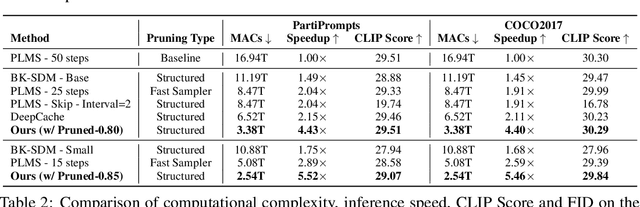

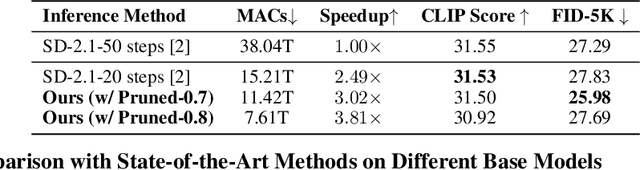
Diffusion models have achieved remarkable progress in the field of image generation due to their outstanding capabilities. However, these models require substantial computing resources because of the multi-step denoising process during inference. While traditional pruning methods have been employed to optimize these models, the retraining process necessitates large-scale training datasets and extensive computational costs to maintain generalization ability, making it neither convenient nor efficient. Recent studies attempt to utilize the similarity of features across adjacent denoising stages to reduce computational costs through simple and static strategies. However, these strategies cannot fully harness the potential of the similar feature patterns across adjacent timesteps. In this work, we propose a novel pruning method that derives an efficient diffusion model via a more intelligent and differentiable pruner. At the core of our approach is casting the model pruning process into a SubNet search process. Specifically, we first introduce a SuperNet based on standard diffusion via adding some backup connections built upon the similar features. We then construct a plugin pruner network and design optimization losses to identify redundant computation. Finally, our method can identify an optimal SubNet through few-step gradient optimization and a simple post-processing procedure. We conduct extensive experiments on various diffusion models including Stable Diffusion series and DiTs. Our DiP-GO approach achieves 4.4 x speedup for SD-1.5 without any loss of accuracy, significantly outperforming the previous state-of-the-art methods.