 Add to Chrome
 Add to Firefox
 Add to Edge
OScaR: The Occam's Razor for Extreme KV Cache Quantization in LLMs and Beyond
May 19, 2026
The rapid advancement toward long-context reasoning and multi-modal intelligence has made the memory footprint of the Key-Value (KV) cache a dominant memory bottleneck for efficient deployment. While the established per-channel quantization effectively accommodates intrinsic channel-wise outliers in Key tensors, its efficacy diminishes under extreme compression. In this work, we revisit the inherent limitations of the per-channel quantization paradigm from both empirical and theoretical perspectives. Our analysis identifies Token Norm Imbalance (TNI) as the primary bottleneck to quantization fidelity. We demonstrate that TNI systematically amplifies errors when shared quantization parameters are required to span token groups exhibiting substantial norm disparities. Instead of relying on intricate quantization pipelines (e.g., TurboQuant), we propose OScaR (Omni-Scaled Canalized Rotation), an accurate and lightweight KV cache compression framework for X-LLMs (i.e., text-only, multi-modal, and omni-modal LLMs). Advancing the per-channel paradigm, OScaR employs Canalized Rotation followed by Omni-Token Scaling to mitigate TNI-induced sequence-dimensional variance both effectively and efficiently, further supported by our optimized system design and CUDA kernels. Extensive evaluations across X-LLMs show that OScaR consistently outperforms existing methods and achieves near-lossless performance under INT2 quantization, establishing it as a robust, low-complexity, and universal framework that defines a new Pareto front. Compared with the BF16 FlashDecoding-v2 baseline, our OScaR implementation achieves a notable up to 3.0x speedup in decoding, reduces memory footprint by 5.3x, and increases throughput by 4.1x. The code for OScaR is publicly available at https://github.com/ZunhaiSu/OScaR-KV-Quant.

Attention Sink in Transformers: A Survey on Utilization, Interpretation, and Mitigation
Apr 11, 2026As the foundational architecture of modern machine learning, Transformers have driven remarkable progress across diverse AI domains. Despite their transformative impact, a persistent challenge across various Transformers is Attention Sink (AS), in which a disproportionate amount of attention is focused on a small subset of specific yet uninformative tokens. AS complicates interpretability, significantly affecting the training and inference dynamics, and exacerbates issues such as hallucinations. In recent years, substantial research has been dedicated to understanding and harnessing AS. However, a comprehensive survey that systematically consolidates AS-related research and offers guidance for future advancements remains lacking. To address this gap, we present the first survey on AS, structured around three key dimensions that define the current research landscape: Fundamental Utilization, Mechanistic Interpretation, and Strategic Mitigation. Our work provides a pivotal contribution by clarifying key concepts and guiding researchers through the evolution and trends of the field. We envision this survey as a definitive resource, empowering researchers and practitioners to effectively manage AS within the current Transformer paradigm, while simultaneously inspiring innovative advancements for the next generation of Transformers. The paper list of this work is available at https://github.com/ZunhaiSu/Awesome-Attention-Sink.
Beyond Outliers: A Data-Free Layer-wise Mixed-Precision Quantization Approach Driven by Numerical and Structural Dual-Sensitivity
Mar 18, 2026Layer-wise mixed-precision quantization (LMPQ) enables effective compression under extreme low-bit settings by allocating higher precision to sensitive layers. However, existing methods typically treat all intra-layer weight modules uniformly and rely on a single numerical property when estimating sensitivity, overlooking their distinct operational roles and structural characteristics. To address this, we propose NSDS, a novel calibration-free LMPQ framework driven by Numerical and Structural Dual-Sensitivity. Specifically, it first mechanistically decomposes each layer into distinct operational roles and quantifies their sensitivity from both numerical and structural perspectives. These dual-aspect scores are then aggregated into a unified layer-wise metric through a robust aggregation scheme based on MAD-Sigmoid and Soft-OR to guide bit allocation. Extensive experiments demonstrate that NSDS consistently achieves superior performance compared to various baselines across diverse models and downstream tasks, without relying on any calibration data.
SnapMLA: Efficient Long-Context MLA Decoding via Hardware-Aware FP8 Quantized Pipelining
Feb 12, 2026While FP8 attention has shown substantial promise in innovations like FlashAttention-3, its integration into the decoding phase of the DeepSeek Multi-head Latent Attention (MLA) architecture presents notable challenges. These challenges include numerical heterogeneity arising from the decoupling of positional embeddings, misalignment of quantization scales in FP8 PV GEMM, and the need for optimized system-level support. In this paper, we introduce SnapMLA, an FP8 MLA decoding framework optimized to improve long-context efficiency through the following hardware-aware algorithm-kernel co-optimization techniques: (i) RoPE-Aware Per-Token KV Quantization, where the RoPE part is maintained in high precision, motivated by our comprehensive analysis of the heterogeneous quantization sensitivity inherent to the MLA KV cache. Furthermore, per-token granularity is employed to align with the autoregressive decoding process and maintain quantization accuracy. (ii) Quantized PV Computation Pipeline Reconstruction, which resolves the misalignment of quantization scale in FP8 PV computation stemming from the shared KV structure of the MLA KV cache. (iii) End-to-End Dataflow Optimization, where we establish an efficient data read-and-write workflow using specialized kernels, ensuring efficient data flow and performance gains. Extensive experiments on state-of-the-art MLA LLMs show that SnapMLA achieves up to a 1.91x improvement in throughput, with negligible risk of performance degradation in challenging long-context tasks, including mathematical reasoning and code generation benchmarks. Code is available at https://github.com/meituan-longcat/SGLang-FluentLLM.
SDFP: Speculative Decoding with FIT-Pruned Models for Training-Free and Plug-and-Play LLM Acceleration
Feb 05, 2026Large language models (LLMs) underpin interactive multimedia applications such as captioning, retrieval, recommendation, and creative content generation, yet their autoregressive decoding incurs substantial latency. Speculative decoding reduces latency using a lightweight draft model, but deployment is often limited by the cost and complexity of acquiring, tuning, and maintaining an effective draft model. Recent approaches usually require auxiliary training or specialization, and even training-free methods incur costly search or optimization. We propose SDFP, a fully training-free and plug-and-play framework that builds the draft model via Fisher Information Trace (FIT)-based layer pruning of a given LLM. Using layer sensitivity as a proxy for output perturbation, SDFP removes low-impact layers to obtain a compact draft while preserving compatibility with the original model for standard speculative verification. SDFP needs no additional training, hyperparameter tuning, or separately maintained drafts, enabling rapid, deployment-friendly draft construction. Across benchmarks, SDFP delivers 1.32x-1.5x decoding speedup without altering the target model's output distribution, supporting low-latency multimedia applications.
Locate, Steer, and Improve: A Practical Survey of Actionable Mechanistic Interpretability in Large Language Models
Jan 20, 2026Mechanistic Interpretability (MI) has emerged as a vital approach to demystify the opaque decision-making of Large Language Models (LLMs). However, existing reviews primarily treat MI as an observational science, summarizing analytical insights while lacking a systematic framework for actionable intervention. To bridge this gap, we present a practical survey structured around the pipeline: "Locate, Steer, and Improve." We formally categorize Localizing (diagnosis) and Steering (intervention) methods based on specific Interpretable Objects to establish a rigorous intervention protocol. Furthermore, we demonstrate how this framework enables tangible improvements in Alignment, Capability, and Efficiency, effectively operationalizing MI as an actionable methodology for model optimization. The curated paper list of this work is available at https://github.com/rattlesnakey/Awesome-Actionable-MI-Survey.
XStreamVGGT: Extremely Memory-Efficient Streaming Vision Geometry Grounded Transformer with KV Cache Compression
Jan 03, 2026Learning-based 3D visual geometry models have benefited substantially from large-scale transformers. Among these, StreamVGGT leverages frame-wise causal attention for strong streaming reconstruction, but suffers from unbounded KV cache growth, leading to escalating memory consumption and inference latency as input frames accumulate. We propose XStreamVGGT, a tuning-free approach that systematically compresses the KV cache through joint pruning and quantization, enabling extremely memory-efficient streaming inference. Specifically, redundant KVs originating from multi-view inputs are pruned through efficient token importance identification, enabling a fixed memory budget. Leveraging the unique distribution of KV tensors, we incorporate KV quantization to further reduce memory consumption. Extensive evaluations show that XStreamVGGT achieves mostly negligible performance degradation while substantially reducing memory usage by 4.42$\times$ and accelerating inference by 5.48$\times$, enabling scalable and practical streaming 3D applications. The code is available at https://github.com/ywh187/XStreamVGGT/.
DoPE: Denoising Rotary Position Embedding
Nov 12, 2025Rotary Position Embedding (RoPE) in Transformer models has inherent limits that weaken length extrapolation. We reinterpret the attention map with positional encoding as a noisy feature map, and propose Denoising Positional Encoding (DoPE), a training-free method based on truncated matrix entropy to detect outlier frequency bands in the feature map. Leveraging the noise characteristics of the feature map, we further reparameterize it with a parameter-free Gaussian distribution to achieve robust extrapolation. Our method theoretically reveals the underlying cause of the attention sink phenomenon and its connection to truncated matrix entropy. Experiments on needle-in-a-haystack and many-shot in-context learning tasks demonstrate that DoPE significantly improves retrieval accuracy and reasoning stability across extended contexts (up to 64K tokens). The results show that the denoising strategy for positional embeddings effectively mitigates attention sinks and restores balanced attention patterns, providing a simple yet powerful solution for improving length generalization. Our project page is Project: https://The-physical-picture-of-LLMs.github.io
AKVQ-VL: Attention-Aware KV Cache Adaptive 2-Bit Quantization for Vision-Language Models
Jan 25, 2025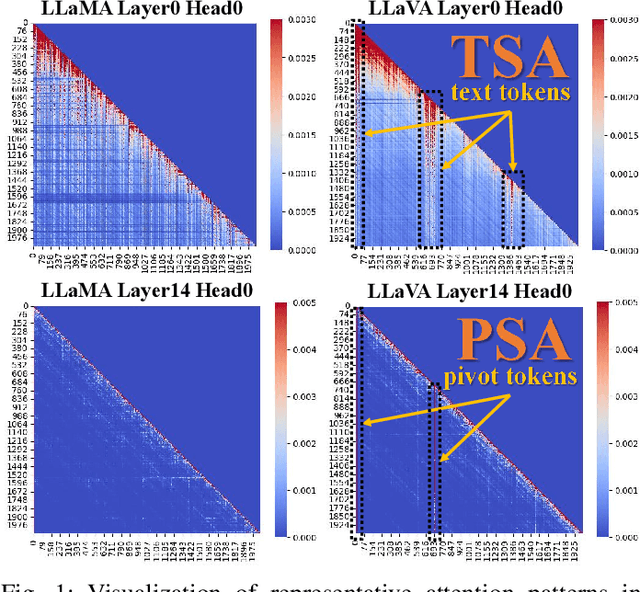
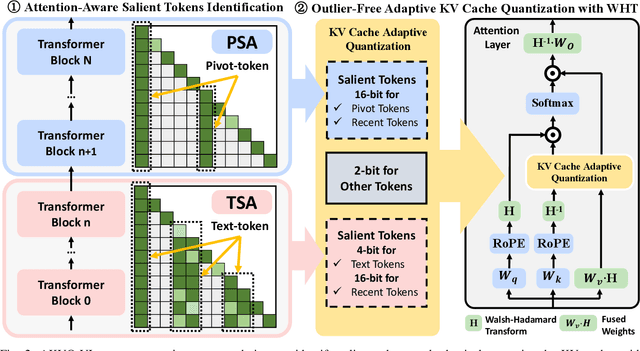
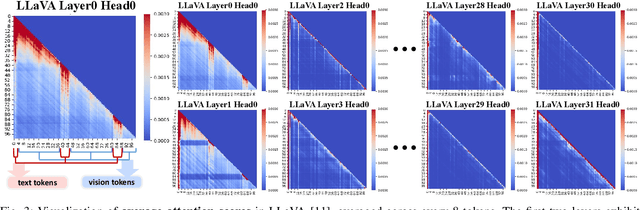
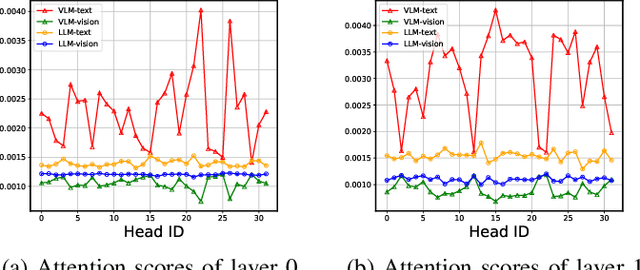
Vision-language models (VLMs) show remarkable performance in multimodal tasks. However, excessively long multimodal inputs lead to oversized Key-Value (KV) caches, resulting in significant memory consumption and I/O bottlenecks. Previous KV quantization methods for Large Language Models (LLMs) may alleviate these issues but overlook the attention saliency differences of multimodal tokens, resulting in suboptimal performance. In this paper, we investigate the attention-aware token saliency patterns in VLM and propose AKVQ-VL. AKVQ-VL leverages the proposed Text-Salient Attention (TSA) and Pivot-Token-Salient Attention (PSA) patterns to adaptively allocate bit budgets. Moreover, achieving extremely low-bit quantization requires effectively addressing outliers in KV tensors. AKVQ-VL utilizes the Walsh-Hadamard transform (WHT) to construct outlier-free KV caches, thereby reducing quantization difficulty. Evaluations of 2-bit quantization on 12 long-context and multimodal tasks demonstrate that AKVQ-VL maintains or even improves accuracy, outperforming LLM-oriented methods. AKVQ-VL can reduce peak memory usage by 2.13x, support up to 3.25x larger batch sizes and 2.46x throughput.