 Add to Chrome
 Add to Firefox
 Add to Edge
ConQuR: Corner Aligned Activation Quantization via Optimized Rotations for LLMs
May 11, 2026
Large language models (LLMs) are costly to deploy due to their large memory footprint and high inference cost. Weight-activation quantization can reduce these costs, but low-bit activation quantization remains difficult because activation outliers induce large quantization error. Recent rotation-based methods address this by applying orthogonal transformations that redistribute activation magnitude across dimensions, but existing approaches either require expensive end-to-end rotation training or rely on stored activation corpora, introducing significant compute or storage overhead. We propose a lightweight post-training rotation calibration method for LLM activation quantization. Our method learns orthogonal rotations that align normalized activations with the corners of an inscribed hypercube, encouraging activation energy to be distributed more evenly across dimensions. This objective admits an efficient closed-form update via the orthogonal Procrustes problem, avoiding gradient-based optimization over the orthogonal group. We further introduce an online calibration procedure that updates rotations as calibration samples are processed, eliminating the need to store activations on disk and allowing rotations to adapt to quantized activation distributions during calibration. Experiments on Llama-2 and Llama-3 models from 3B to 70B parameters show that our method achieves competitive or improved performance across perplexity benchmarks and common sense reasoning tasks while avoiding both costly end-to-end training and large offline activation storage.

Zero Sum SVD: Balancing Loss Sensitivity for Low Rank LLM Compression
Feb 02, 2026Advances in large language models have driven strong performance across many tasks, but their memory and compute costs still hinder deployment. SVD-based compression reduces storage and can speed up inference via low-rank factors, yet performance depends on how rank is allocated under a global compression ratio. Prior methods often use homogeneous ranks for similarly sized matrices, despite large differences in loss sensitivity, or rely on expensive iterative pre-truncation optimization to determine per matrix ranks. We propose \textbf{Zero Sum SVD} (\textbf{ZS-SVD}), a post-training method that performs \emph{global} singular component selection using activation whitening and first-order calibration loss estimates in whitened coordinates. \textbf{ZS-SVD} prunes components across the whole model with a \textbf{zero sum} rule that keeps the cumulative predicted loss change near zero, automatically yielding heterogeneous ranks without solving a rank allocation optimization. Motivated by evidence that gradients near pretrained solutions exhibit low rank structure, we also introduce an optional lightweight correction that applies a \textbf{single} projected gradient update after truncation, followed by re-truncation. Extensive experiments across multiple LLM architectures show consistent gains across diverse benchmarks and compression ratios. Code is available at https://github.com/mint-vu/Zero-Sum-SVD
MCNC: Manifold Constrained Network Compression
Jun 27, 2024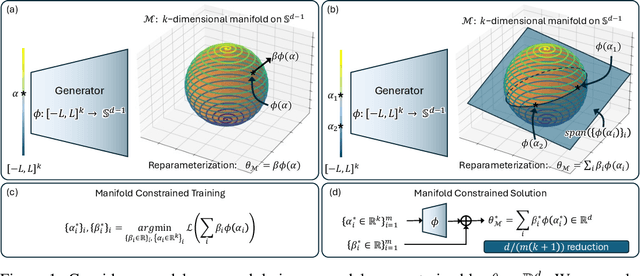
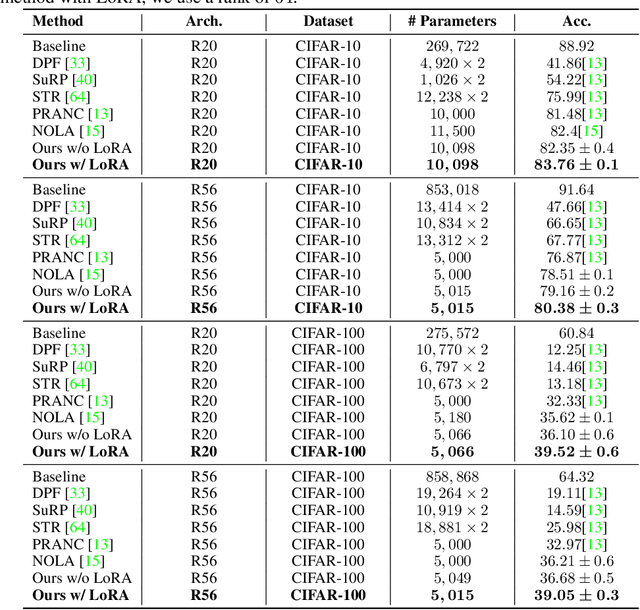

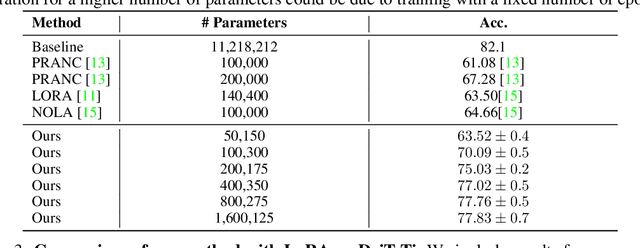
The outstanding performance of large foundational models across diverse tasks-from computer vision to speech and natural language processing-has significantly increased their demand. However, storing and transmitting these models pose significant challenges due to their massive size (e.g., 350GB for GPT-3). Recent literature has focused on compressing the original weights or reducing the number of parameters required for fine-tuning these models. These compression methods typically involve constraining the parameter space, for example, through low-rank reparametrization (e.g., LoRA) or quantization (e.g., QLoRA) during model training. In this paper, we present MCNC as a novel model compression method that constrains the parameter space to low-dimensional pre-defined and frozen nonlinear manifolds, which effectively cover this space. Given the prevalence of good solutions in over-parameterized deep neural networks, we show that by constraining the parameter space to our proposed manifold, we can identify high-quality solutions while achieving unprecedented compression rates across a wide variety of tasks. Through extensive experiments in computer vision and natural language processing tasks, we demonstrate that our method, MCNC, significantly outperforms state-of-the-art baselines in terms of compression, accuracy, and/or model reconstruction time.
CovarNav: Machine Unlearning via Model Inversion and Covariance Navigation
Nov 21, 2023
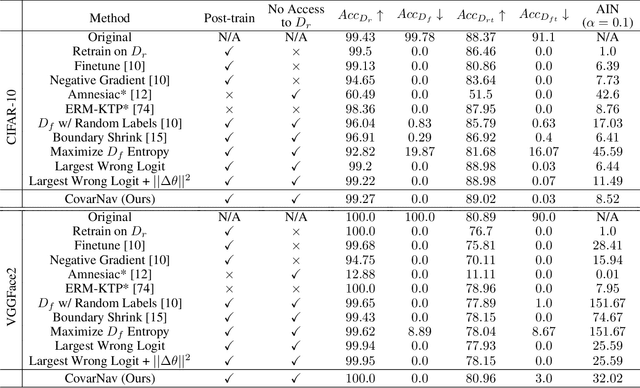


The rapid progress of AI, combined with its unprecedented public adoption and the propensity of large neural networks to memorize training data, has given rise to significant data privacy concerns. To address these concerns, machine unlearning has emerged as an essential technique to selectively remove the influence of specific training data points on trained models. In this paper, we approach the machine unlearning problem through the lens of continual learning. Given a trained model and a subset of training data designated to be forgotten (i.e., the "forget set"), we introduce a three-step process, named CovarNav, to facilitate this forgetting. Firstly, we derive a proxy for the model's training data using a model inversion attack. Secondly, we mislabel the forget set by selecting the most probable class that deviates from the actual ground truth. Lastly, we deploy a gradient projection method to minimize the cross-entropy loss on the modified forget set (i.e., learn incorrect labels for this set) while preventing forgetting of the inverted samples. We rigorously evaluate CovarNav on the CIFAR-10 and Vggface2 datasets, comparing our results with recent benchmarks in the field and demonstrating the efficacy of our proposed approach.