 Add to Chrome
 Add to Firefox
 Add to Edge
Signal Processing Foundations of Reconfigurable Antennas in the Tri-Hybrid MIMO Architecture
Apr 26, 2026
To enable larger apertures in multipleinput multipleoutput MIMO systems the trihybrid MIMO architecture offers a promising lowcost and lowpower solution by introducing reconfigurable antennas as a third layer of precoding on top of conventional digital and analog processing In this paper we develop a unified signal processing framework for trihybrid MIMO that explicitly captures the electromagnetic EM characteristics of diverse reconfigurable antenna technologies We first propose a generic inputoutput model that incorporates the reconfigurable antenna layer into an effective channel representation revealing a fundamental coupling between the channel precoder and radiated power Building on this model we formulate a general optimization problem that jointly accounts for digital analog and antennadomain precoding under hardware and power constraints We then instantiate this framework across seven representative reconfigurable antenna architectures including parasitic arrays dynamic metasurface antennas fluidpixel antennas polarizationreconfigurable antennas stacked intelligent metasurfaces pinching antenna systems and nonradiating wires To systematically compare these heterogeneous architectures we introduce a new metric the reconfigurability efficiency factor REF which quantifies the performance gains achievable through antenna reconfiguration under realistic constraints Numerical results demonstrate the tradeoffs among aperture size power consumption hardware complexity and spectral efficiency Our results establish that EMlevel reconfiguration reshapes the signal processing design space highlighting the need for new architectures and algorithms that jointly optimize across digital analog and electromagnetic domains This work reveals that electromagnetic reconfiguration couples the channel and precoder

Frequency-selective beamforming and single-shot beam training with dynamic metasurface antennas
Nov 29, 2024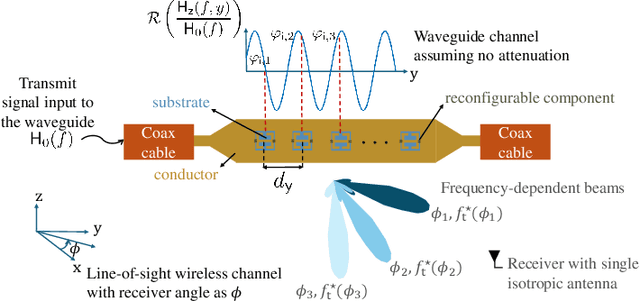
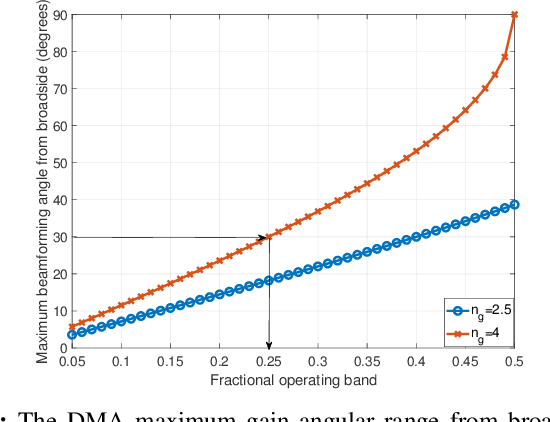
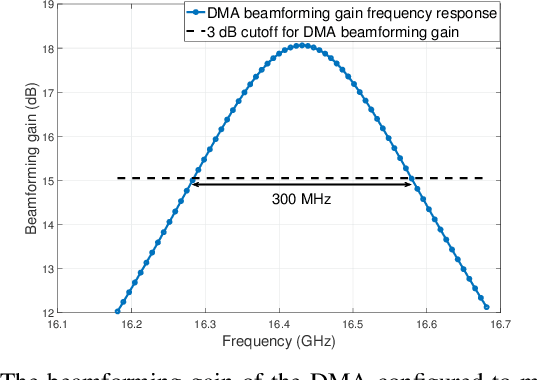
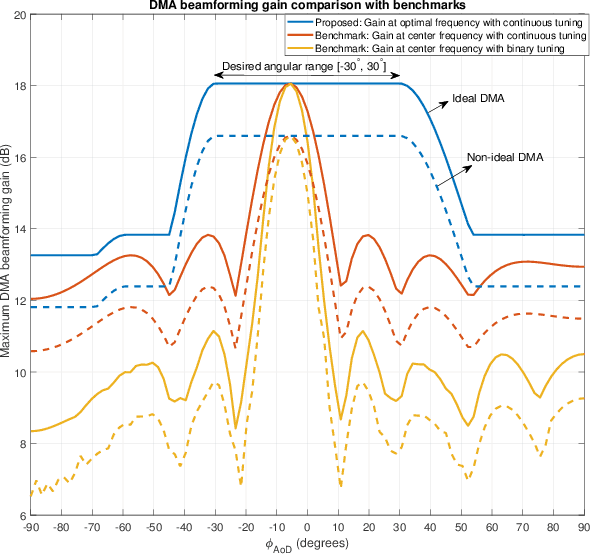
Dynamic metasurface antennas (DMAs) beamform through low-powered components that enable reconfiguration of each radiating element. Previous research on a single-user multiple-input-single-output (MISO) system with a dynamic metasurface antenna at the transmitter has focused on maximizing the beamforming gain at a fixed operating frequency. The DMA, however, has a frequency-selective response that leads to magnitude degradation for frequencies away from the resonant frequency of each element. This causes reduction in beamforming gain if the DMA only operates at a fixed frequency. We exploit the frequency reconfigurability of the DMA to dynamically optimize both the operating frequency and the element configuration, maximizing the beamforming gain. We leverage this approach to develop a single-shot beam training procedure using a DMA sub-array architecture that estimates the receiver's angular direction with a single OFDM pilot signal. We evaluate the beamforming gain performance of the DMA array using the receiver's angular direction estimate obtained from beam training. Our results show that it is sufficient to use a limited number of resonant frequency states to do both beam training and beamforming instead of using an infinite resolution DMA beamformer.
Hierarchical Codebook Design with Dynamic Metasurface Antennas for Energy-Efficient Arrays
May 15, 2023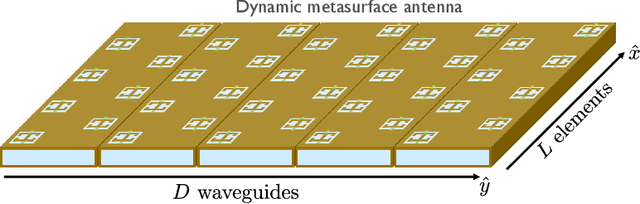
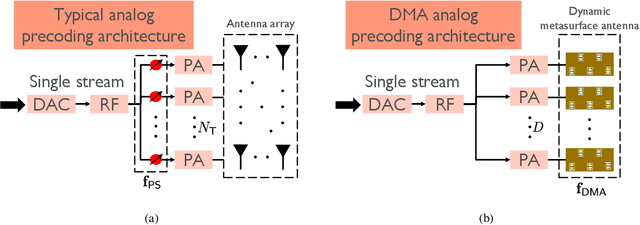
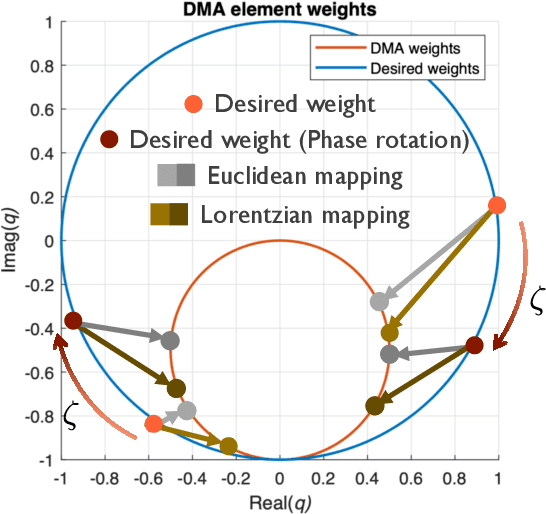
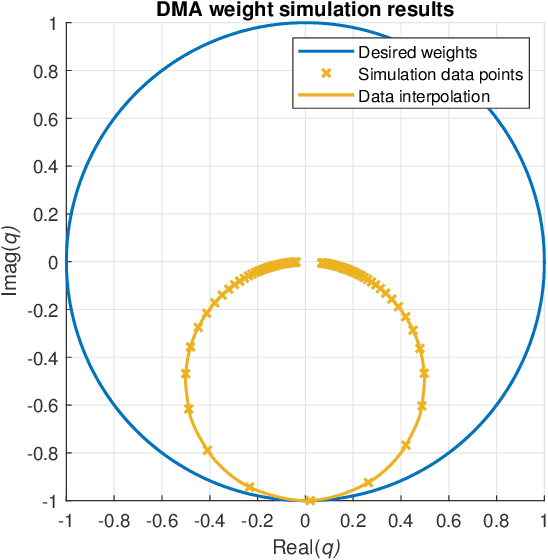
Dynamic metasurface antennas (DMA) provide a solution to form compact, cost-effective, energy-efficient multiple-input-multiple output (MIMO) arrays. In this paper, we implement a practical hierarchical codebook with a realistic DMA design through electromagnetic simulations. We leverage existing DMA models to derive a novel method for enhancing the beamforming gain. We find that the proposed method provides better coverage and spectral efficiency results than prior methods. We also present and verify a new technique for creating wide beamwidths through the DMA and hierarchical codebook. Additionally, we use a detailed transmitter architecture model to determine the power consumption savings of the DMA compared to a typical phased array. The DMA largely outperforms a passive phased array in terms of spectral and energy efficiency due to high component loss from a high-resolution passive phase shifter. While the DMA provides lower spectral efficiency results than the active phased array, the DMA achieves a higher energy efficiency because of the significant power consumption for the active phase shifters. Therefore, we find that DMAs in a realistic wireless environment provide sufficient coverage and spectral efficiency compared to typical phased arrays while maintaining a substantially lower power consumption.