 Add to Chrome
 Add to Firefox
 Add to Edge
Signal Processing Foundations of Reconfigurable Antennas in the Tri-Hybrid MIMO Architecture
Apr 26, 2026
To enable larger apertures in multipleinput multipleoutput MIMO systems the trihybrid MIMO architecture offers a promising lowcost and lowpower solution by introducing reconfigurable antennas as a third layer of precoding on top of conventional digital and analog processing In this paper we develop a unified signal processing framework for trihybrid MIMO that explicitly captures the electromagnetic EM characteristics of diverse reconfigurable antenna technologies We first propose a generic inputoutput model that incorporates the reconfigurable antenna layer into an effective channel representation revealing a fundamental coupling between the channel precoder and radiated power Building on this model we formulate a general optimization problem that jointly accounts for digital analog and antennadomain precoding under hardware and power constraints We then instantiate this framework across seven representative reconfigurable antenna architectures including parasitic arrays dynamic metasurface antennas fluidpixel antennas polarizationreconfigurable antennas stacked intelligent metasurfaces pinching antenna systems and nonradiating wires To systematically compare these heterogeneous architectures we introduce a new metric the reconfigurability efficiency factor REF which quantifies the performance gains achievable through antenna reconfiguration under realistic constraints Numerical results demonstrate the tradeoffs among aperture size power consumption hardware complexity and spectral efficiency Our results establish that EMlevel reconfiguration reshapes the signal processing design space highlighting the need for new architectures and algorithms that jointly optimize across digital analog and electromagnetic domains This work reveals that electromagnetic reconfiguration couples the channel and precoder

Domain-Aware Hybrid Quantum Learning via Correlation-Guided Circuit Design for Crime Pattern Analytics
Apr 11, 2026Crime pattern analysis is critical for law enforcement and predictive policing, yet the surge in criminal activities from rapid urbanization creates high-dimensional, imbalanced datasets that challenge traditional classification methods. This study presents a quantum-classical comparison framework for crime analytics, evaluating four computational paradigms: quantum models, classical baseline machine learning models, and two hybrid quantum-classical architectures. Using 16-year crime statistics, we systematically assess classification performance and computational efficiency under rigorous cross-validation methods. Experimental results show that quantum-inspired approaches, particularly QAOA, achieve up to 84.6% accuracy, while requiring fewer trainable parameters than classical baselines, suggesting practical advantages for memory-constrained edge deployment. The proposed correlation-aware circuit design demonstrates the potential of incorporating domain-specific feature relationships into quantum models. Furthermore, hybrid approaches exhibit competitive training efficiency, making them suitable candidates for resource-constrained environments. The framework's low computational overhead and compact parameter footprint suggest potential advantages for wireless sensor network deployments in smart city surveillance systems, where distributed nodes perform localized crime analytics with minimal communication costs. Our findings provide a preliminary empirical assessment of quantum-enhanced machine learning for structured crime data and motivate further investigation with larger datasets and realistic quantum hardware considerations.
A Novel Edge-Assisted Quantum-Classical Hybrid Framework for Crime Pattern Learning and Classification
Apr 08, 2026Crime pattern analysis is critical for law enforcement and predictive policing, yet the surge in criminal activities from rapid urbanization creates high-dimensional, imbalanced datasets that challenge traditional classification methods. This study presents a quantum-classical comparison framework for crime analytics, evaluating four computational paradigms: quantum models, classical baseline machine learning models, and two hybrid quantum-classical architectures. Using 16-year Bangladesh crime statistics, we systematically assess classification performance and computational efficiency under rigorous cross-validation methods. Experimental results show that quantum-inspired approaches, particularly QAOA, achieve up to 84.6% accuracy, while requiring fewer trainable parameters than classical baselines, suggesting practical advantages for memory-constrained edge deployment. The proposed correlation-aware circuit design demonstrates the potential of incorporating domain-specific feature relationships into quantum models. Furthermore, hybrid approaches exhibit competitive training efficiency, making them suitable candidates for resource-constrained environments. The framework's low computational overhead and compact parameter footprint suggest potential advantages for wireless sensor network deployments in smart city surveillance systems, where distributed nodes perform localized crime analytics with minimal communication costs. Our findings provide a preliminary empirical assessment of quantum-enhanced machine learning for structured crime data and motivate further investigation with larger datasets and realistic quantum hardware considerations.
Tertiary-Mode STAR-RIS for Secure NOMA: Integrating Transmission, Reflection, and Jamming
Mar 29, 2026This paper investigates the physical layer security of a non-orthogonal multiple access (NOMA) system assisted by a tertiary-mode simultaneously transmitting and reflecting reconfigurable intelligent surface (STAR-RIS), which can perform transmission, reflection, and jamming simultaneously. The system comprises a base station (BS) serving two users located on opposite sides of the STAR-RIS, assuming perfect channel state information (CSI) at the transmitter. To enhance secrecy performance, a subset of STAR-RIS elements is adaptively configured for jamming. A penalty-based alternating optimization algorithm is developed to jointly optimize the BS's active beamforming and the STAR-RIS's passive beamforming and mode selection. Simulation results demonstrate that the proposed design substantially improves the achievable sum rate and secrecy performance compared to conventional RIS-assisted and no-RIS benchmarks, highlighting the potential of tertiary-mode STAR-RIS for secure and efficient next-generation wireless communications.
Variational Bayesian Channel Estimation and Data Detection for Cell-Free Massive MIMO with Low-Resolution Quantized Fronthaul Links
Jun 23, 2025We study the joint channel estimation and data detection (JED) problem in a cell-free massive multiple-input multiple-output (CF-mMIMO) network, where access points (APs) communicate with a central processing unit (CPU) over fronthaul links. However, the bandwidth of these links is limited, and thus, presents challenges to the applicability of CF-mMIMO, especially with an ever-increasing number of users. To address this, we propose a method based on variational Bayesian (VB) inference for performing the JED process, where the APs forward low-resolution quantized versions of the signals to the CPU. We consider two approaches: \emph{quantization-and-estimation} (Q-E) and \emph{estimation-and-quantization} (E-Q). In the Q-E approach, each AP uses a low-bit quantizer to quantize the signal before forwarding it to the CPU, while in the E-Q approach, each AP first performs local channel estimation and then sends a low-bit quantized version of the estimated channel to the CPU. We evaluate the performance of our VB-based approach under perfect fronthaul link (PFL) with unquantized received signals, Q-E, and E-Q in terms of symbol error rate (SER), normalized mean square error (NMSE) of the channel estimation, computational complexity, and fronthaul signaling overhead. We also compare these results with those of the linear minimum mean squared error (LMMSE) method under the PFL scenario. Our numerical results show that both the VB(Q-E) and VB(E-Q) approaches achieve superior performance compared to LMMSE(PFL), benefiting from the nonlinear modeling inherent in VB. Furthermore, the VB(Q-E) method outperforms VB(E-Q) due to errors in the local channel estimation process at the APs within the VB(E-Q) approach.
Federated Dropout: Convergence Analysis and Resource Allocation
Dec 31, 2024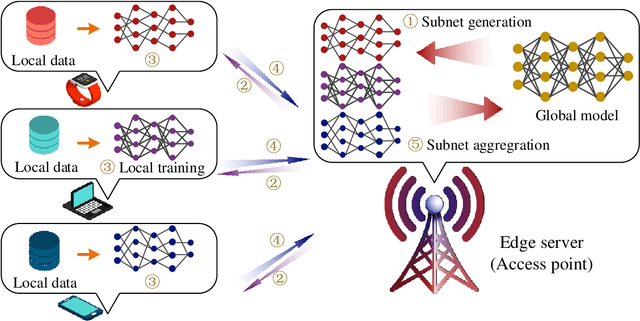

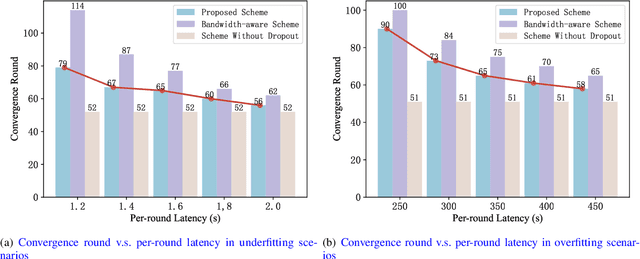
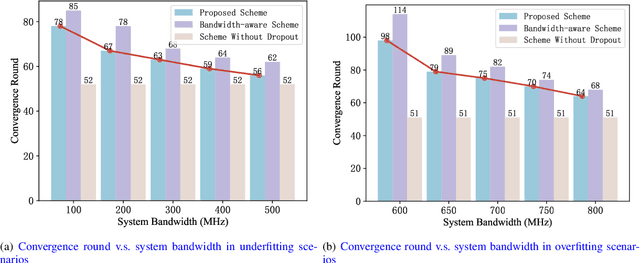
Federated Dropout is an efficient technique to overcome both communication and computation bottlenecks for deploying federated learning at the network edge. In each training round, an edge device only needs to update and transmit a sub-model, which is generated by the typical method of dropout in deep learning, and thus effectively reduces the per-round latency. \textcolor{blue}{However, the theoretical convergence analysis for Federated Dropout is still lacking in the literature, particularly regarding the quantitative influence of dropout rate on convergence}. To address this issue, by using the Taylor expansion method, we mathematically show that the gradient variance increases with a scaling factor of $\gamma/(1-\gamma)$, with $\gamma \in [0, \theta)$ denoting the dropout rate and $\theta$ being the maximum dropout rate ensuring the loss function reduction. Based on the above approximation, we provide the convergence analysis for Federated Dropout. Specifically, it is shown that a larger dropout rate of each device leads to a slower convergence rate. This provides a theoretical foundation for reducing the convergence latency by making a tradeoff between the per-round latency and the overall rounds till convergence. Moreover, a low-complexity algorithm is proposed to jointly optimize the dropout rate and the bandwidth allocation for minimizing the loss function in all rounds under a given per-round latency and limited network resources. Finally, numerical results are provided to verify the effectiveness of the proposed algorithm.
OFDM-Based Active STAR-RIS-Aided Integrated Sensing and Communication Systems
Jun 04, 2024Simultaneously transmitting and reflecting reconfigurable intelligent surface (STAR-RIS), which consists of numerous passive elements, has recently emerged in wireless communication systems as a promising technology providing 360$^\circ$ coverage and better performance. In our research, we introduce an active STAR-RIS (ASTARS)-aided integrated sensing and communications (ISAC) system designed to optimize the radar signal-to-noise ratio (SNR), enhancing detection and signal transmission efficiency. The introduction of an ISAC system aims to improve both communication efficiency and sensing capabilities. Also, we employ orthogonal frequency division multiplexing (OFDM) to address the frequency-selective fading problem. Furthermore, we evaluate the radar sensing capabilities by examining the range and velocity, and assess the performance through the mean-squared error (MSE) of their estimations. Our simulation results demonstrate that ASTARS outperforms STAR-RIS in our system configurations, and that the proposed optimization approach further enhances the system performance. Additionally, we confirm that an increase in the subcarrier spacing can reduce the transmission bit error rate (BER) under high-velocity conditions.
Joint Power Allocation and Beamforming for In-band Full-duplex Multi-cell Multi-user Networks
Mar 16, 2024


This paper investigates a robust joint power allocation and beamforming scheme for in-band full-duplex multi-cell multi-user (IBFD-MCMU) networks. A mean-squared error (MSE) minimization problem is formulated with constraints on the power budgets and residual self-interference (RSI) power. The problem is not convex, so we decompose it into two sub-problems: interference management beamforming and power allocation, and give closed-form solutions to the sub-problems. Then we propose an iterative algorithm to yield an overall solution. The computational complexity and convergence behavior of the algorithm are analyzed. Our method can enhance the analog self-interference cancellation (ASIC) depth provided by the precoder with less effect on the downlink communication than the existing null-space projection method, inspiring a low-cost but efficient IBFD transceiver design. It can achieve 42.9% of IBFD gain in terms of spectral efficiency with only antenna isolation, while this value increases to 60.9% with further digital self-interference cancellation (DSIC). Numerical results illustrate that our algorithm is robust to hardware impairments and channel uncertainty. With sufficient ASIC depth, our method reduces the computation time by at least 20% than the existing scheme due to its faster convergence speed at the cost of < 12.5% sum rate loss. The benefit is much more significant with single-antenna users that our algorithm saves at least 40% of the computation time at the cost of < 10% sum rate reduction.
On the Secrecy Rate of In-Band Full-duplex Two-way Wiretap Channel
Mar 11, 2024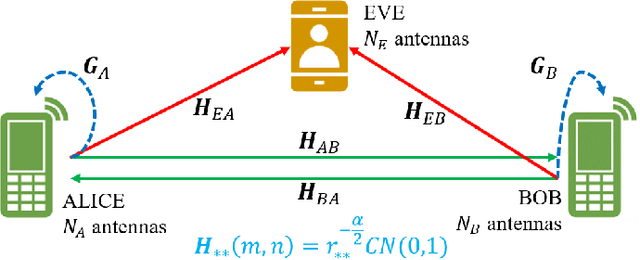
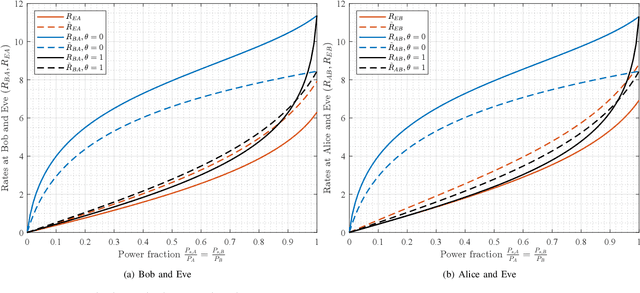
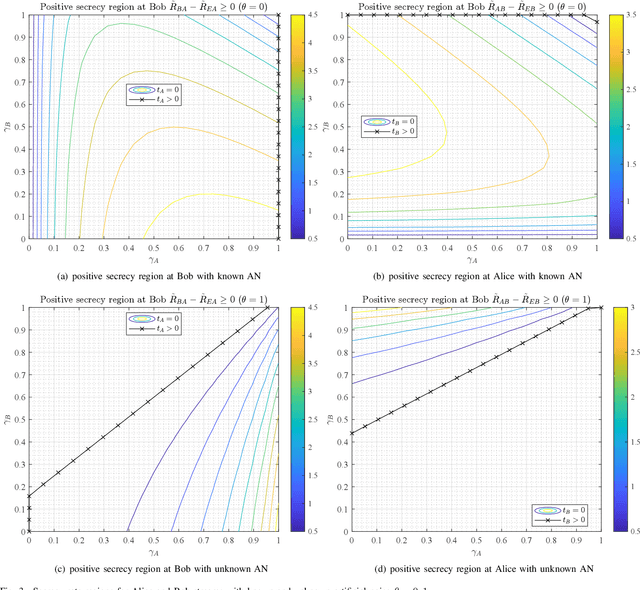
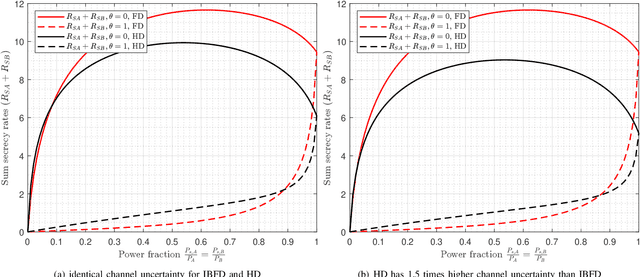
In this paper, we consider a two-way wiretap Multi-Input Multi-Output Multi-antenna Eve (MIMOME) channel, where both nodes (Alice and Bob) transmit and receive in an in-band full-duplex (IBFD) manner. For this system with keyless security, we provide a novel artificial noise (AN) based signal design, where the AN is injected in both signal and null spaces. We present an ergodic secrecy rate approximation to derive the power allocation algorithm. We consider scenarios where AN is known and unknown to legitimate users and include imperfect channel information effects. To maximize secrecy rates subject to the transmit power constraint, a two-step power allocation solution is proposed, where the first step is known at Eve, and the second step helps to improve the secrecy further. We also consider scenarios where partial information is known by Eve and the effects of non-ideal self-interference cancellation. The usefulness and limitations of the resulting power allocation solution are analyzed and verified via simulations. Results show that secrecy rates are less when AN is unknown to receivers or Eve has more information about legitimate users. Since the ergodic approximation only considers Eves distance, the resulting power allocation provides secrecy rates close to the actual ones.
Two-Timescale Design for Active STAR-RIS Aided Massive MIMO Systems
Feb 15, 2024Simultaneously transmitting and reflecting \textcolor{black}{reconfigurable intelligent surface} (STAR-RIS) is a promising implementation of RIS-assisted systems that enables full-space coverage. However, STAR-RIS as well as conventional RIS suffer from the double-fading effect. Thus, in this paper, we propose the marriage of active RIS and STAR-RIS, denoted as ASTARS for massive multiple-input multiple-output (mMIMO) systems, and we focus on the energy splitting (ES) and mode switching (MS) protocols. Compared to prior literature, we consider the impact of correlated fading, and we rely our analysis on the two timescale protocol, being dependent on statistical channel state information (CSI). On this ground, we propose a channel estimation method for ASTARS with reduced overhead that accounts for its architecture. Next, we derive a \textcolor{black}{closed-form expression} for the achievable sum-rate for both types of users in the transmission and reflection regions in a unified approach with significant practical advantages such as reduced complexity and overhead, which result in a lower number of required iterations for convergence compared to an alternating optimization (AO) approach. Notably, we maximize simultaneously the amplitudes, the phase shifts, and the active amplifying coefficients of the ASTARS by applying the projected gradient ascent method (PGAM). Remarkably, the proposed optimization can be executed at every several coherence intervals that reduces the processing burden considerably. Simulations corroborate the analytical results, provide insight into the effects of fundamental variables on the sum achievable SE, and present the superiority of 16 ASTARS compared to passive STAR-RIS for a practical number of surface elements.