 Add to Chrome
 Add to Firefox
 Add to Edge
Power consumption and spectral efficiency analysis for uplink analog radio-over-fiber
May 31, 2026
Radio-over-fiber centralizes radio access networks by using a low-loss optical fiber link between the remote radio head and the central unit. Analog radio-over-fiber (A-RoF) transmits RF signals modulated directly onto an optical carrier, avoiding digitization and digital signal processing at the remote radio head. In this way, A-RoF shifts power-hungry processing from the antenna to the baseband unit. This paper outlines a mathematical framework to analyze the effect of fiber nonlinearity in an uplink wireless system supported by A-RoF. We model an input/output relationship that incorporates the wireless channel, thermal noise, and impairments encountered in the optical fiber channel: chromatic dispersion, electrical-to-optical conversion loss, amplification noise, and fiber nonlinear interference. We compare A-RoF with DSP-assisted A-RoF and digital radio receivers. Our results show that A-RoF achieves higher energy efficiency as compared to digital receivers with 8- and 16-bit analog-to-digital converters and DSP-assisted A-RoF. We further characterize the trade-offs among transmit power, nonlinear interference, and spectral efficiency, demonstrating that nonlinear effects fundamentally limit achievable rates. These results identify the linear operating regions where A-RoF is most effective for uplink wireless communication.

Signal Processing Foundations of Reconfigurable Antennas in the Tri-Hybrid MIMO Architecture
Apr 26, 2026To enable larger apertures in multipleinput multipleoutput MIMO systems the trihybrid MIMO architecture offers a promising lowcost and lowpower solution by introducing reconfigurable antennas as a third layer of precoding on top of conventional digital and analog processing In this paper we develop a unified signal processing framework for trihybrid MIMO that explicitly captures the electromagnetic EM characteristics of diverse reconfigurable antenna technologies We first propose a generic inputoutput model that incorporates the reconfigurable antenna layer into an effective channel representation revealing a fundamental coupling between the channel precoder and radiated power Building on this model we formulate a general optimization problem that jointly accounts for digital analog and antennadomain precoding under hardware and power constraints We then instantiate this framework across seven representative reconfigurable antenna architectures including parasitic arrays dynamic metasurface antennas fluidpixel antennas polarizationreconfigurable antennas stacked intelligent metasurfaces pinching antenna systems and nonradiating wires To systematically compare these heterogeneous architectures we introduce a new metric the reconfigurability efficiency factor REF which quantifies the performance gains achievable through antenna reconfiguration under realistic constraints Numerical results demonstrate the tradeoffs among aperture size power consumption hardware complexity and spectral efficiency Our results establish that EMlevel reconfiguration reshapes the signal processing design space highlighting the need for new architectures and algorithms that jointly optimize across digital analog and electromagnetic domains This work reveals that electromagnetic reconfiguration couples the channel and precoder
Switch-DFT: Adaptive Waveform and MIMO Switching for Energy-Efficient Base Stations
Mar 28, 2026Energy efficiency has emerged as a critical challenge in modern base stations (BSs), as the power amplifier (PA) consumes a substantial portion of the total power due to its limited efficiency. We investigate waveform and mode adaptation to enhance the energy efficiency of BSs. We propose Switch-DFT, an adaptive switching framework that selects between cyclic prefix orthogonal frequency division multiplexing (CP-OFDM) and discrete Fourier transform-spread-OFDM (DFT-s-OFDM) waveforms, as well as between single-input multiple-output (SIMO) and multiple-input multiple-output (MIMO) modes. Switch-DFT improves efficiency by reducing PA backoff with DFT-s-OFDM and achieves the target rate at lower power by leveraging higher MIMO throughput. This results in superior energy efficiency over a wide range of the spectral efficiencies compared with static configurations.
Fixed-wing UAV relay optimization for coverage hole recovery
Mar 27, 2026Unmanned aerial vehicles (UAVs) fill coverage holes as wireless relays during emergency situations. Fixed-wing UAVs offer longer flight duration and larger coverage in such situations than rotary-wing counterparts. Maximizing the effectiveness of fixed-wing UAV relay systems requires careful tuning of system and flight parameters. This process is challenging because factors including flight trajectory, timeshare, and user scheduling are not easily optimized. In this paper, we propose an optimization for UAV-based wireless relaying networks based on a setup which is applicable to arbitrary spatial user positions. In the setup, a fixed-wing UAV flies over a circular trajectory and relays data from ground users in a coverage hole to a distant base station (BS). Our optimization iteratively maximizes the average achievable spectral efficiency (SE) for the UAV trajectory, user scheduling, and relay timeshare. The simulation results show that our optimization is effective for varying user distributions and that it performs especially well on distributions with a high standard deviation.
A Short and Unified Convergence Analysis of the SAG, SAGA, and IAG Algorithms
Feb 05, 2026Stochastic variance-reduced algorithms such as Stochastic Average Gradient (SAG) and SAGA, and their deterministic counterparts like the Incremental Aggregated Gradient (IAG) method, have been extensively studied in large-scale machine learning. Despite their popularity, existing analyses for these algorithms are disparate, relying on different proof techniques tailored to each method. Furthermore, the original proof of SAG is known to be notoriously involved, requiring computer-aided analysis. Focusing on finite-sum optimization with smooth and strongly convex objective functions, our main contribution is to develop a single unified convergence analysis that applies to all three algorithms: SAG, SAGA, and IAG. Our analysis features two key steps: (i) establishing a bound on delays due to stochastic sub-sampling using simple concentration tools, and (ii) carefully designing a novel Lyapunov function that accounts for such delays. The resulting proof is short and modular, providing the first high-probability bounds for SAG and SAGA that can be seamlessly extended to non-convex objectives and Markov sampling. As an immediate byproduct of our new analysis technique, we obtain the best known rates for the IAG algorithm, significantly improving upon prior bounds.
Symbol Distributions in Semantic Communications: A Source-Channel Equilibrium Perspective
Dec 16, 2025Semantic communication systems often use an end-to-end neural network to map input data into continuous symbols. These symbols, which are essentially neural network features, usually have fixed dimensions and heavy-tailed distributions. However, due to the end-to-end training nature of the neural network encoder, the underlying reason for the symbol distribution remains underexplored. We propose a new explanation for the semantic symbol distribution: an inherent trade-off between source coding and communications. Specifically, the encoder balances two objectives: allocating power for minimum \emph{effective codelength} (for source coding) and maximizing mutual information (for communications). We formalize this trade-off via an information-theoretic optimization framework, which yields a Student's $t$-distribution as the resulting symbol distribution. Through extensive studies on image-based semantic systems, we find that our formulation models the learned symbols and predicts how the symbol distribution's shape parameter changes with respect to (i) the use of variable-length coding and (ii) the dataset's entropy variability. Furthermore, we demonstrate how introducing a regularizer that enforces a target symbol distribution, which guides the encoder towards a target prior (e.g., Gaussian), improves training convergence and supports our hypothesis.
Achieving Tighter Finite-Time Rates for Heterogeneous Federated Stochastic Approximation under Markovian Sampling
Apr 15, 2025Motivated by collaborative reinforcement learning (RL) and optimization with time-correlated data, we study a generic federated stochastic approximation problem involving $M$ agents, where each agent is characterized by an agent-specific (potentially nonlinear) local operator. The goal is for the agents to communicate intermittently via a server to find the root of the average of the agents' local operators. The generality of our setting stems from allowing for (i) Markovian data at each agent and (ii) heterogeneity in the roots of the agents' local operators. The limited recent work that has accounted for both these features in a federated setting fails to guarantee convergence to the desired point or to show any benefit of collaboration; furthermore, they rely on projection steps in their algorithms to guarantee bounded iterates. Our work overcomes each of these limitations. We develop a novel algorithm titled \texttt{FedHSA}, and prove that it guarantees convergence to the correct point, while enjoying an $M$-fold linear speedup in sample-complexity due to collaboration. To our knowledge, \emph{this is the first finite-time result of its kind}, and establishing it (without relying on a projection step) entails a fairly intricate argument that accounts for the interplay between complex temporal correlations due to Markovian sampling, multiple local steps to save communication, and the drift-effects induced by heterogeneous local operators. Our results have implications for a broad class of heterogeneous federated RL problems (e.g., policy evaluation and control) with function approximation, where the agents' Markov decision processes can differ in their probability transition kernels and reward functions.
Next-slot OFDM-CSI Prediction: Multi-head Self-attention or State Space Model?
May 17, 2024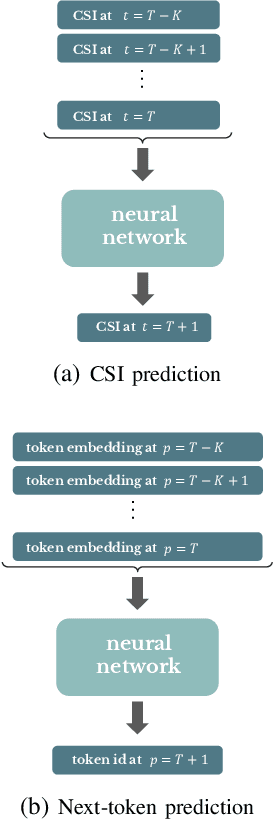
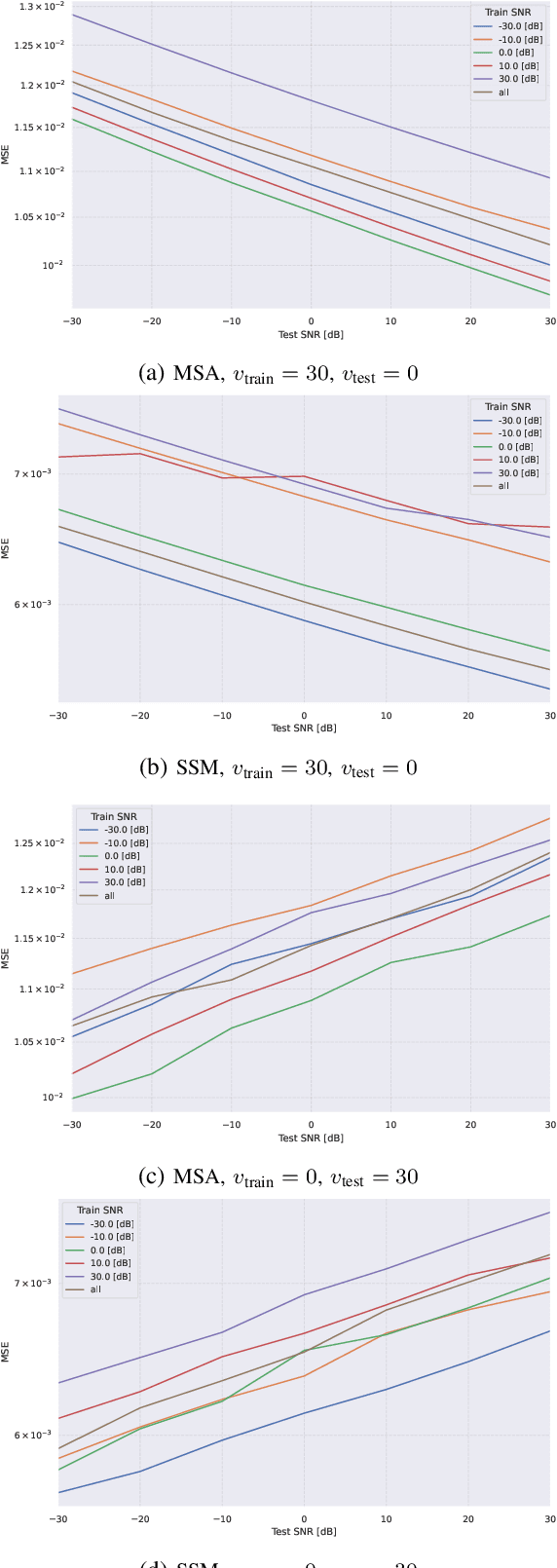
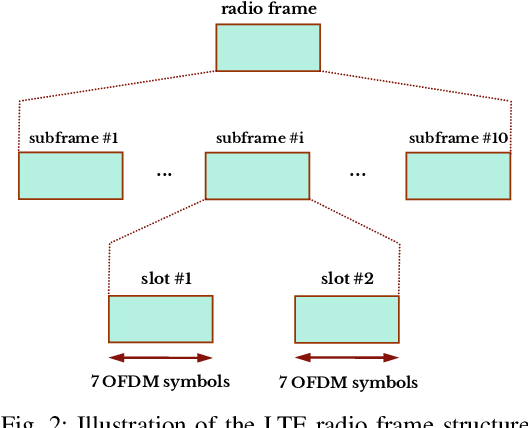
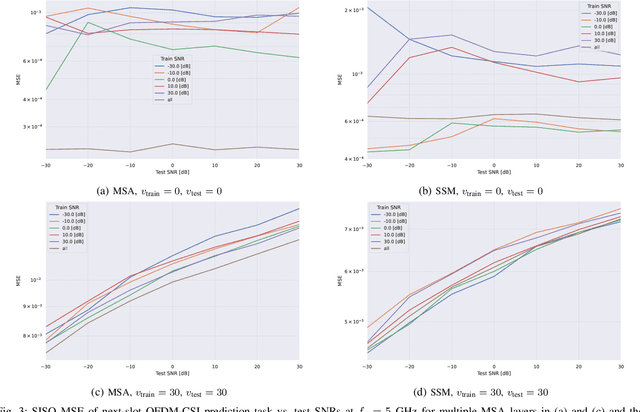
The ongoing fifth-generation (5G) standardization is exploring the use of deep learning (DL) methods to enhance the new radio (NR) interface. Both in academia and industry, researchers are investigating the performance and complexity of multiple DL architecture candidates for specific one-sided and two-sided use cases such as channel state estimation (CSI) feedback, CSI prediction, beam management, and positioning. In this paper, we set focus on the CSI prediction task and study the performance and generalization of the two main DL layers that are being extensively benchmarked within the DL community, namely, multi-head self-attention (MSA) and state-space model (SSM). We train and evaluate MSA and SSM layers to predict the next slot for uplink and downlink communication scenarios over urban microcell (UMi) and urban macrocell (UMa) OFDM 5G channel models. Our numerical results demonstrate that SSMs exhibit better prediction and generalization capabilities than MSAs only for SISO cases. For MIMO scenarios, however, the MSA layer outperforms the SSM one. While both layers represent potential DL architectures for future DL-enabled 5G use cases, the overall investigation of this paper favors MSAs over SSMs.
Super-Wideband Massive MIMO
Aug 02, 2022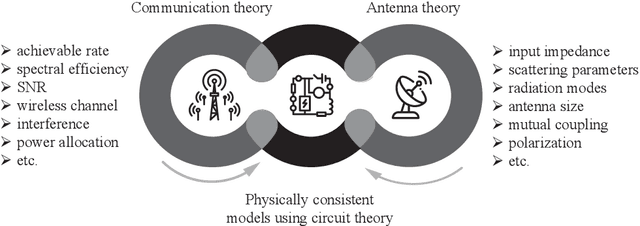
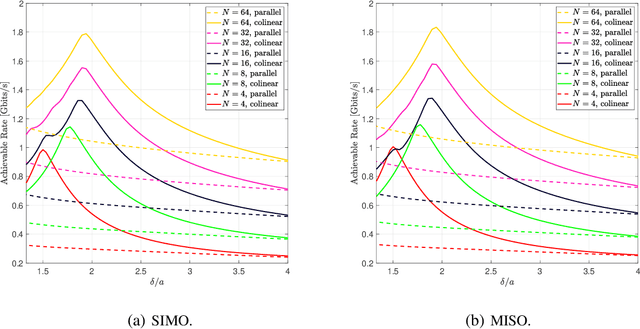
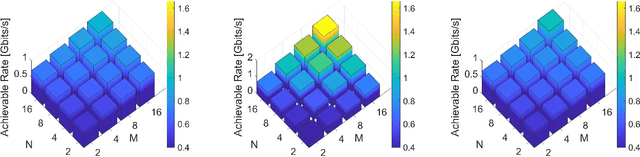
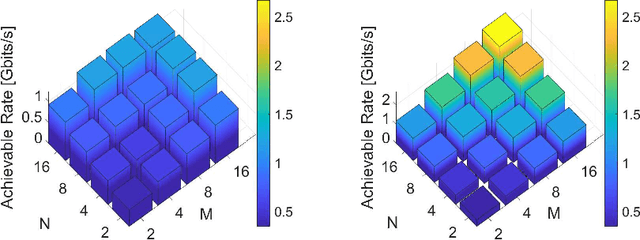
We present a unified model for connected antenna arrays with a massive (but finite) number of tightly integrated (i.e., coupled) antennas in a compact space within the context of massive multiple-input multiple-output (MIMO) communication. We refer to this system as tightly-coupled massive MIMO. From an information-theoretic perspective, scaling the design of tightly-coupled massive MIMO systems in terms of the number of antennas, the operational bandwidth, and form factor was not addressed in prior art and hence not clearly understood. We investigate this open research problem using a physically consistent modeling approach for far-field (FF) MIMO communication based on multi-port circuit theory. In doing so, we turn mutual coupling (MC) from a foe to a friend of MIMO systems design, thereby challenging a basic percept in antenna systems engineering that promotes MC mitigation/compensation. We show that tight MC widens the operational bandwidth of antenna arrays thereby unleashing a missing MIMO gain that we coin "bandwidth gain". Furthermore, we derive analytically the asymptotically optimum spacing-to-antenna-size ratio by establishing a condition for tight coupling in the limit of large-size antenna arrays with quasi-continuous apertures. We also optimize the antenna array size while maximizing the achievable rate under fixed transmit power and inter-element spacing. Then, we study the impact of MC on the achievable rate of MIMO systems under light-of-sight (LoS) and Rayleigh fading channels. These results reveal new insights into the design of tightly-coupled massive antenna arrays as opposed to the widely-adopted "disconnected" designs that disregard MC by putting faith in the half-wavelength spacing rule.
Challenges and Opportunities of Future Rural Wireless Communications
Aug 11, 2021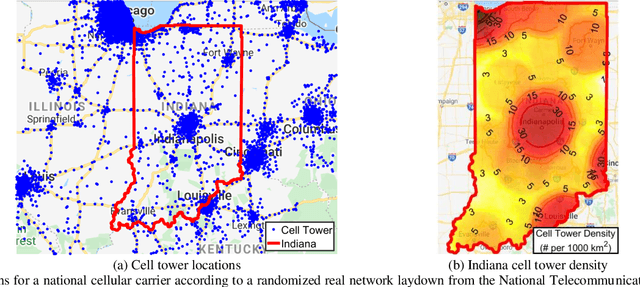
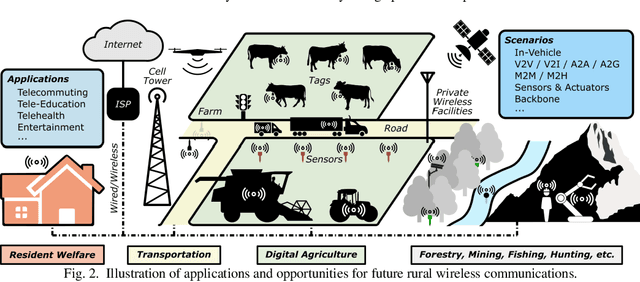
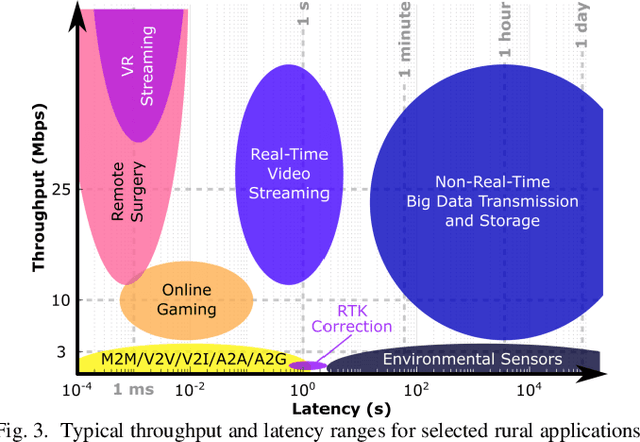
Broadband access is key to ensuring robust economic development and improving quality of life. Unfortunately, the communication infrastructure deployed in rural areas throughout the world lags behind its urban counterparts due to low population density and economics. This article examines the motivations and challenges of providing broadband access over vast rural regions, with an emphasis on the wireless aspect in view of its irreplaceable role in closing the digital gap. Applications and opportunities for future rural wireless communications are discussed for a variety of areas, including residential welfare, digital agriculture, and transportation. This article also comprehensively investigates current and emerging wireless technologies that could facilitate rural deployment. Although there is no simple solution, there is an urgent need for researchers to work on coverage, cost, and reliability of rural wireless access.