 Add to Chrome
 Add to Firefox
 Add to Edge
JADE: Expert-Grounded Dynamic Evaluation for Open-Ended Professional Tasks
Feb 06, 2026
Evaluating agentic AI on open-ended professional tasks faces a fundamental dilemma between rigor and flexibility. Static rubrics provide rigorous, reproducible assessment but fail to accommodate diverse valid response strategies, while LLM-as-a-judge approaches adapt to individual responses yet suffer from instability and bias. Human experts address this dilemma by combining domain-grounded principles with dynamic, claim-level assessment. Inspired by this process, we propose JADE, a two-layer evaluation framework. Layer 1 encodes expert knowledge as a predefined set of evaluation skills, providing stable evaluation criteria. Layer 2 performs report-specific, claim-level evaluation to flexibly assess diverse reasoning strategies, with evidence-dependency gating to invalidate conclusions built on refuted claims. Experiments on BizBench show that JADE improves evaluation stability and reveals critical agent failure modes missed by holistic LLM-based evaluators. We further demonstrate strong alignment with expert-authored rubrics and effective transfer to a medical-domain benchmark, validating JADE across professional domains. Our code is publicly available at https://github.com/smiling-world/JADE.

Denoising Time Cycle Modeling for Recommendation
Feb 05, 2024
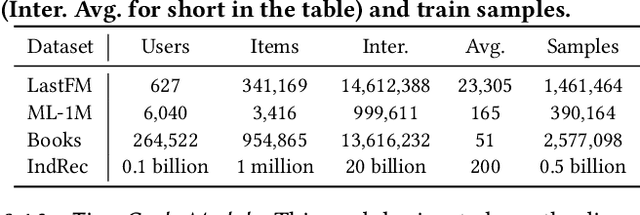


Recently, modeling temporal patterns of user-item interactions have attracted much attention in recommender systems. We argue that existing methods ignore the variety of temporal patterns of user behaviors. We define the subset of user behaviors that are irrelevant to the target item as noises, which limits the performance of target-related time cycle modeling and affect the recommendation performance. In this paper, we propose Denoising Time Cycle Modeling (DiCycle), a novel approach to denoise user behaviors and select the subset of user behaviors that are highly related to the target item. DiCycle is able to explicitly model diverse time cycle patterns for recommendation. Extensive experiments are conducted on both public benchmarks and a real-world dataset, demonstrating the superior performance of DiCycle over the state-of-the-art recommendation methods.
COUPA: An Industrial Recommender System for Online to Offline Service Platforms
Apr 25, 2023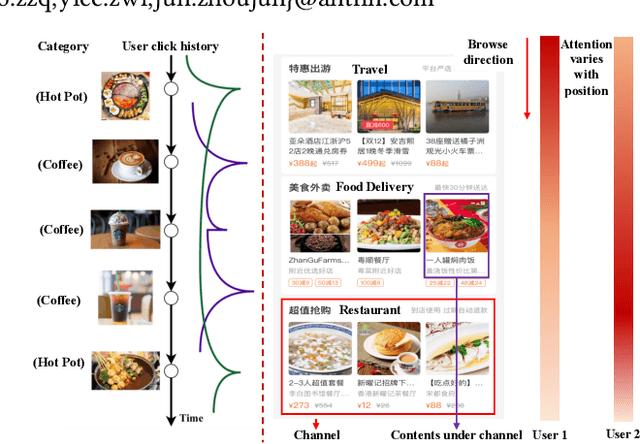
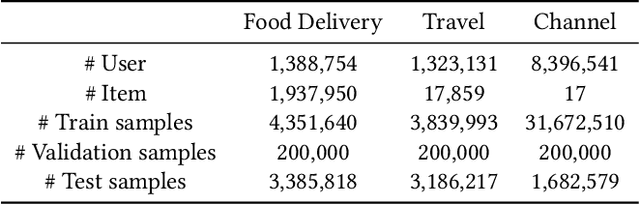
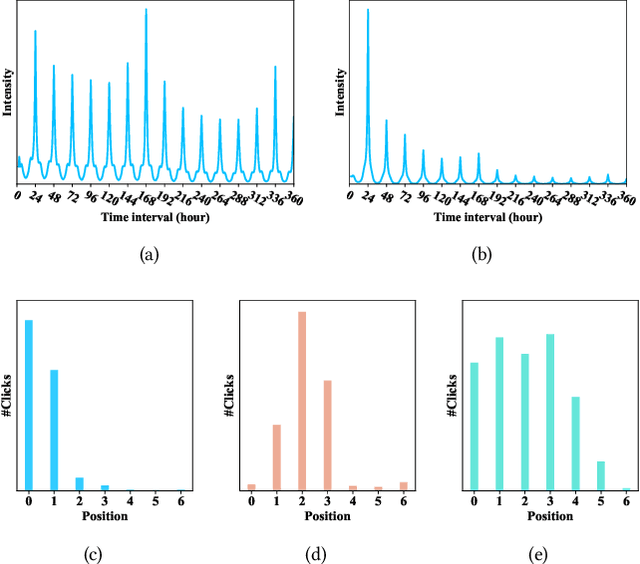

Aiming at helping users locally discovery retail services (e.g., entertainment and dinning), Online to Offline (O2O) service platforms have become popular in recent years, which greatly challenge current recommender systems. With the real data in Alipay, a feeds-like scenario for O2O services, we find that recurrence based temporal patterns and position biases commonly exist in our scenarios, which seriously threaten the recommendation effectiveness. To this end, we propose COUPA, an industrial system targeting for characterizing user preference with following two considerations: (1) Time aware preference: we employ the continuous time aware point process equipped with an attention mechanism to fully capture temporal patterns for recommendation. (2) Position aware preference: a position selector component equipped with a position personalization module is elaborately designed to mitigate position bias in a personalized manner. Finally, we carefully implement and deploy COUPA on Alipay with a cooperation of edge, streaming and batch computing, as well as a two-stage online serving mode, to support several popular recommendation scenarios. We conduct extensive experiments to demonstrate that COUPA consistently achieves superior performance and has potential to provide intuitive evidences for recommendation