 Add to Chrome
 Add to Firefox
 Add to Edge
JADE: Expert-Grounded Dynamic Evaluation for Open-Ended Professional Tasks
Feb 06, 2026
Evaluating agentic AI on open-ended professional tasks faces a fundamental dilemma between rigor and flexibility. Static rubrics provide rigorous, reproducible assessment but fail to accommodate diverse valid response strategies, while LLM-as-a-judge approaches adapt to individual responses yet suffer from instability and bias. Human experts address this dilemma by combining domain-grounded principles with dynamic, claim-level assessment. Inspired by this process, we propose JADE, a two-layer evaluation framework. Layer 1 encodes expert knowledge as a predefined set of evaluation skills, providing stable evaluation criteria. Layer 2 performs report-specific, claim-level evaluation to flexibly assess diverse reasoning strategies, with evidence-dependency gating to invalidate conclusions built on refuted claims. Experiments on BizBench show that JADE improves evaluation stability and reveals critical agent failure modes missed by holistic LLM-based evaluators. We further demonstrate strong alignment with expert-authored rubrics and effective transfer to a medical-domain benchmark, validating JADE across professional domains. Our code is publicly available at https://github.com/smiling-world/JADE.

AACP: Model Compression by Accurate and Automatic Channel Pruning
Jan 31, 2021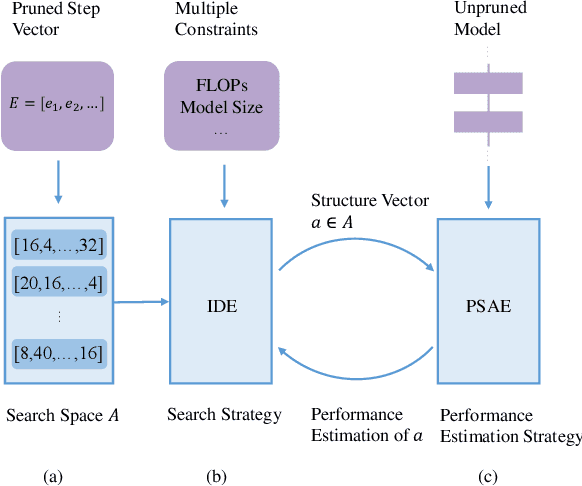
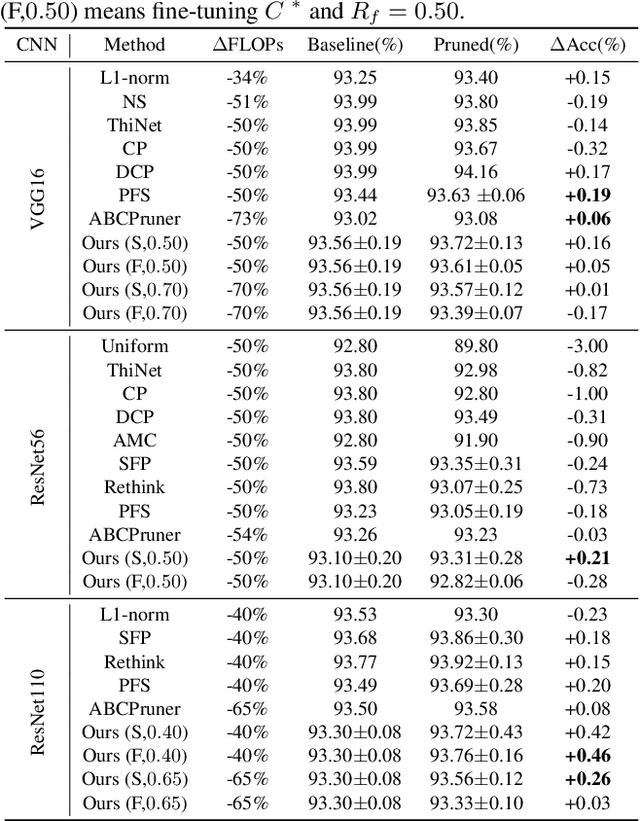
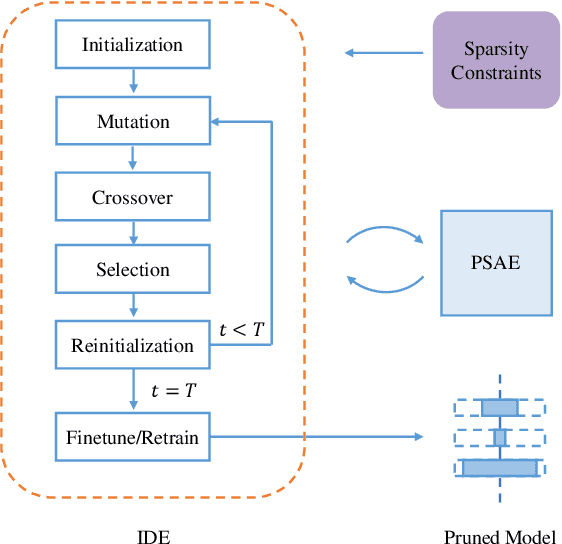
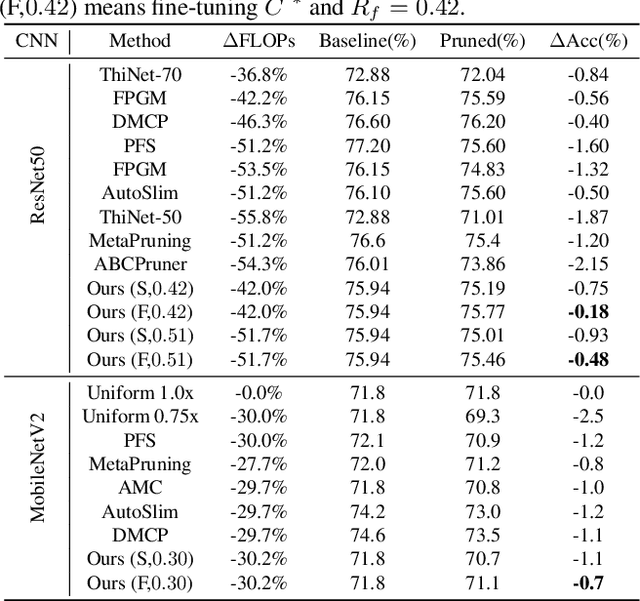
Channel pruning is formulated as a neural architecture search (NAS) problem recently. However, existing NAS-based methods are challenged by huge computational cost and inflexibility of applications. How to deal with multiple sparsity constraints simultaneously and speed up NAS-based channel pruning are still open challenges. In this paper, we propose a novel Accurate and Automatic Channel Pruning (AACP) method to address these problems. Firstly, AACP represents the structure of a model as a structure vector and introduces a pruning step vector to control the compressing granularity of each layer. Secondly, AACP utilizes Pruned Structure Accuracy Estimator (PSAE) to speed up the performance estimation process. Thirdly, AACP proposes Improved Differential Evolution (IDE) algorithm to search the optimal structure vector effectively. Because of IDE, AACP can deal with FLOPs constraint and model size constraint simultaneously and efficiently. Our method can be easily applied to various tasks and achieve state of the art performance. On CIFAR10, our method reduces $65\%$ FLOPs of ResNet110 with an improvement of $0.26\%$ top-1 accuracy. On ImageNet, we reduce $42\%$ FLOPs of ResNet50 with a small loss of $0.18\%$ top-1 accuracy and reduce $30\%$ FLOPs of MobileNetV2 with a small loss of $0.7\%$ top-1 accuracy. The source code will be released after publication.