 Add to Chrome
 Add to Firefox
 Add to Edge
NegROI: Click-Centric Uncertainty-Guided Refinement with Scene-Conditioned Negative Prompts for Robust Interactive 3D Segmentation
Jul 07, 2026
Interactive 3D segmentation aims to extract object masks in point clouds with minimal user clicks. Despite recent progress, most existing approaches still struggle with (i) coarse voxel resolution that blurs fine boundaries under limited clicks and (ii) hard false positives caused by confusing background structures. These issues are exacerbated by density and scale shifts across datasets (e.g., dense RGB-D reconstructions vs. sparse LiDAR scans), where fixed refinement heuristics and purely click-driven decoding generalize poorly. To address them, we propose NegROI -- a novel transformer-based interactive framework that couples click-centric multi-resolution refinement with scene-conditioned negative prompts. Given a coarse voxel prediction, it refines only a local Region Of Interest (ROI) around the current click on a finer grid and fuses refined logits back to the coarse mask. To improve robustness and efficiency, we introduce uncertainty-driven selective refinement that prioritizes ambiguous regions. Meanwhile, we model hard background patterns via a set of scene-conditioned negative prompts obtained by cross-attention over scene tokens. We further stabilize these prompts with a diversity regularizer. Finally, we propose boundary-aware hard negative mining to supervise negative-prompt attention toward boundary-proximal, high-confidence false positives. Our experiments on common benchmark datasets (i.e., ScanNet, S3DIS, and KITTI) demonstrate improved click efficiency and reduced false positives, with stronger cross-dataset robustness than the state-of-the-art baselines.

AdaFlow: Efficient Long Video Editing via Adaptive Attention Slimming And Keyframe Selection
Feb 08, 2025Despite great progress, text-driven long video editing is still notoriously challenging mainly due to excessive memory overhead. Although recent efforts have simplified this task into a two-step process of keyframe translation and interpolation generation, the token-wise keyframe translation still plagues the upper limit of video length. In this paper, we propose a novel and training-free approach towards efficient and effective long video editing, termed AdaFlow. We first reveal that not all tokens of video frames hold equal importance for keyframe translation, based on which we propose an Adaptive Attention Slimming scheme for AdaFlow to squeeze the $KV$ sequence, thus increasing the number of keyframes for translations by an order of magnitude. In addition, an Adaptive Keyframe Selection scheme is also equipped to select the representative frames for joint editing, further improving generation quality. With these innovative designs, AdaFlow achieves high-quality long video editing of minutes in one inference, i.e., more than 1$k$ frames on one A800 GPU, which is about ten times longer than the compared methods, e.g., TokenFlow. To validate AdaFlow, we also build a new benchmark for long video editing with high-quality annotations, termed LongV-EVAL. Our code is released at: https://github.com/jidantang55/AdaFlow.
What makes a good data augmentation for few-shot unsupervised image anomaly detection?
Apr 21, 2023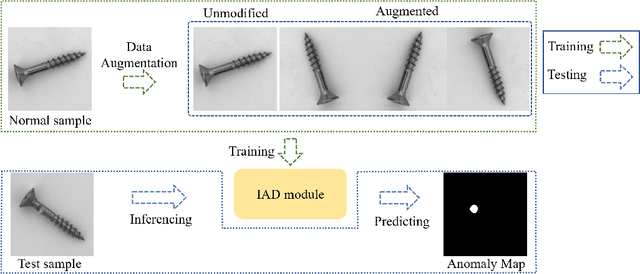
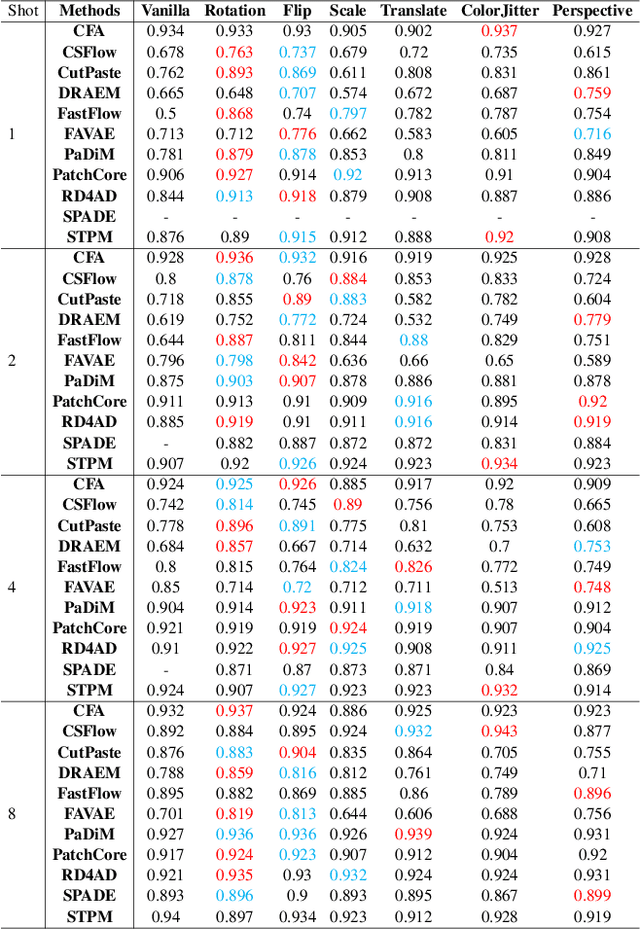
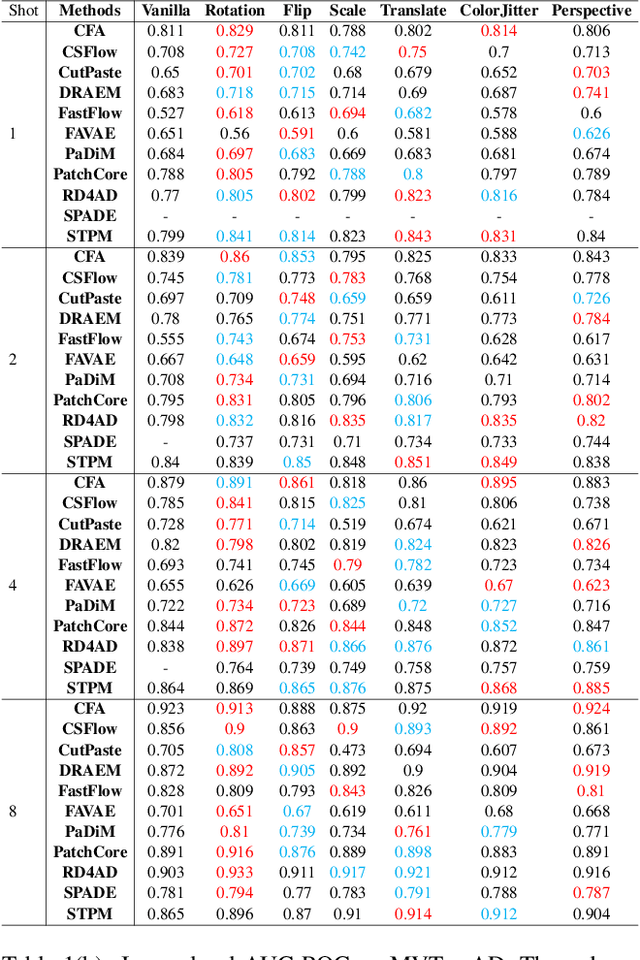
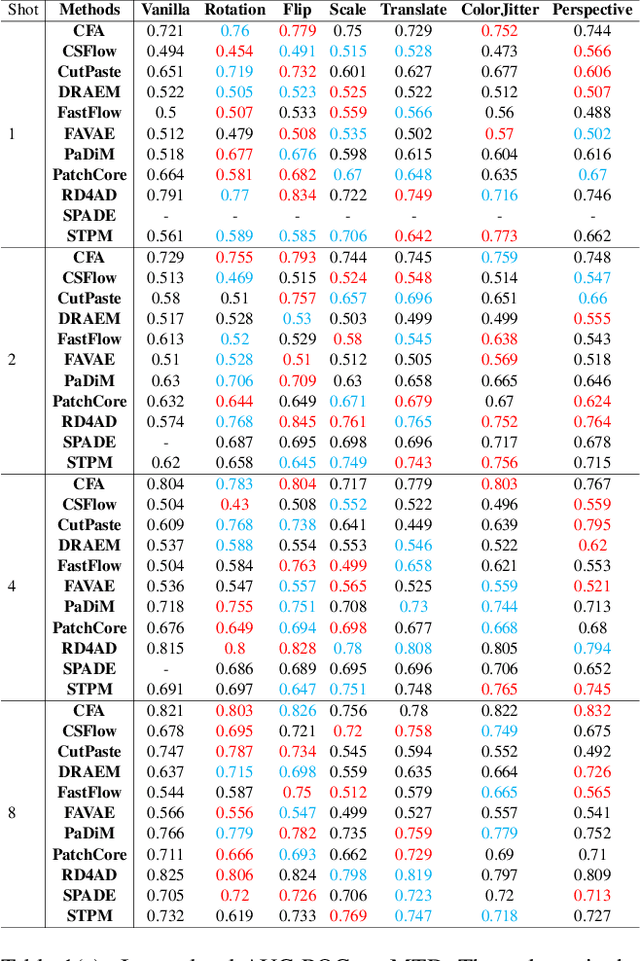
Data augmentation is a promising technique for unsupervised anomaly detection in industrial applications, where the availability of positive samples is often limited due to factors such as commercial competition and sample collection difficulties. In this paper, how to effectively select and apply data augmentation methods for unsupervised anomaly detection is studied. The impact of various data augmentation methods on different anomaly detection algorithms is systematically investigated through experiments. The experimental results show that the performance of different industrial image anomaly detection (termed as IAD) algorithms is not significantly affected by the specific data augmentation method employed and that combining multiple data augmentation methods does not necessarily yield further improvements in the accuracy of anomaly detection, although it can achieve excellent results on specific methods. These findings provide useful guidance on selecting appropriate data augmentation methods for different requirements in IAD.
Cardiac Functional Analysis with Cine MRI via Deep Learning Reconstruction
May 17, 2021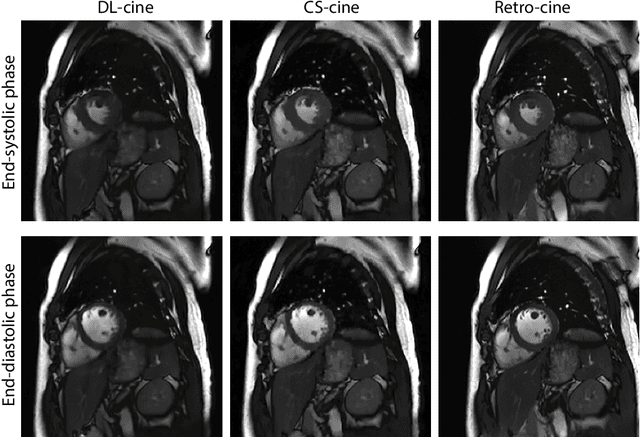
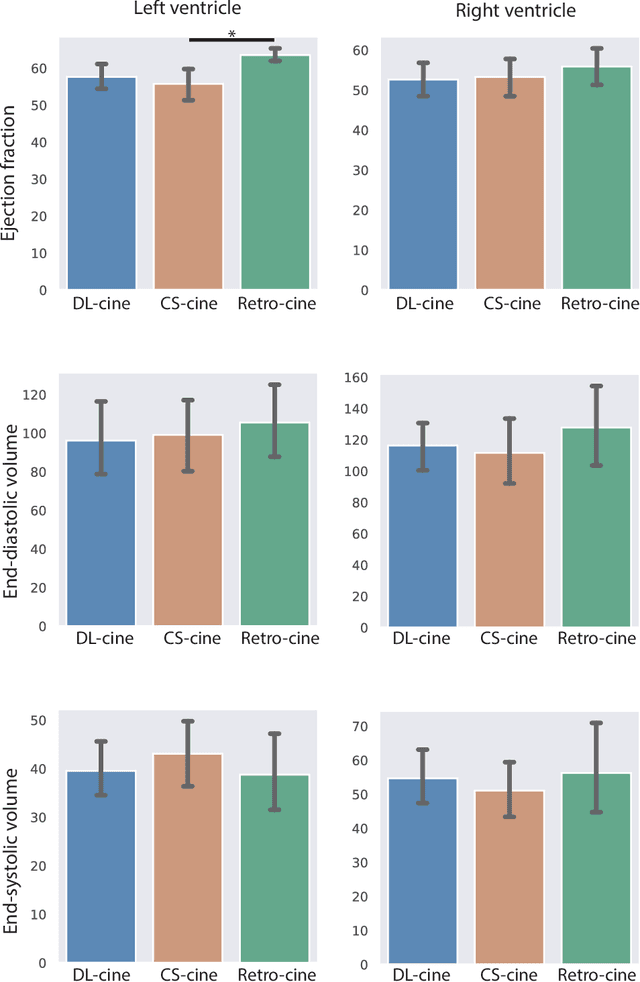
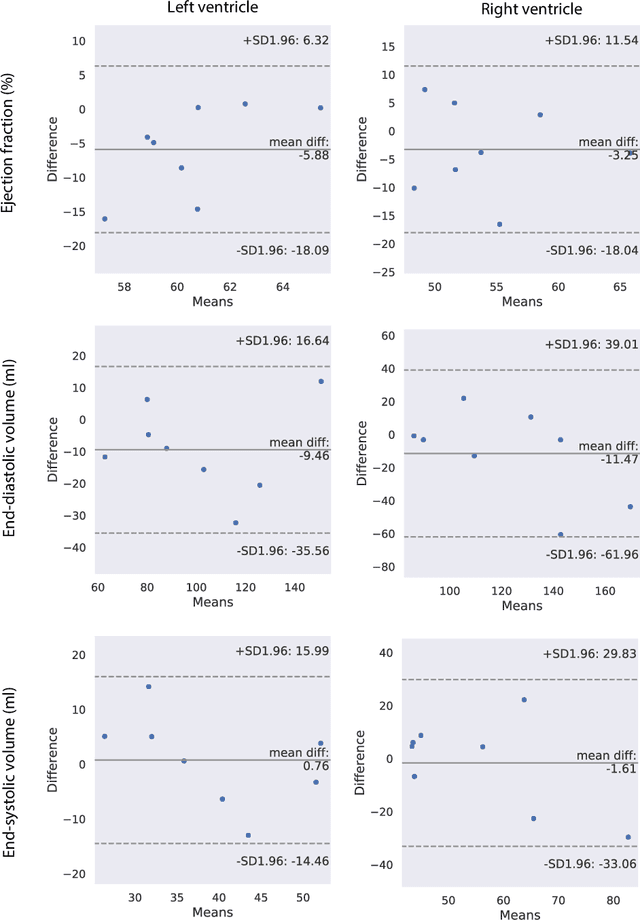
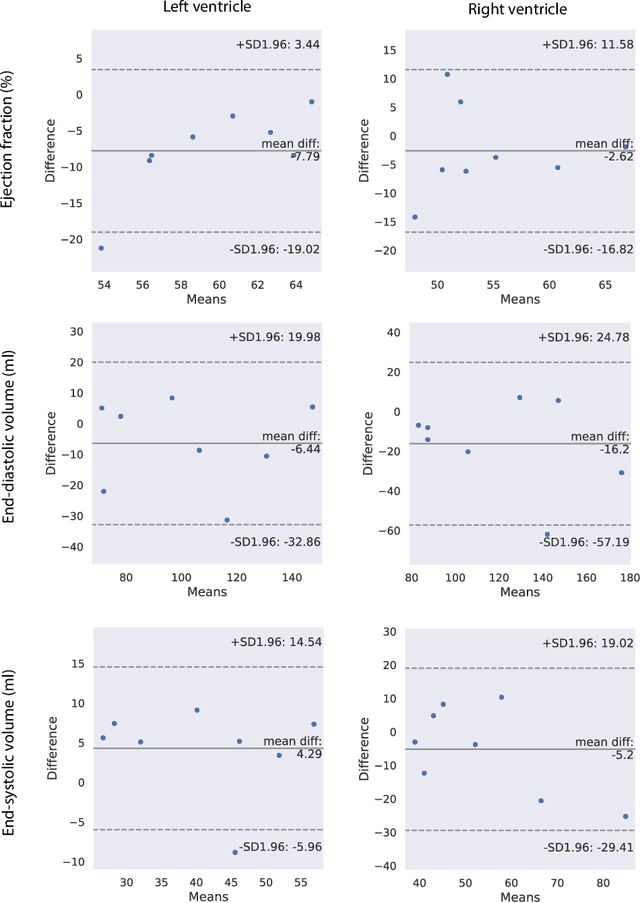
Retrospectively gated cine (retro-cine) MRI is the clinical standard for cardiac functional analysis. Deep learning (DL) based methods have been proposed for the reconstruction of highly undersampled MRI data and show superior image quality and magnitude faster reconstruction time than CS-based methods. Nevertheless, it remains unclear whether DL reconstruction is suitable for cardiac function analysis. To address this question, in this study we evaluate and compare the cardiac functional values (EDV, ESV and EF for LV and RV, respectively) obtained from highly accelerated MRI acquisition using DL based reconstruction algorithm (DL-cine) with values from CS-cine and conventional retro-cine. To the best of our knowledge, this is the first work to evaluate the cine MRI with deep learning reconstruction for cardiac function analysis and compare it with other conventional methods. The cardiac functional values obtained from cine MRI with deep learning reconstruction are consistent with values from clinical standard retro-cine MRI.