 Add to Chrome
 Add to Firefox
 Add to Edge
KnowRL: Boosting LLM Reasoning via Reinforcement Learning with Minimal-Sufficient Knowledge Guidance
Apr 14, 2026
RLVR improves reasoning in large language models, but its effectiveness is often limited by severe reward sparsity on hard problems. Recent hint-based RL methods mitigate sparsity by injecting partial solutions or abstract templates, yet they typically scale guidance by adding more tokens, which introduce redundancy, inconsistency, and extra training overhead. We propose \textbf{KnowRL} (Knowledge-Guided Reinforcement Learning), an RL training framework that treats hint design as a minimal-sufficient guidance problem. During RL training, KnowRL decomposes guidance into atomic knowledge points (KPs) and uses Constrained Subset Search (CSS) to construct compact, interaction-aware subsets for training. We further identify a pruning interaction paradox -- removing one KP may help while removing multiple such KPs can hurt -- and explicitly optimize for robust subset curation under this dependency structure. We train KnowRL-Nemotron-1.5B from OpenMath-Nemotron-1.5B. Across eight reasoning benchmarks at the 1.5B scale, KnowRL-Nemotron-1.5B consistently outperforms strong RL and hinting baselines. Without KP hints at inference, KnowRL-Nemotron-1.5B reaches 70.08 average accuracy, already surpassing Nemotron-1.5B by +9.63 points; with selected KPs, performance improves to 74.16, establishing a new state of the art at this scale. The model, curated training data, and code are publicly available at https://github.com/Hasuer/KnowRL.

Sparse Growing Transformer: Training-Time Sparse Depth Allocation via Progressive Attention Looping
Mar 25, 2026Existing approaches to increasing the effective depth of Transformers predominantly rely on parameter reuse, extending computation through recursive execution. Under this paradigm, the network structure remains static along the training timeline, and additional computational depth is uniformly assigned to entire blocks at the parameter level. This rigidity across training time and parameter space leads to substantial computational redundancy during training. In contrast, we argue that depth allocation during training should not be a static preset, but rather a progressively growing structural process. Our systematic analysis reveals a deep-to-shallow maturation trajectory across layers, where high-entropy attention heads play a crucial role in semantic integration. Motivated by this observation, we introduce the Sparse Growing Transformer (SGT). SGT is a training-time sparse depth allocation framework that progressively extends recurrence from deeper to shallower layers via targeted attention looping on informative heads. This mechanism induces structural sparsity by selectively increasing depth only for a small subset of parameters as training evolves. Extensive experiments across multiple parameter scales demonstrate that SGT consistently outperforms training-time static block-level looping baselines under comparable settings, while reducing the additional training FLOPs overhead from approximately 16--20% to only 1--3% relative to a standard Transformer backbone.
ATTNPO: Attention-Guided Process Supervision for Efficient Reasoning
Feb 10, 2026Large reasoning models trained with reinforcement learning and verifiable rewards (RLVR) achieve strong performance on complex reasoning tasks, yet often overthink, generating redundant reasoning without performance gains. Existing trajectory-level length penalties often fail to effectively shorten reasoning length and degrade accuracy, as they uniformly treat all reasoning steps and lack fine-grained signals to distinguish redundancy from necessity. Meanwhile, process-supervised methods are typically resource-intensive and suffer from inaccurate credit assignment. To address these issues, we propose ATTNPO, a low-overhead process-supervised RL framework that leverages the model's intrinsic attention signals for step-level credit assignment. We first identify a set of special attention heads that naturally focus on essential steps while suppressing redundant ones. By leveraging the attention scores of these heads, We then employ two sub-strategies to mitigate overthinking by discouraging redundant steps while preserving accuracy by reducing penalties on essential steps. Experimental results show that ATTNPO substantially reduces reasoning length while significantly improving performance across 9 benchmarks.
ExpSeek: Self-Triggered Experience Seeking for Web Agents
Jan 13, 2026Experience intervention in web agents emerges as a promising technical paradigm, enhancing agent interaction capabilities by providing valuable insights from accumulated experiences. However, existing methods predominantly inject experience passively as global context before task execution, struggling to adapt to dynamically changing contextual observations during agent-environment interaction. We propose ExpSeek, which shifts experience toward step-level proactive seeking: (1) estimating step-level entropy thresholds to determine intervention timing using the model's intrinsic signals; (2) designing step-level tailor-designed experience content. Experiments on Qwen3-8B and 32B models across four challenging web agent benchmarks demonstrate that ExpSeek achieves absolute improvements of 9.3% and 7.5%, respectively. Our experiments validate the feasibility and advantages of entropy as a self-triggering signal, reveal that even a 4B small-scale experience model can significantly boost the performance of larger agent models.
S1-Bench: A Simple Benchmark for Evaluating System 1 Thinking Capability of Large Reasoning Models
Apr 14, 2025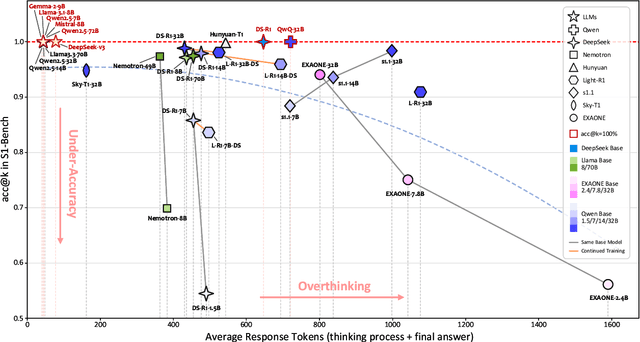
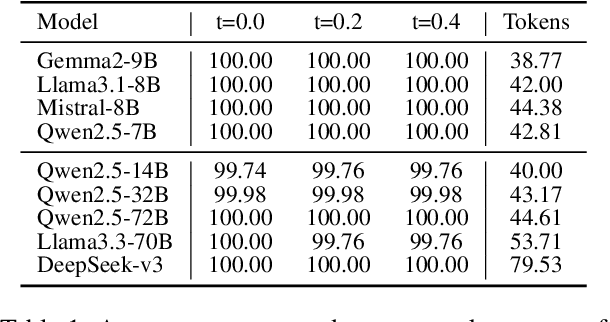
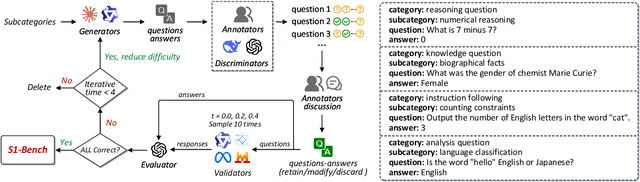
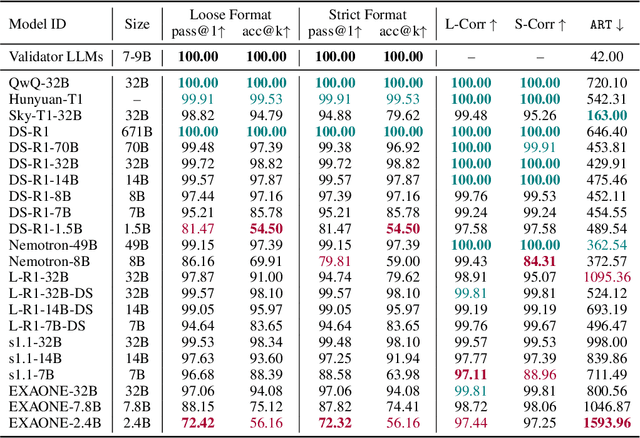
We introduce S1-Bench, a novel benchmark designed to evaluate Large Reasoning Models' (LRMs) performance on simple tasks that favor intuitive system 1 thinking rather than deliberative system 2 reasoning. While LRMs have achieved significant breakthroughs in complex reasoning tasks through explicit chains of thought, their reliance on deep analytical thinking may limit their system 1 thinking capabilities. Moreover, a lack of benchmark currently exists to evaluate LRMs' performance in tasks that require such capabilities. To fill this gap, S1-Bench presents a set of simple, diverse, and naturally clear questions across multiple domains and languages, specifically designed to assess LRMs' performance in such tasks. Our comprehensive evaluation of 22 LRMs reveals significant lower efficiency tendencies, with outputs averaging 15.5 times longer than those of traditional small LLMs. Additionally, LRMs often identify correct answers early but continue unnecessary deliberation, with some models even producing numerous errors. These findings highlight the rigid reasoning patterns of current LRMs and underscore the substantial development needed to achieve balanced dual-system thinking capabilities that can adapt appropriately to task complexity.
Revealing the Challenge of Detecting Character Knowledge Errors in LLM Role-Playing
Sep 18, 2024


Large language model (LLM) role-playing has gained widespread attention, where the authentic character knowledge is crucial for constructing realistic LLM role-playing agents. However, existing works usually overlook the exploration of LLMs' ability to detect characters' known knowledge errors (KKE) and unknown knowledge errors (UKE) while playing roles, which would lead to low-quality automatic construction of character trainable corpus. In this paper, we propose a probing dataset to evaluate LLMs' ability to detect errors in KKE and UKE. The results indicate that even the latest LLMs struggle to effectively detect these two types of errors, especially when it comes to familiar knowledge. We experimented with various reasoning strategies and propose an agent-based reasoning method, Self-Recollection and Self-Doubt (S2RD), to further explore the potential for improving error detection capabilities. Experiments show that our method effectively improves the LLMs' ability to detect error character knowledge, but it remains an issue that requires ongoing attention.