 Add to Chrome
 Add to Firefox
 Add to Edge
GenRec: An LLM-Backed Recommendation Ranker at Netflix
Aug 10, 2026
Large language models (LLMs) are reshaping recommender systems by enabling richer modeling of users, content, and context directly in natural language. At Netflix, we are exploring this direction through GenRec, an LLM-backed recommendation ranker built on top of an in-house foundational LLM. GenRec follows a two-phase framework: Phase 1 adapts an open-source LLM to Netflix data, developing deep understanding of the catalog and member behavior while balancing capabilities such as content understanding and instruction following. Phase 2 post-trains this foundation model with recommendation-ranking specific data, labels, and reward signals, aiming to align the ranker with business requirements and long-term member satisfaction. This paper focuses on Phase 2 and the transition from a traditional discriminative ranker with thousands of engineered features to an LLM-backed ranker driven by verbalized user histories and context. We describe our design for input verbalization and context engineering, post-training data construction, reward integration, model architecture, and a cost-constrained serving design based on a prefill-only inference approach. We report results from a large-scale A/B test comparing GenRec against the current production ranker model, where we show that a GenRec model trained with substantially fewer Phase-2 labeled training examples and input signals can achieve statistically significant gains in offline and online metrics. We discuss how LLM-backed recommenders could shift the recommendation paradigm: from feature engineering to context engineering, and from bespoke architectures to shared foundation backbones. We also outline practical lessons for serving such systems under real-world resource constraints.

From Logs to Language: Learning Optimal Verbalization for LLM-Based Recommendation in Production
Feb 24, 2026Large language models (LLMs) are promising backbones for generative recommender systems, yet a key challenge remains underexplored: verbalization, i.e., converting structured user interaction logs into effective natural language inputs. Existing methods rely on rigid templates that simply concatenate fields, yielding suboptimal representations for recommendation. We propose a data-centric framework that learns verbalization for LLM-based recommendation. Using reinforcement learning, a verbalization agent transforms raw interaction histories into optimized textual contexts, with recommendation accuracy as the training signal. This agent learns to filter noise, incorporate relevant metadata, and reorganize information to improve downstream predictions. Experiments on a large-scale industrial streaming dataset show that learned verbalization delivers up to 93% relative improvement in discovery item recommendation accuracy over template-based baselines. Further analysis reveals emergent strategies such as user interest summarization, noise removal, and syntax normalization, offering insights into effective context construction for LLM-based recommender systems.
SSL4EO-L: Datasets and Foundation Models for Landsat Imagery
Jun 15, 2023

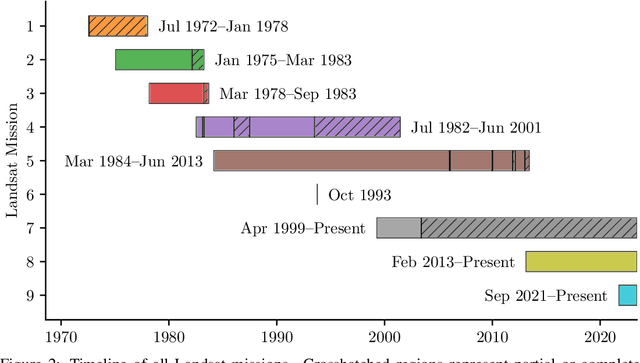

The Landsat program is the longest-running Earth observation program in history, with 50+ years of data acquisition by 8 satellites. The multispectral imagery captured by sensors onboard these satellites is critical for a wide range of scientific fields. Despite the increasing popularity of deep learning and remote sensing, the majority of researchers still use decision trees and random forests for Landsat image analysis due to the prevalence of small labeled datasets and lack of foundation models. In this paper, we introduce SSL4EO-L, the first ever dataset designed for Self-Supervised Learning for Earth Observation for the Landsat family of satellites (including 3 sensors and 2 product levels) and the largest Landsat dataset in history (5M image patches). Additionally, we modernize and re-release the L7 Irish and L8 Biome cloud detection datasets, and introduce the first ML benchmark datasets for Landsats 4-5 TM and Landsat 7 ETM+ SR. Finally, we pre-train the first foundation models for Landsat imagery using SSL4EO-L and evaluate their performance on multiple semantic segmentation tasks. All datasets and model weights are available via the TorchGeo (https://github.com/microsoft/torchgeo) library, making reproducibility and experimentation easy, and enabling scientific advancements in the burgeoning field of remote sensing for a myriad of downstream applications.