 Add to Chrome
 Add to Firefox
 Add to Edge
Multimedia Asset Personalization via Multimodal Embeddings at Netflix
Aug 18, 2026
Personalized promotional assets, namely artwork images and video preview clips, are critical to content discovery on Netflix. Traditional models for asset selection rely on ID-based interaction history, leaving them blind to asset content and unable to serve newly launched titles and assets. We describe how multimodal embeddings reshaped production systems at Netflix and report transferable lessons for practitioners adopting foundation-model embeddings into recommender systems. First, pretrained image embeddings unlock cross-title, cross-canvas knowledge transfer. Augmenting a two-tower model with CLIP image embeddings lets a single model serve all five Netflix artwork canvas types, replacing five separately trained per-canvas models and substantially improving cold-start performance. A lightweight extension reuses CLIP's joint text-image space to make artwork personalization query-aware in search. Second, multimodality decisively beats any single modality for video preview personalization. We describe MediaFM, our in-house tri-modal foundation model trained on a large-scale corpus of shots from the Netflix show catalog, fusing visual (SeqCLIP), audio (wav2vec 2.0), and timed-text signals; adopted for video preview personalization, it outperforms strong visual-only baselines both offline and in online A/B tests. Third, a simple offline proxy task whose performance correlates with online outcomes can accelerate the experimentation and productization cycle. Predicting the popularity-based winner from embeddings alone ranks embedding models and versions, pruning the choice space before any end-to-end integration or A/B test; it now gates every new MediaFM checkpoint. We also share the production engineering decisions (shared embedding infrastructure, low-latency serving, cheap screening) that made these deployments viable, along with the design tradeoffs and failure modes we encountered.

GenRec: An LLM-Backed Recommendation Ranker at Netflix
Aug 10, 2026Large language models (LLMs) are reshaping recommender systems by enabling richer modeling of users, content, and context directly in natural language. At Netflix, we are exploring this direction through GenRec, an LLM-backed recommendation ranker built on top of an in-house foundational LLM. GenRec follows a two-phase framework: Phase 1 adapts an open-source LLM to Netflix data, developing deep understanding of the catalog and member behavior while balancing capabilities such as content understanding and instruction following. Phase 2 post-trains this foundation model with recommendation-ranking specific data, labels, and reward signals, aiming to align the ranker with business requirements and long-term member satisfaction. This paper focuses on Phase 2 and the transition from a traditional discriminative ranker with thousands of engineered features to an LLM-backed ranker driven by verbalized user histories and context. We describe our design for input verbalization and context engineering, post-training data construction, reward integration, model architecture, and a cost-constrained serving design based on a prefill-only inference approach. We report results from a large-scale A/B test comparing GenRec against the current production ranker model, where we show that a GenRec model trained with substantially fewer Phase-2 labeled training examples and input signals can achieve statistically significant gains in offline and online metrics. We discuss how LLM-backed recommenders could shift the recommendation paradigm: from feature engineering to context engineering, and from bespoke architectures to shared foundation backbones. We also outline practical lessons for serving such systems under real-world resource constraints.
Stability Analysis and Learning Bounds for Transductive Regression Algorithms
Apr 05, 2009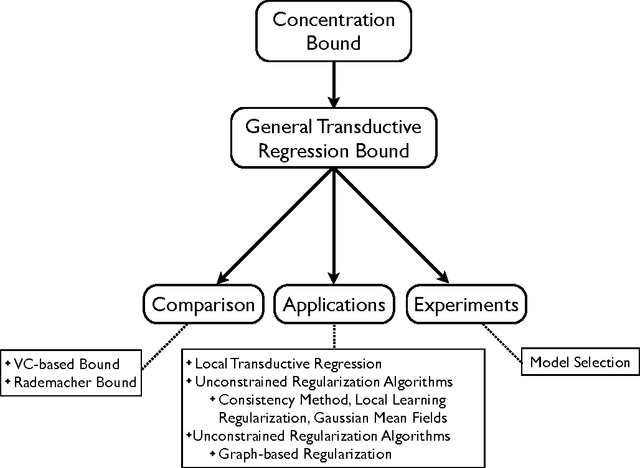
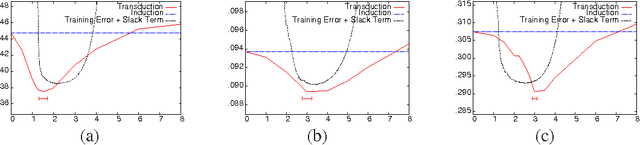
This paper uses the notion of algorithmic stability to derive novel generalization bounds for several families of transductive regression algorithms, both by using convexity and closed-form solutions. Our analysis helps compare the stability of these algorithms. It also shows that a number of widely used transductive regression algorithms are in fact unstable. Finally, it reports the results of experiments with local transductive regression demonstrating the benefit of our stability bounds for model selection, for one of the algorithms, in particular for determining the radius of the local neighborhood used by the algorithm.