 Add to Chrome
 Add to Firefox
 Add to Edge
GenRec: An LLM-Backed Recommendation Ranker at Netflix
Aug 10, 2026
Large language models (LLMs) are reshaping recommender systems by enabling richer modeling of users, content, and context directly in natural language. At Netflix, we are exploring this direction through GenRec, an LLM-backed recommendation ranker built on top of an in-house foundational LLM. GenRec follows a two-phase framework: Phase 1 adapts an open-source LLM to Netflix data, developing deep understanding of the catalog and member behavior while balancing capabilities such as content understanding and instruction following. Phase 2 post-trains this foundation model with recommendation-ranking specific data, labels, and reward signals, aiming to align the ranker with business requirements and long-term member satisfaction. This paper focuses on Phase 2 and the transition from a traditional discriminative ranker with thousands of engineered features to an LLM-backed ranker driven by verbalized user histories and context. We describe our design for input verbalization and context engineering, post-training data construction, reward integration, model architecture, and a cost-constrained serving design based on a prefill-only inference approach. We report results from a large-scale A/B test comparing GenRec against the current production ranker model, where we show that a GenRec model trained with substantially fewer Phase-2 labeled training examples and input signals can achieve statistically significant gains in offline and online metrics. We discuss how LLM-backed recommenders could shift the recommendation paradigm: from feature engineering to context engineering, and from bespoke architectures to shared foundation backbones. We also outline practical lessons for serving such systems under real-world resource constraints.

From Logs to Language: Learning Optimal Verbalization for LLM-Based Recommendation in Production
Feb 24, 2026Large language models (LLMs) are promising backbones for generative recommender systems, yet a key challenge remains underexplored: verbalization, i.e., converting structured user interaction logs into effective natural language inputs. Existing methods rely on rigid templates that simply concatenate fields, yielding suboptimal representations for recommendation. We propose a data-centric framework that learns verbalization for LLM-based recommendation. Using reinforcement learning, a verbalization agent transforms raw interaction histories into optimized textual contexts, with recommendation accuracy as the training signal. This agent learns to filter noise, incorporate relevant metadata, and reorganize information to improve downstream predictions. Experiments on a large-scale industrial streaming dataset show that learned verbalization delivers up to 93% relative improvement in discovery item recommendation accuracy over template-based baselines. Further analysis reveals emergent strategies such as user interest summarization, noise removal, and syntax normalization, offering insights into effective context construction for LLM-based recommender systems.
Localized, High-resolution Geographic Representations with Slepian Functions
Jan 30, 2026Geographic data is fundamentally local. Disease outbreaks cluster in population centers, ecological patterns emerge along coastlines, and economic activity concentrates within country borders. Machine learning models that encode geographic location, however, distribute representational capacity uniformly across the globe, struggling at the fine-grained resolutions that localized applications require. We propose a geographic location encoder built from spherical Slepian functions that concentrate representational capacity inside a region-of-interest and scale to high resolutions without extensive computational demands. For settings requiring global context, we present a hybrid Slepian-Spherical Harmonic encoder that efficiently bridges the tradeoff between local-global performance, while retaining desirable properties such as pole-safety and spherical-surface-distance preservation. Across five tasks spanning classification, regression, and image-augmented prediction, Slepian encodings outperform baselines and retain performance advantages across a wide range of neural network architectures.
A Long Short-Term Memory for AI Applications in Spike-based Neuromorphic Hardware
Jul 08, 2021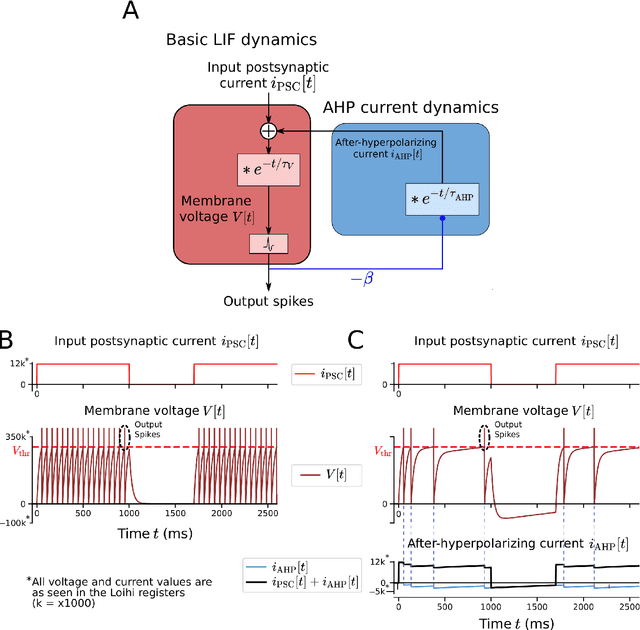
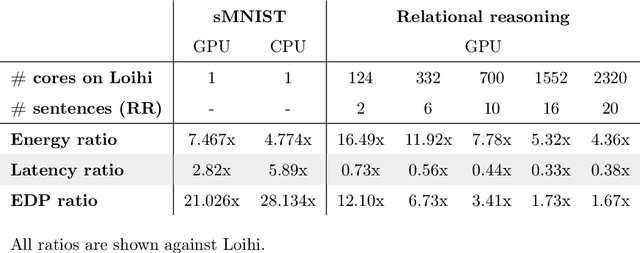
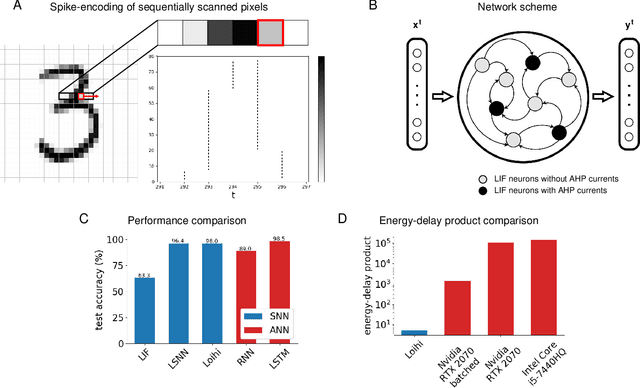
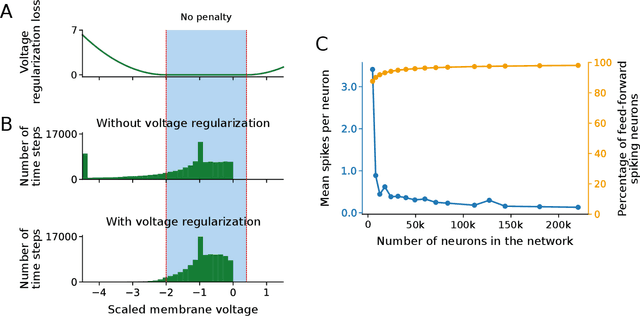
In spite of intensive efforts it has remained an open problem to what extent current Artificial Intelligence (AI) methods that employ Deep Neural Networks (DNNs) can be implemented more energy-efficiently on spike-based neuromorphic hardware. This holds in particular for AI methods that solve sequence processing tasks, a primary application target for spike-based neuromorphic hardware. One difficulty is that DNNs for such tasks typically employ Long Short-Term Memory (LSTM) units. Yet an efficient emulation of these units in spike-based hardware has been missing. We present a biologically inspired solution that solves this problem. This solution enables us to implement a major class of DNNs for sequence processing tasks such as time series classification and question answering with substantial energy savings on neuromorphic hardware. In fact, the Relational Network for reasoning about relations between objects that we use for question answering is the first example of a large DNN that carries out a sequence processing task with substantial energy-saving on neuromorphic hardware.