 Add to Chrome
 Add to Firefox
 Add to Edge
Generative Model Proposal based Particle Filtering for Data Assimilation
Jul 01, 2026
Data assimilation models state dynamics conditioned on sequential observations, and has wide-ranging scientific applications. In the filtering setting, the goal is to model the posterior over the current state given all observations so far. Classical solutions typically make simplifying distributional or functional assumptions, e.g., linear-Gaussian systems, which can be inaccurate in many scenarios. In principle, particle filters (PFs) remove these assumptions, yet often collapse in high dimensions. Recent generative approaches learn conditional state transitions, but without principled Bayesian updates they do not recover the correct filtering posterior and can accumulate error over long horizons. In this work, we introduce Flow Proposal Particle Filters (FPPF), which learn a conditional generative model based proposal approximating the variance-minimizing optimal proposal for particle propagation. Conditioning on observations steers particles toward high-likelihood regions before weighting, reducing weight variance and delaying degeneracy. Since our proposal admits tractable likelihood evaluation, FPPF computes accurate importance weights and retains a Bayesian update step. We further extend FPPF to high-dimensional problems through localization strategies, adressing another standard PF failure mode. Extensive experiments on a variety of dynamical systems show that FPPF outperforms statistical baselines and other generative methods in non-linear, non-Gaussian, and high-dimensional regimes.

Alternate loss functions and regression models that achieve robustness to outliers by modulating the learning rate
Jun 23, 2026Most real-world datasets used for training supervised learning models are contaminated with noisy data and outliers leading to large prediction errors. This paper proposes a new approach for achieving robustness where the learning rate is modulated by a factor that is sensitive to outliers. In this approach a reduction of the learning rate is shown to be achieved by using alternate loss functions that are infinitely differentiable, strictly convex or quasiconvex and more closely approximate the absolute error than Huber and log-cosh losses. A comparison of the performance of regression models trained with different loss functions on a wide variety of benchmarks and datasets is presented to demonstrate the superior performance of the Square Root Loss (SRL) and Smooth Mean Absolute Error (SMAE) losses proposed in this paper. Two new robust linear regression models are presented. Highly vectorized robust parameter update formulae that take advantage of modern GPUs for both stochastic and batch gradient descent are presented.
Plan Before You Trade: Inference-Time Optimization for RL Trading Agents
May 12, 2026Reinforcement learning agents for portfolio management are typically trained and deployed as static policies, with no mechanism for using price forecasts at inference time. We propose $\text{FPILOT}$ (**Fin**ancial **P**lugin **I**nference-time **L**earning for **O**ptimal **T**rading), a plugin inference-time optimization framework inspired by Model Predictive Control (MPC). Our key structural insight is that future prices mostly do not depend on one agent's portfolio allocation, so a suitable predictive model can produce a multi-step price trajectory without iterative action-conditioned rollouts as in typical reinforcement learning. At each decision step, we use the forecaster's predicted price trajectory to construct an allocation-based imagined return objective, and optimize the policy at inference-time before executing one step of the trade. Our framework is compatible with any pre-trained agent and adapts the policy to the forecaster's predictions without any retraining. Evaluated across five policy learning algorithms on the TradeMaster DJ30 benchmark, $\text{FPILOT}$ produces consistent improvements in total return and return-based risk-adjusted metrics (Sharpe, Sortino, Calmar), with stochastic policies benefiting more than deterministic ones. Further, using synthetic forecasts at calibrated quality levels, we show that gains consistently improve with forecaster quality, suggesting that our performance will improve based on advances in financial forecasting.
Replicable Bandits with UCB based Exploration
Apr 21, 2026We study replicable algorithms for stochastic multi-armed bandits (MAB) and linear bandits with UCB (Upper Confidence Bound) based exploration. A bandit algorithm is $ρ$-replicable if two executions using shared internal randomness but independent reward realizations, produce the same action sequence with probability at least $1-ρ$. Prior work is primarily elimination-based and, in linear bandits with infinitely many actions, relies on discretization, leading to suboptimal dependence on the dimension $d$ and $ρ$. We develop optimistic alternatives for both settings. For stochastic multi-armed bandits, we propose RepUCB, a replicable batched UCB algorithm and show that it attains a regret $O\!\left(\frac{K^2\log^2 T}{ρ^2}\sum_{a:Δ_a>0}\left(Δ_a+\frac{\log(KT\log T)}{Δ_a}\right)\right)$. For stochastic linear bandits, we first introduce RepRidge, a replicable ridge regression estimator that satisfies both a confidence guarantee and a $ρ$-replicability guarantee. Beyond its role in our bandit algorithm, this estimator and its guarantees may also be of independent interest in other statistical estimation settings. We then use RepRidge to design RepLinUCB, a replicable optimistic algorithm for stochastic linear bandits, and show that its regret is bounded by $\widetilde{O}\!\big(\big(d+\frac{d^3}ρ\big)\sqrt{T}\big)$. This improves the best prior regret guarantee by a factor of $O(d/ρ)$, showing that our optimistic algorithm can substantially reduce the price of replicability.
Model Predictive Control with Differentiable World Models for Offline Reinforcement Learning
Mar 23, 2026Offline Reinforcement Learning (RL) aims to learn optimal policies from fixed offline datasets, without further interactions with the environment. Such methods train an offline policy (or value function), and apply it at inference time without further refinement. We introduce an inference time adaptation framework inspired by model predictive control (MPC) that utilizes a pretrained policy along with a learned world model of state transitions and rewards. While existing world model and diffusion-planning methods use learned dynamics to generate imagined trajectories during training, or to sample candidate plans at inference time, they do not use inference-time information to optimize the policy parameters on the fly. In contrast, our design is a Differentiable World Model (DWM) pipeline that enables endto-end gradient computation through imagined rollouts for policy optimization at inference time based on MPC. We evaluate our algorithm on D4RL continuous-control benchmarks (MuJoCo locomotion tasks and AntMaze), and show that exploiting inference-time information to optimize the policy parameters yields consistent gains over strong offline RL baselines.
Gradual Fine-Tuning for Flow Matching Models
Jan 30, 2026Fine-tuning flow matching models is a central challenge in settings with limited data, evolving distributions, or strict efficiency demands, where unconstrained fine-tuning can erode the accuracy and efficiency gains learned during pretraining. Prior work has produced theoretical guarantees and empirical advances for reward-based fine-tuning formulations, but these methods often impose restrictions on permissible drift structure or training techniques. In this work, we propose Gradual Fine-Tuning (GFT), a principled framework for fine-tuning flow-based generative models when samples from the target distribution are available. For stochastic flows, GFT defines a temperature-controlled sequence of intermediate objectives that smoothly interpolate between the pretrained and target drifts, approaching the true target as the temperature approaches zero. We prove convergence results for both marginal and conditional GFT objectives, enabling the use of suitable (e.g., optimal transport) couplings during GFT while preserving correctness. Empirically, GFT improves convergence stability and shortens probability paths, resulting in faster inference, while maintaining generation quality comparable to standard fine-tuning. Our results position GFT as a theoretically grounded and practically effective alternative for scalable adaptation of flow matching models under distribution shift.
Sketched Gaussian Mechanism for Private Federated Learning
Sep 09, 2025Communication cost and privacy are two major considerations in federated learning (FL). For communication cost, gradient compression by sketching the clients' transmitted model updates is often used for reducing per-round communication. For privacy, the Gaussian mechanism (GM), which consists of clipping updates and adding Gaussian noise, is commonly used to guarantee client-level differential privacy. Existing literature on private FL analyzes privacy of sketching and GM in an isolated manner, illustrating that sketching provides privacy determined by the sketching dimension and that GM has to supply any additional desired privacy. In this paper, we introduce the Sketched Gaussian Mechanism (SGM), which directly combines sketching and the Gaussian mechanism for privacy. Using R\'enyi-DP tools, we present a joint analysis of SGM's overall privacy guarantee, which is significantly more flexible and sharper compared to isolated analysis of sketching and GM privacy. In particular, we prove that the privacy level of SGM for a fixed noise magnitude is proportional to $1/\sqrt{b}$, where $b$ is the sketching dimension, indicating that (for moderate $b$) SGM can provide much stronger privacy guarantees than the original GM under the same noise budget. We demonstrate the application of SGM to FL with either gradient descent or adaptive server optimizers, and establish theoretical results on optimization convergence, which exhibits only a logarithmic dependence on the number of parameters $d$. Experimental results confirm that at the same privacy level, SGM based FL is at least competitive with non-sketching private FL variants and outperforms them in some settings. Moreover, using adaptive optimization at the server improves empirical performance while maintaining the privacy guarantees.
Conservative Contextual Bandits: Beyond Linear Representations
Dec 09, 2024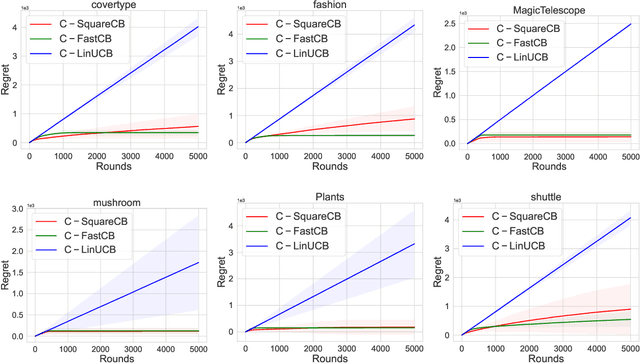

Conservative Contextual Bandits (CCBs) address safety in sequential decision making by requiring that an agent's policy, along with minimizing regret, also satisfies a safety constraint: the performance is not worse than a baseline policy (e.g., the policy that the company has in production) by more than $(1+\alpha)$ factor. Prior work developed UCB-style algorithms in the multi-armed [Wu et al., 2016] and contextual linear [Kazerouni et al., 2017] settings. However, in practice the cost of the arms is often a non-linear function, and therefore existing UCB algorithms are ineffective in such settings. In this paper, we consider CCBs beyond the linear case and develop two algorithms $\mathtt{C-SquareCB}$ and $\mathtt{C-FastCB}$, using Inverse Gap Weighting (IGW) based exploration and an online regression oracle. We show that the safety constraint is satisfied with high probability and that the regret of $\mathtt{C-SquareCB}$ is sub-linear in horizon $T$, while the regret of $\mathtt{C-FastCB}$ is first-order and is sub-linear in $L^*$, the cumulative loss of the optimal policy. Subsequently, we use a neural network for function approximation and online gradient descent as the regression oracle to provide $\tilde{O}(\sqrt{KT} + K/\alpha) $ and $\tilde{O}(\sqrt{KL^*} + K (1 + 1/\alpha))$ regret bounds, respectively. Finally, we demonstrate the efficacy of our algorithms on real-world data and show that they significantly outperform the existing baseline while maintaining the performance guarantee.
Sketched Adaptive Federated Deep Learning: A Sharp Convergence Analysis
Nov 12, 2024
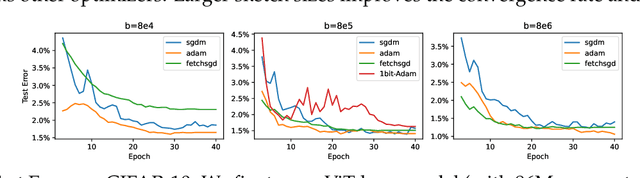
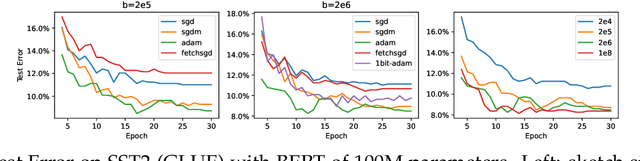
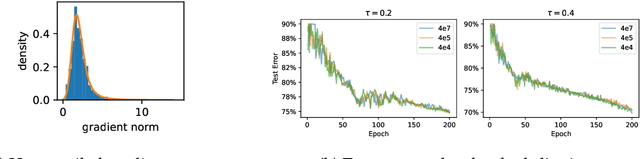
Combining gradient compression methods (e.g., CountSketch, quantization) and adaptive optimizers (e.g., Adam, AMSGrad) is a desirable goal in federated learning (FL), with potential benefits on both fewer communication rounds and less per-round communication. In spite of the preliminary empirical success of sketched adaptive methods, existing convergence analyses show the communication cost to have a linear dependence on the ambient dimension, i.e., number of parameters, which is prohibitively high for modern deep learning models. In this work, we introduce specific sketched adaptive federated learning (SAFL) algorithms and, as our main contribution, provide theoretical convergence analyses in different FL settings with guarantees on communication cost depending only logarithmically (instead of linearly) on the ambient dimension. Unlike existing analyses, we show that the entry-wise sketching noise existent in the preconditioners and the first moments of SAFL can be implicitly addressed by leveraging the recently-popularized anisotropic curvatures in deep learning losses, e.g., fast decaying loss Hessian eigen-values. In the i.i.d. client setting of FL, we show that SAFL achieves asymptotic $O(1/\sqrt{T})$ convergence, and converges faster in the initial epochs. In the non-i.i.d. client setting, where non-adaptive methods lack convergence guarantees, we show that SACFL (SAFL with clipping) algorithms can provably converge in spite of the additional heavy-tailed noise. Our theoretical claims are supported by empirical studies on vision and language tasks, and in both fine-tuning and training-from-scratch regimes. Surprisingly, as a by-product of our analysis, the proposed SAFL methods are competitive with the state-of-the-art communication-efficient federated learning algorithms based on error feedback.
On the Generalizability of Foundation Models for Crop Type Mapping
Sep 14, 2024Foundation models pre-trained using self-supervised and weakly-supervised learning have shown powerful transfer learning capabilities on various downstream tasks, including language understanding, text generation, and image recognition. Recently, the Earth observation (EO) field has produced several foundation models pre-trained directly on multispectral satellite imagery (e.g., Sentinel-2) for applications like precision agriculture, wildfire and drought monitoring, and natural disaster response. However, few studies have investigated the ability of these models to generalize to new geographic locations, and potential concerns of geospatial bias -- models trained on data-rich developed countries not transferring well to data-scarce developing countries -- remain. We investigate the ability of popular EO foundation models to transfer to new geographic regions in the agricultural domain, where differences in farming practices and class imbalance make transfer learning particularly challenging. We first select six crop classification datasets across five continents, normalizing for dataset size and harmonizing classes to focus on four major cereal grains: maize, soybean, rice, and wheat. We then compare three popular foundation models, pre-trained on SSL4EO-S12, SatlasPretrain, and ImageNet, using in-distribution (ID) and out-of-distribution (OOD) evaluation. Experiments show that pre-trained weights designed explicitly for Sentinel-2, such as SSL4EO-S12, outperform general pre-trained weights like ImageNet. Furthermore, the benefits of pre-training on OOD data are the most significant when only 10--100 ID training samples are used. Transfer learning and pre-training with OOD and limited ID data show promising applications, as many developing regions have scarce crop type labels. All harmonized datasets and experimental code are open-source and available for download.