 Add to Chrome
 Add to Firefox
 Add to Edge
From Boundaries to Semantics: Prompt-Guided Multi-Task Learning for Petrographic Thin-section Segmentation
Apr 16, 2026
Grain-edge segmentation (GES) and lithology semantic segmentation (LSS) are two pivotal tasks for quantifying rock fabric and composition. However, these two tasks are often treated separately, and the segmentation quality is implausible albeit expensive, time-consuming, and expert-annotated datasets have been used. Recently, foundation models, especially the Segment Anything Model (SAM), have demonstrated impressive robustness for boundary alignment. However, directly adapting SAM to joint GES and LSS is nontrivial due to 1) severe domain gap induced by extinction-dependent color variations and ultra-fine grain boundaries, and 2) lacking novel modules for joint learning on multi-angle petrographic image stacks. In this paper, we propose Petro-SAM, a novel two-stage, multi-task framework that can achieve high-quality joint GES and LSS on petrographic images. Specifically, based on SAM, we introduce a Merge Block to integrate seven polarized views, effectively solving the extinction issue. Moreover, we introduce multi-scale feature fusion and color-entropy priors to refine the detection.

Tarot-SAM3: Training-free SAM3 for Any Referring Expression Segmentation
Apr 09, 2026Referring Expression Segmentation (RES) aims to segment image regions described by natural-language expressions, serving as a bridge between vision and language understanding. Existing RES methods, however, rely heavily on large annotated datasets and are limited to either explicit or implicit expressions, hindering their ability to generalize to any referring expression. Recently, the Segment Anything Model 3 (SAM3) has shown impressive robustness in Promptable Concept Segmentation. Nonetheless, applying it to RES remains challenging: (1) SAM3 struggles with longer or implicit expressions; (2) naive coupling of SAM3 with a multimodal large language model (MLLM) makes the final results overly dependent on the MLLM's reasoning capability, without enabling refinement of SAM3's segmentation outputs. To this end, we present Tarot-SAM3, a novel training-free framework that can accurately segment from any referring expression. Specifically, Tarot-SAM3 consists of two key phases. First, the Expression Reasoning Interpreter (ERI) phase introduces reasoning-assisted prompt options to support structured expression parsing and evaluation-aware rephrasing. This transforms arbitrary queries into robust heterogeneous prompts for generating reliable masks with SAM3. Second, the Mask Self-Refining (MSR) phase selects the best mask across prompt types and performs self-refinement by leveraging rich feature relationships from DINOv3 to compare discriminative regions among ERI outputs. It then infers region affiliation to the target, thereby correcting over- and under-segmentation. Extensive experiments demonstrate that Tarot-SAM3 achieves strong performance on both explicit and implicit RES benchmarks, as well as open-world scenarios. Ablation studies further validate the effectiveness of each phase.
PanoSAM2: Lightweight Distortion- and Memory-aware Adaptions of SAM2 for 360 Video Object Segmentation
Apr 09, 2026360 video object segmentation (360VOS) aims to predict temporally-consistent masks in 360 videos, offering full-scene coverage, benefiting applications, such as VR/AR and embodied AI. Learning 360VOS model is nontrivial due to the lack of high-quality labeled dataset. Recently, Segment Anything Models (SAMs), especially SAM2 -- with its design of memory module -- shows strong, promptable VOS capability. However, directly using SAM2 for 360VOS yields implausible results as 360 videos suffer from the projection distortion, semantic inconsistency of left-right sides, and sparse object mask information in SAM2's memory. To this end, we propose PanoSAM2, a novel 360VOS framework based on our lightweight distortion- and memory-aware adaptation strategies of SAM2 to achieve reliable 360VOS while retaining SAM2's user-friendly prompting design. Concretely, to tackle the projection distortion and semantic inconsistency issues, we propose a Pano-Aware Decoder with seam-consistent receptive fields and iterative distortion refinement to maintain continuity across the 0/360 degree boundary. Meanwhile, a Distortion-Guided Mask Loss is introduced to weight pixels by distortion magnitude, stressing stretched regions and boundaries. To address the object sparsity issue, we propose a Long-Short Memory Module to maintain a compact long-term object pointer to re-instantiate and align short-term memories, thereby enhancing temporal coherence. Extensive experiments show that PanoSAM2 yields substantial gains over SAM2: +5.6 on 360VOTS and +6.7 on PanoVOS, showing the effectiveness of our method.
Leader360V: The Large-scale, Real-world 360 Video Dataset for Multi-task Learning in Diverse Environment
Jun 17, 2025360 video captures the complete surrounding scenes with the ultra-large field of view of 360X180. This makes 360 scene understanding tasks, eg, segmentation and tracking, crucial for appications, such as autonomous driving, robotics. With the recent emergence of foundation models, the community is, however, impeded by the lack of large-scale, labelled real-world datasets. This is caused by the inherent spherical properties, eg, severe distortion in polar regions, and content discontinuities, rendering the annotation costly yet complex. This paper introduces Leader360V, the first large-scale, labeled real-world 360 video datasets for instance segmentation and tracking. Our datasets enjoy high scene diversity, ranging from indoor and urban settings to natural and dynamic outdoor scenes. To automate annotation, we design an automatic labeling pipeline, which subtly coordinates pre-trained 2D segmentors and large language models to facilitate the labeling. The pipeline operates in three novel stages. Specifically, in the Initial Annotation Phase, we introduce a Semantic- and Distortion-aware Refinement module, which combines object mask proposals from multiple 2D segmentors with LLM-verified semantic labels. These are then converted into mask prompts to guide SAM2 in generating distortion-aware masks for subsequent frames. In the Auto-Refine Annotation Phase, missing or incomplete regions are corrected either by applying the SDR again or resolving the discontinuities near the horizontal borders. The Manual Revision Phase finally incorporates LLMs and human annotators to further refine and validate the annotations. Extensive user studies and evaluations demonstrate the effectiveness of our labeling pipeline. Meanwhile, experiments confirm that Leader360V significantly enhances model performance for 360 video segmentation and tracking, paving the way for more scalable 360 scene understanding.
NEON: Living Needs Prediction System in Meituan
Jul 31, 2023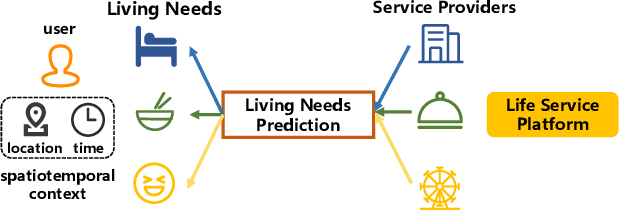
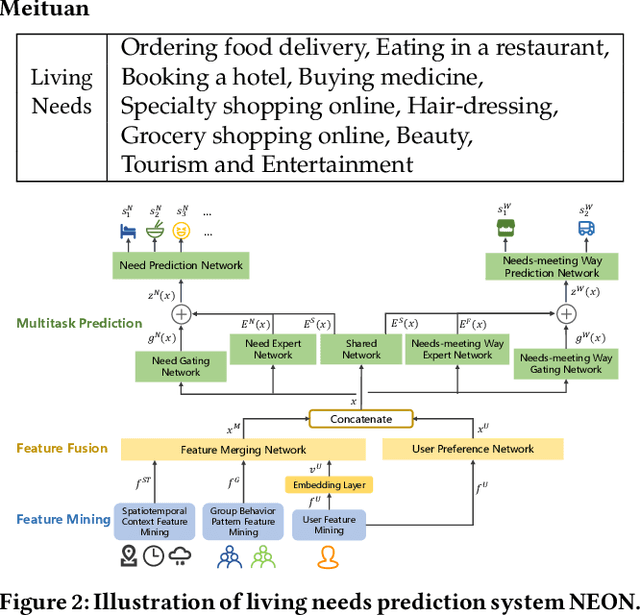


Living needs refer to the various needs in human's daily lives for survival and well-being, including food, housing, entertainment, etc. On life service platforms that connect users to service providers, such as Meituan, the problem of living needs prediction is fundamental as it helps understand users and boost various downstream applications such as personalized recommendation. However, the problem has not been well explored and is faced with two critical challenges. First, the needs are naturally connected to specific locations and times, suffering from complex impacts from the spatiotemporal context. Second, there is a significant gap between users' actual living needs and their historical records on the platform. To address these two challenges, we design a system of living NEeds predictiON named NEON, consisting of three phases: feature mining, feature fusion, and multi-task prediction. In the feature mining phase, we carefully extract individual-level user features for spatiotemporal modeling, and aggregated-level behavioral features for enriching data, which serve as the basis for addressing two challenges, respectively. Further, in the feature fusion phase, we propose a neural network that effectively fuses two parts of features into the user representation. Moreover, we design a multi-task prediction phase, where the auxiliary task of needs-meeting way prediction can enhance the modeling of spatiotemporal context. Extensive offline evaluations verify that our NEON system can effectively predict users' living needs. Furthermore, we deploy NEON into Meituan's algorithm engine and evaluate how it enhances the three downstream prediction applications, via large-scale online A/B testing.