 Add to Chrome
 Add to Firefox
 Add to Edge
Tarot-SAM3: Training-free SAM3 for Any Referring Expression Segmentation
Apr 09, 2026
Referring Expression Segmentation (RES) aims to segment image regions described by natural-language expressions, serving as a bridge between vision and language understanding. Existing RES methods, however, rely heavily on large annotated datasets and are limited to either explicit or implicit expressions, hindering their ability to generalize to any referring expression. Recently, the Segment Anything Model 3 (SAM3) has shown impressive robustness in Promptable Concept Segmentation. Nonetheless, applying it to RES remains challenging: (1) SAM3 struggles with longer or implicit expressions; (2) naive coupling of SAM3 with a multimodal large language model (MLLM) makes the final results overly dependent on the MLLM's reasoning capability, without enabling refinement of SAM3's segmentation outputs. To this end, we present Tarot-SAM3, a novel training-free framework that can accurately segment from any referring expression. Specifically, Tarot-SAM3 consists of two key phases. First, the Expression Reasoning Interpreter (ERI) phase introduces reasoning-assisted prompt options to support structured expression parsing and evaluation-aware rephrasing. This transforms arbitrary queries into robust heterogeneous prompts for generating reliable masks with SAM3. Second, the Mask Self-Refining (MSR) phase selects the best mask across prompt types and performs self-refinement by leveraging rich feature relationships from DINOv3 to compare discriminative regions among ERI outputs. It then infers region affiliation to the target, thereby correcting over- and under-segmentation. Extensive experiments demonstrate that Tarot-SAM3 achieves strong performance on both explicit and implicit RES benchmarks, as well as open-world scenarios. Ablation studies further validate the effectiveness of each phase.

DA-PFL: Dynamic Affinity Aggregation for Personalized Federated Learning
Mar 14, 2024
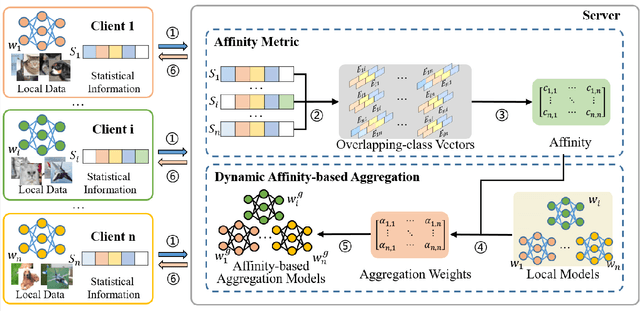

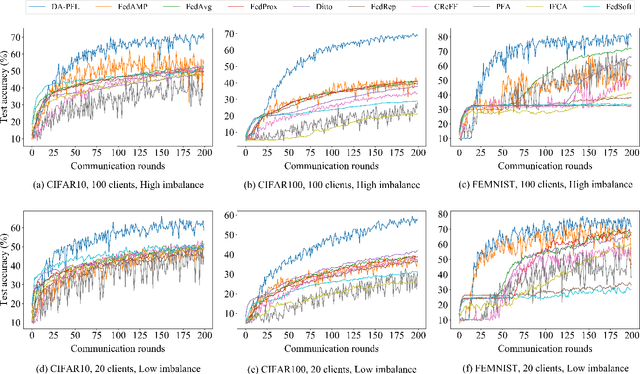
Personalized federated learning becomes a hot research topic that can learn a personalized learning model for each client. Existing personalized federated learning models prefer to aggregate similar clients with similar data distribution to improve the performance of learning models. However, similaritybased personalized federated learning methods may exacerbate the class imbalanced problem. In this paper, we propose a novel Dynamic Affinity-based Personalized Federated Learning model (DA-PFL) to alleviate the class imbalanced problem during federated learning. Specifically, we build an affinity metric from a complementary perspective to guide which clients should be aggregated. Then we design a dynamic aggregation strategy to dynamically aggregate clients based on the affinity metric in each round to reduce the class imbalanced risk. Extensive experiments show that the proposed DA-PFL model can significantly improve the accuracy of each client in three real-world datasets with state-of-the-art comparison methods.