 Add to Chrome
 Add to Firefox
 Add to Edge
Can Heterogeneous Language Models Be Fused?
Apr 02, 2026
Model merging aims to integrate multiple expert models into a single model that inherits their complementary strengths without incurring the inference-time cost of ensembling. Recent progress has shown that merging can be highly effective when all source models are \emph{homogeneous}, i.e., derived from the same pretrained backbone and therefore share aligned parameter coordinates or compatible task vectors. Yet this assumption is increasingly unrealistic in open model ecosystems, where useful experts are often built on different families such as Llama, Qwen, and Mistral. In such \emph{heterogeneous} settings, direct weight-space fusion becomes ill-posed due to architectural mismatch, latent basis misalignment, and amplified cross-source conflict. We address this problem with \texttt{HeteroFusion} for heterogeneous language model fusion, which consists of two key components: topology-based alignment that transfers knowledge across heterogeneous backbones by matching functional module structures instead of raw tensor coordinates, and conflict-aware denoising that suppresses incompatible or noisy transfer signals during fusion. We further provide analytical justification showing that preserving the target adapter basis while predicting structured updates leads to a stable and well-conditioned transfer process. Across heterogeneous transfer, multi-source fusion, noisy-source robustness, and cross-family generalization settings, \texttt{HeteroFusion} consistently outperforms strong merging, fusion, and ensemble baselines.

Black-box Model Merging for Language-Model-as-a-Service with Massive Model Repositories
Sep 16, 2025
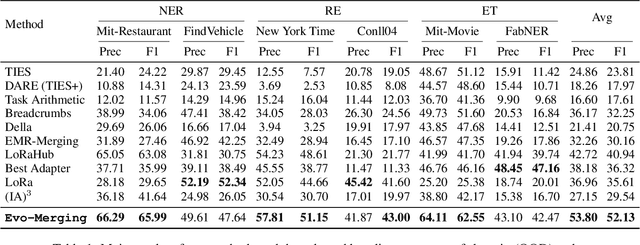
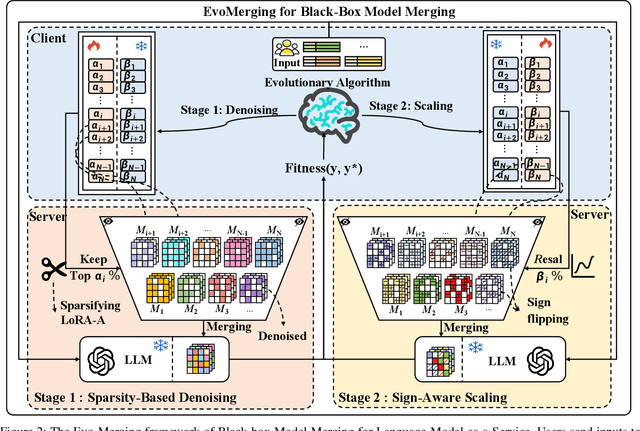
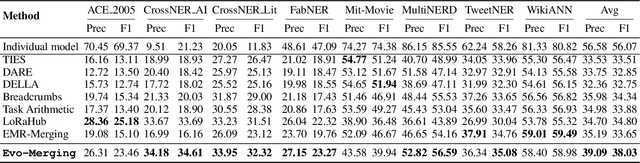
Model merging refers to the process of integrating multiple distinct models into a unified model that preserves and combines the strengths and capabilities of the individual models. Most existing approaches rely on task vectors to combine models, typically under the assumption that model parameters are accessible. However, for extremely large language models (LLMs) such as GPT-4, which are often provided solely as black-box services through API interfaces (Language-Model-as-a-Service), model weights are not available to end users. This presents a significant challenge, which we refer to as black-box model merging (BMM) with massive LLMs. To address this challenge, we propose a derivative-free optimization framework based on the evolutionary algorithm (Evo-Merging) that enables effective model merging using only inference-time API queries. Our method consists of two key components: (1) sparsity-based denoising, designed to identify and filter out irrelevant or redundant information across models, and (2) sign-aware scaling, which dynamically computes optimal combination weights for the relevant models based on their performance. We also provide a formal justification, along with a theoretical analysis, for our asymmetric sparsification. Extensive experimental evaluations demonstrate that our approach achieves state-of-the-art results on a range of tasks, significantly outperforming existing strong baselines.
Forget What's Sensitive, Remember What Matters: Token-Level Differential Privacy in Memory Sculpting for Continual Learning
Sep 16, 2025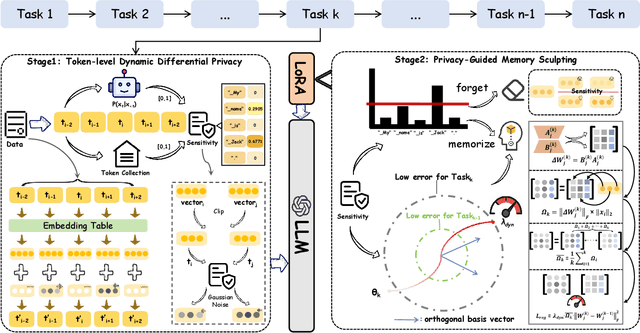
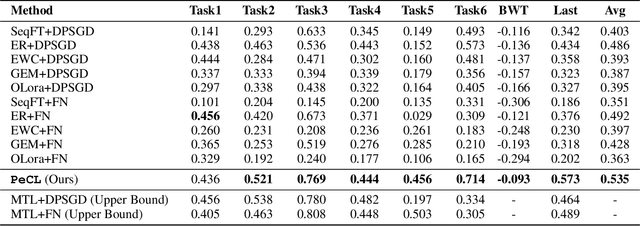
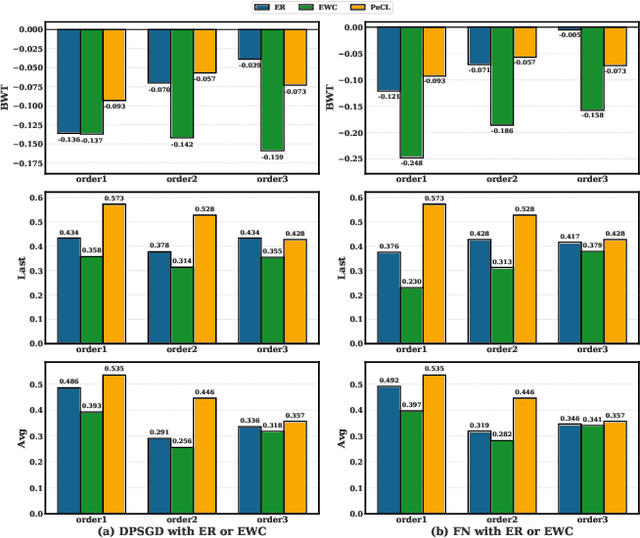

Continual Learning (CL) models, while adept at sequential knowledge acquisition, face significant and often overlooked privacy challenges due to accumulating diverse information. Traditional privacy methods, like a uniform Differential Privacy (DP) budget, indiscriminately protect all data, leading to substantial model utility degradation and hindering CL deployment in privacy-sensitive areas. To overcome this, we propose a privacy-enhanced continual learning (PeCL) framework that forgets what's sensitive and remembers what matters. Our approach first introduces a token-level dynamic Differential Privacy strategy that adaptively allocates privacy budgets based on the semantic sensitivity of individual tokens. This ensures robust protection for private entities while minimizing noise injection for non-sensitive, general knowledge. Second, we integrate a privacy-guided memory sculpting module. This module leverages the sensitivity analysis from our dynamic DP mechanism to intelligently forget sensitive information from the model's memory and parameters, while explicitly preserving the task-invariant historical knowledge crucial for mitigating catastrophic forgetting. Extensive experiments show that PeCL achieves a superior balance between privacy preserving and model utility, outperforming baseline models by maintaining high accuracy on previous tasks while ensuring robust privacy.
A Survey of Slow Thinking-based Reasoning LLMs using Reinforced Learning and Inference-time Scaling Law
May 05, 2025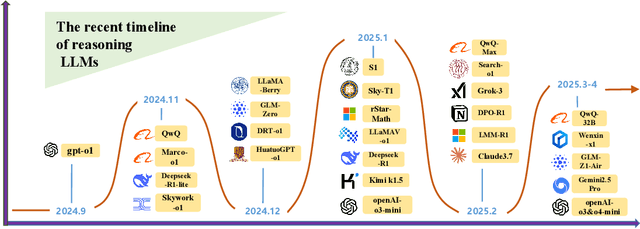
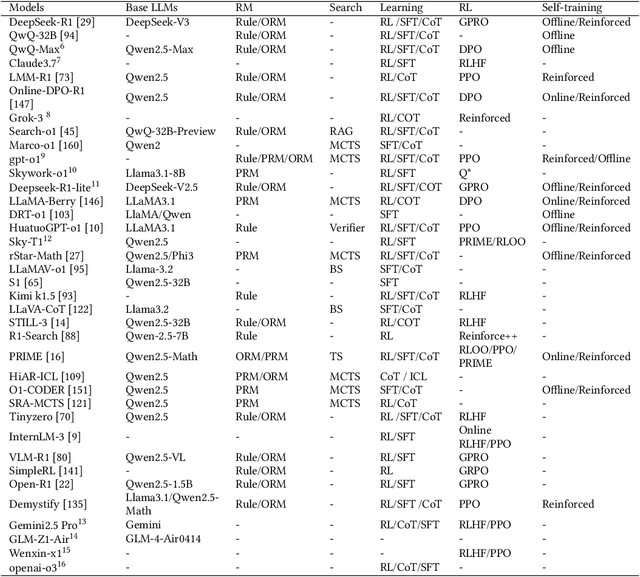
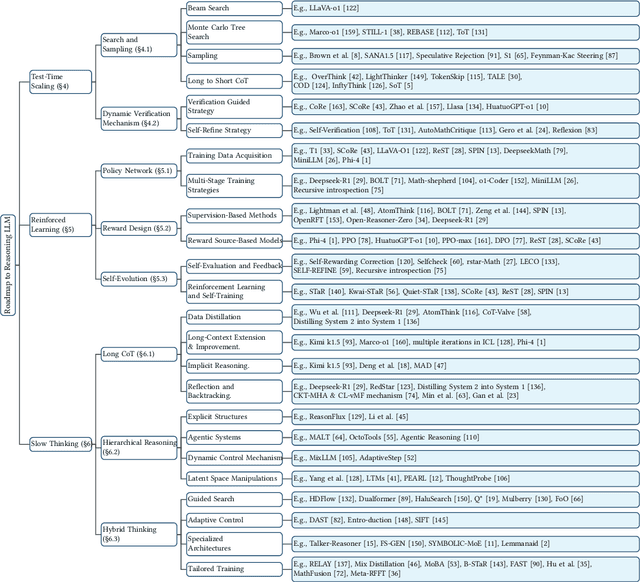
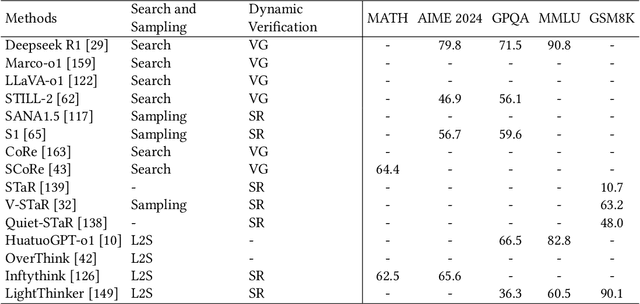
This survey explores recent advancements in reasoning large language models (LLMs) designed to mimic "slow thinking" - a reasoning process inspired by human cognition, as described in Kahneman's Thinking, Fast and Slow. These models, like OpenAI's o1, focus on scaling computational resources dynamically during complex tasks, such as math reasoning, visual reasoning, medical diagnosis, and multi-agent debates. We present the development of reasoning LLMs and list their key technologies. By synthesizing over 100 studies, it charts a path toward LLMs that combine human-like deep thinking with scalable efficiency for reasoning. The review breaks down methods into three categories: (1) test-time scaling dynamically adjusts computation based on task complexity via search and sampling, dynamic verification; (2) reinforced learning refines decision-making through iterative improvement leveraging policy networks, reward models, and self-evolution strategies; and (3) slow-thinking frameworks (e.g., long CoT, hierarchical processes) that structure problem-solving with manageable steps. The survey highlights the challenges and further directions of this domain. Understanding and advancing the reasoning abilities of LLMs is crucial for unlocking their full potential in real-world applications, from scientific discovery to decision support systems.