 Add to Chrome
 Add to Firefox
 Add to Edge
CITED: A Decision Boundary-Aware Signature for GNNs Towards Model Extraction Defense
Feb 23, 2026
Graph neural networks (GNNs) have demonstrated superior performance in various applications, such as recommendation systems and financial risk management. However, deploying large-scale GNN models locally is particularly challenging for users, as it requires significant computational resources and extensive property data. Consequently, Machine Learning as a Service (MLaaS) has become increasingly popular, offering a convenient way to deploy and access various models, including GNNs. However, an emerging threat known as Model Extraction Attacks (MEAs) presents significant risks, as adversaries can readily obtain surrogate GNN models exhibiting similar functionality. Specifically, attackers repeatedly query the target model using subgraph inputs to collect corresponding responses. These input-output pairs are subsequently utilized to train their own surrogate models at minimal cost. Many techniques have been proposed to defend against MEAs, but most are limited to specific output levels (e.g., embedding or label) and suffer from inherent technical drawbacks. To address these limitations, we propose a novel ownership verification framework CITED which is a first-of-its-kind method to achieve ownership verification on both embedding and label levels. Moreover, CITED is a novel signature-based method that neither harms downstream performance nor introduces auxiliary models that reduce efficiency, while still outperforming all watermarking and fingerprinting approaches. Extensive experiments demonstrate the effectiveness and robustness of our CITED framework. Code is available at: https://github.com/LabRAI/CITED.

CREDIT: Certified Ownership Verification of Deep Neural Networks Against Model Extraction Attacks
Feb 23, 2026Machine Learning as a Service (MLaaS) has emerged as a widely adopted paradigm for providing access to deep neural network (DNN) models, enabling users to conveniently leverage these models through standardized APIs. However, such services are highly vulnerable to Model Extraction Attacks (MEAs), where an adversary repeatedly queries a target model to collect input-output pairs and uses them to train a surrogate model that closely replicates its functionality. While numerous defense strategies have been proposed, verifying the ownership of a suspicious model with strict theoretical guarantees remains a challenging task. To address this gap, we introduce CREDIT, a certified ownership verification against MEAs. Specifically, we employ mutual information to quantify the similarity between DNN models, propose a practical verification threshold, and provide rigorous theoretical guarantees for ownership verification based on this threshold. We extensively evaluate our approach on several mainstream datasets across different domains and tasks, achieving state-of-the-art performance. Our implementation is publicly available at: https://github.com/LabRAI/CREDIT.
FAST-CAD: A Fairness-Aware Framework for Non-Contact Stroke Diagnosis
Nov 14, 2025Stroke is an acute cerebrovascular disease, and timely diagnosis significantly improves patient survival. However, existing automated diagnosis methods suffer from fairness issues across demographic groups, potentially exacerbating healthcare disparities. In this work we propose FAST-CAD, a theoretically grounded framework that combines domain-adversarial training (DAT) with group distributionally robust optimization (Group-DRO) for fair and accurate non-contact stroke diagnosis. Our approach is built on domain adaptation and minimax fairness theory and provides convergence guarantees and fairness bounds. We curate a multimodal dataset covering 12 demographic subgroups defined by age, gender, and posture. FAST-CAD employs self-supervised encoders with adversarial domain discrimination to learn demographic-invariant representations, while Group-DRO optimizes worst-group risk to ensure robust performance across all subgroups. Extensive experiments show that our method achieves superior diagnostic performance while maintaining fairness across demographic groups, and our theoretical analysis supports the effectiveness of the unified DAT + Group-DRO framework. This work provides both practical advances and theoretical insights for fair medical AI systems.
Graph Synthetic Out-of-Distribution Exposure with Large Language Models
Apr 29, 2025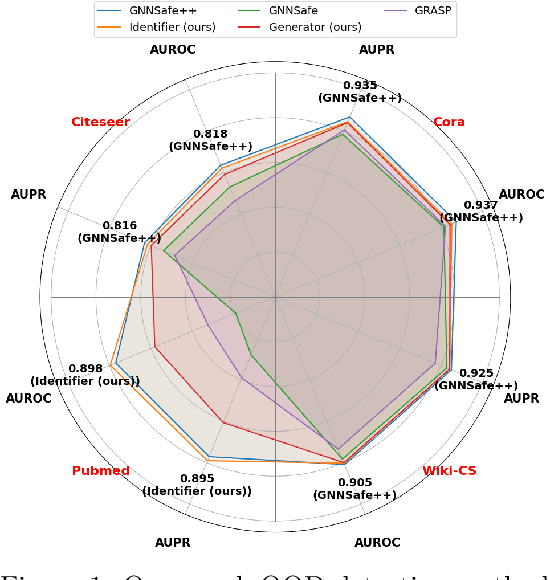
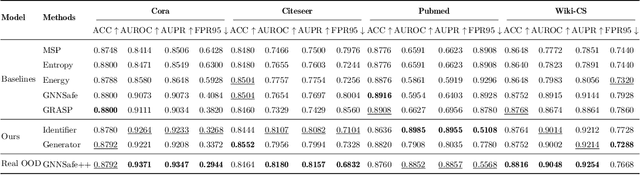
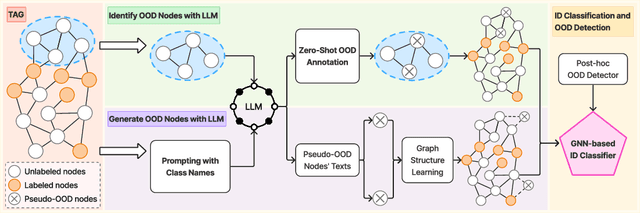

Out-of-distribution (OOD) detection in graphs is critical for ensuring model robustness in open-world and safety-sensitive applications. Existing approaches to graph OOD detection typically involve training an in-distribution (ID) classifier using only ID data, followed by the application of post-hoc OOD scoring techniques. Although OOD exposure - introducing auxiliary OOD samples during training - has proven to be an effective strategy for enhancing detection performance, current methods in the graph domain generally assume access to a set of real OOD nodes. This assumption, however, is often impractical due to the difficulty and cost of acquiring representative OOD samples. In this paper, we introduce GOE-LLM, a novel framework that leverages Large Language Models (LLMs) for OOD exposure in graph OOD detection without requiring real OOD nodes. GOE-LLM introduces two pipelines: (1) identifying pseudo-OOD nodes from the initially unlabeled graph using zero-shot LLM annotations, and (2) generating semantically informative synthetic OOD nodes via LLM-prompted text generation. These pseudo-OOD nodes are then used to regularize the training of the ID classifier for improved OOD awareness. We evaluate our approach across multiple benchmark datasets, showing that GOE-LLM significantly outperforms state-of-the-art graph OOD detection methods that do not use OOD exposure and achieves comparable performance to those relying on real OOD data.
ATOM: A Framework of Detecting Query-Based Model Extraction Attacks for Graph Neural Networks
Mar 20, 2025Graph Neural Networks (GNNs) have gained traction in Graph-based Machine Learning as a Service (GMLaaS) platforms, yet they remain vulnerable to graph-based model extraction attacks (MEAs), where adversaries reconstruct surrogate models by querying the victim model. Existing defense mechanisms, such as watermarking and fingerprinting, suffer from poor real-time performance, susceptibility to evasion, or reliance on post-attack verification, making them inadequate for handling the dynamic characteristics of graph-based MEA variants. To address these limitations, we propose ATOM, a novel real-time MEA detection framework tailored for GNNs. ATOM integrates sequential modeling and reinforcement learning to dynamically detect evolving attack patterns, while leveraging $k$-core embedding to capture the structural properties, enhancing detection precision. Furthermore, we provide theoretical analysis to characterize query behaviors and optimize detection strategies. Extensive experiments on multiple real-world datasets demonstrate that ATOM outperforms existing approaches in detection performance, maintaining stable across different time steps, thereby offering a more effective defense mechanism for GMLaaS environments.
Enhanced Recommendation Combining Collaborative Filtering and Large Language Models
Dec 25, 2024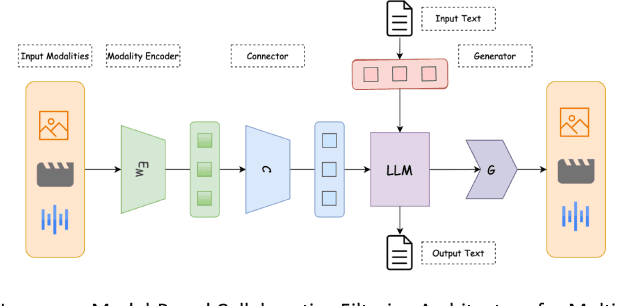
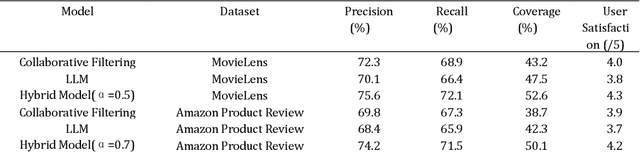
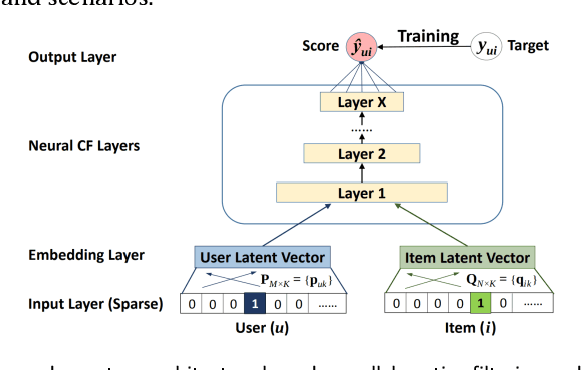
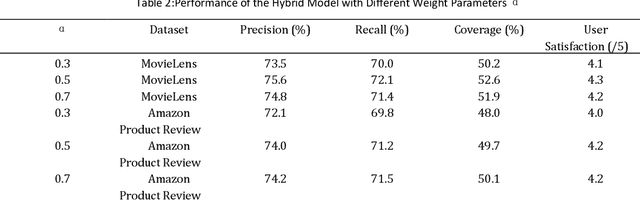
With the advent of the information explosion era, the importance of recommendation systems in various applications is increasingly significant. Traditional collaborative filtering algorithms are widely used due to their effectiveness in capturing user behavior patterns, but they encounter limitations when dealing with cold start problems and data sparsity. Large Language Models (LLMs), with their strong natural language understanding and generation capabilities, provide a new breakthrough for recommendation systems. This study proposes an enhanced recommendation method that combines collaborative filtering and LLMs, aiming to leverage collaborative filtering's advantage in modeling user preferences while enhancing the understanding of textual information about users and items through LLMs to improve recommendation accuracy and diversity. This paper first introduces the fundamental theories of collaborative filtering and LLMs, then designs a recommendation system architecture that integrates both, and validates the system's effectiveness through experiments. The results show that the hybrid model based on collaborative filtering and LLMs significantly improves precision, recall, and user satisfaction, demonstrating its potential in complex recommendation scenarios.
Analysis of Financial Risk Behavior Prediction Using Deep Learning and Big Data Algorithms
Oct 25, 2024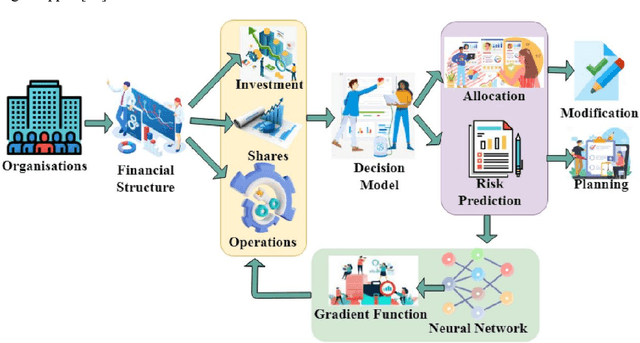
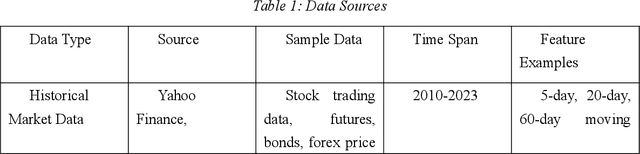
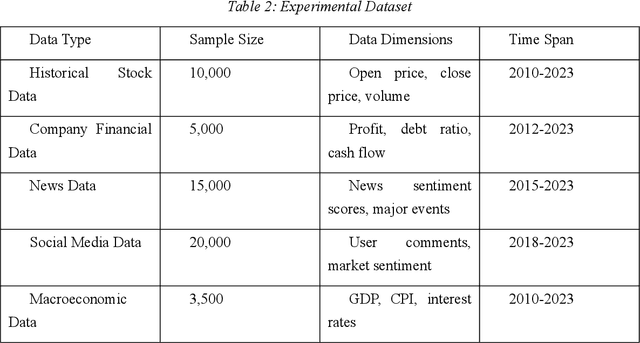
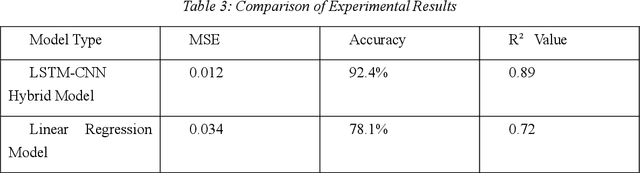
As the complexity and dynamism of financial markets continue to grow, traditional financial risk prediction methods increasingly struggle to handle large datasets and intricate behavior patterns. This paper explores the feasibility and effectiveness of using deep learning and big data algorithms for financial risk behavior prediction. First, the application and advantages of deep learning and big data algorithms in the financial field are analyzed. Then, a deep learning-based big data risk prediction framework is designed and experimentally validated on actual financial datasets. The experimental results show that this method significantly improves the accuracy of financial risk behavior prediction and provides valuable support for risk management in financial institutions. Challenges in the application of deep learning are also discussed, along with potential directions for future research.