 Add to Chrome
 Add to Firefox
 Add to Edge
EgoLive: A Large-Scale Egocentric Dataset from Real-World Human Tasks
Apr 26, 2026
The advancement of robot learning is currently hindered by the scarcity of large-scale, high-quality datasets. While established data collection methods such as teleoperation and universal manipulation interfaces dominate current datasets, they suffer from inherent limitations in scalability and real-world deployability. Human egocentric video collection, by contrast, has emerged as a promising approach to enable scalable, natural and in-the-wild data collection. As such, we present EgoLive, a large-scale, high-quality egocentric dataset designed explicitly for robot manipulation learning. EgoLive establishes three distinctive technical advantages over existing egocentric datasets: first, it represents the largest open-source annotated egocentric dataset focused on real-world task-oriented human routines to date; second, it delivers leading data quality via a customized head-mounted capture device and comprehensive high-precision multi-modal annotations; third, all data is collected exclusively in unconstrained real-world scenarios and encompasses vertical field human working data, including home service, retail, and other practical work scenarios, providing superior diversity and ecological validity. With the introduction of EgoLive, we aim to provide the research community with a scalable, high-quality dataset that accelerates breakthroughs in generalizable robotic models and facilitates the real-world deployment of robot systems.

MathDuels: Evaluating LLMs as Problem Posers and Solvers
Apr 23, 2026As frontier language models attain near-ceiling performance on static mathematical benchmarks, existing evaluations are increasingly unable to differentiate model capabilities, largely because they cast models solely as solvers of fixed problem sets. We introduce MathDuels, a self-play benchmark in which models occupy dual roles: each authors math problems under adversarial prompting and solves problems authored by every other participant. Problems are produced through a three-stage generation pipeline (meta-prompting, problem generation, and difficulty amplification), and validated by an independent verifier that excludes ill-posed questions. A Rasch model (Rasch, 1993) jointly estimates solver abilities and problem difficulties; author quality is derived from the difficulties of each model's authored problems. Experiments across 19 frontier models reveal that authoring and solving capabilities are partially decoupled, and that dual-role evaluation reveals capability separations invisible in single-role benchmarks. As newer models enter the arena, they produce problems that defeat previously dominant solvers, so the benchmark's difficulty co-evolves with participant strength rather than saturating at a fixed ceiling. We host a public leaderboard that updates as new models are released.
JoyAI-RA 0.1: A Foundation Model for Robotic Autonomy
Apr 22, 2026Robotic autonomy in open-world environments is fundamentally limited by insufficient data diversity and poor cross-embodiment generalization. Existing robotic datasets are often limited in scale and task coverage, while relatively large differences across robot embodiments impede effective behavior knowledge transfer. To address these challenges, we propose JoyAI-RA, a vision-language-action (VLA) embodied foundation model tailored for generalizable robotic manipulation. JoyAI-RA presents a multi-source multi-level pretraining framework that integrates web data, large-scale egocentric human manipulation videos, simulation-generated trajectories, and real-robot data. Through training on heterogeneous multi-source data with explicit action-space unification, JoyAI-RA effectively bridges embodiment gaps, particularly between human manipulation and robotic control, thereby enhancing cross-embodiment behavior learning. JoyAI-RA outperforms state-of-the-art methods in both simulation and real-world benchmarks, especially on diverse tasks with generalization demands.
Next-Scale Autoregressive Models for Text-to-Motion Generation
Apr 04, 2026Autoregressive (AR) models offer stable and efficient training, but standard next-token prediction is not well aligned with the temporal structure required for text-conditioned motion generation. We introduce MoScale, a next-scale AR framework that generates motion hierarchically from coarse to fine temporal resolutions. By providing global semantics at the coarsest scale and refining them progressively, MoScale establishes a causal hierarchy better suited for long-range motion structure. To improve robustness under limited text-motion data, we further incorporate cross-scale hierarchical refinement for improving per-scale initial predictions and in-scale temporal refinement for selective bidirectional re-prediction. MoScale achieves SOTA text-to-motion performance with high training efficiency, scales effectively with model size, and generalizes zero-shot to diverse motion generation and editing tasks.
On Improving Neurosymbolic Learning by Exploiting the Representation Space
Feb 08, 2026We study the problem of learning neural classifiers in a neurosymbolic setting where the hidden gold labels of input instances must satisfy a logical formula. Learning in this setting proceeds by first computing (a subset of) the possible combinations of labels that satisfy the formula and then computing a loss using those combinations and the classifiers' scores. One challenge is that the space of label combinations can grow exponentially, making learning difficult. We propose a technique that prunes this space by exploiting the intuition that instances with similar latent representations are likely to share the same label. While this intuition has been widely used in weakly supervised learning, its application in our setting is challenging due to label dependencies imposed by logical constraints. We formulate the pruning process as an integer linear program that discards inconsistent label combinations while respecting logical structure. Our approach, CLIPPER, is orthogonal to existing training algorithms and can be seamlessly integrated with them. Across 16 benchmarks over complex neurosymbolic tasks, we demonstrate that CLIPPER boosts the performance of state-of-the-art neurosymbolic engines like Scallop, Dolphin, and ISED by up to 48%, 53%, and 8%, leading to state-of-the-art accuracies.
AdaMorph: Unified Motion Retargeting via Embodiment-Aware Adaptive Transformers
Jan 12, 2026Retargeting human motion to heterogeneous robots is a fundamental challenge in robotics, primarily due to the severe kinematic and dynamic discrepancies between varying embodiments. Existing solutions typically resort to training embodiment-specific models, which scales poorly and fails to exploit shared motion semantics. To address this, we present AdaMorph, a unified neural retargeting framework that enables a single model to adapt human motion to diverse robot morphologies. Our approach treats retargeting as a conditional generation task. We map human motion into a morphology-agnostic latent intent space and utilize a dual-purpose prompting mechanism to condition the generation. Instead of simple input concatenation, we leverage Adaptive Layer Normalization (AdaLN) to dynamically modulate the decoder's feature space based on embodiment constraints. Furthermore, we enforce physical plausibility through a curriculum-based training objective that ensures orientation and trajectory consistency via integration. Experimental results on 12 distinct humanoid robots demonstrate that AdaMorph effectively unifies control across heterogeneous topologies, exhibiting strong zero-shot generalization to unseen complex motions while preserving the dynamic essence of the source behaviors.
A Federated Parameter Aggregation Method for Node Classification Tasks with Different Graph Network Structures
Mar 24, 2024
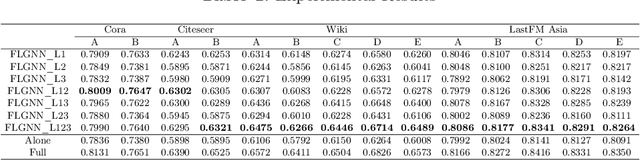

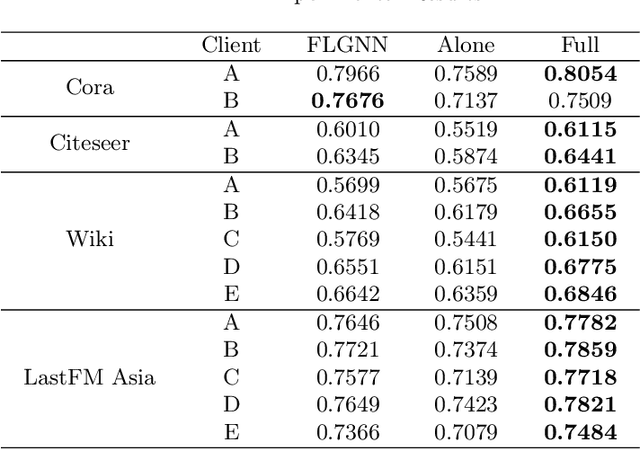
Over the past few years, federated learning has become widely used in various classical machine learning fields because of its collaborative ability to train data from multiple sources without compromising privacy. However, in the area of graph neural networks, the nodes and network structures of graphs held by clients are different in many practical applications, and the aggregation method that directly shares model gradients cannot be directly applied to this scenario. Therefore, this work proposes a federated aggregation method FLGNN applied to various graph federation scenarios and investigates the aggregation effect of parameter sharing at each layer of the graph neural network model. The effectiveness of the federated aggregation method FLGNN is verified by experiments on real datasets. Additionally, for the privacy security of FLGNN, this paper designs membership inference attack experiments and differential privacy defense experiments. The results show that FLGNN performs good robustness, and the success rate of privacy theft is further reduced by adding differential privacy defense methods.