 Add to Chrome
 Add to Firefox
 Add to Edge
MathDuels: Evaluating LLMs as Problem Posers and Solvers
Apr 23, 2026
As frontier language models attain near-ceiling performance on static mathematical benchmarks, existing evaluations are increasingly unable to differentiate model capabilities, largely because they cast models solely as solvers of fixed problem sets. We introduce MathDuels, a self-play benchmark in which models occupy dual roles: each authors math problems under adversarial prompting and solves problems authored by every other participant. Problems are produced through a three-stage generation pipeline (meta-prompting, problem generation, and difficulty amplification), and validated by an independent verifier that excludes ill-posed questions. A Rasch model (Rasch, 1993) jointly estimates solver abilities and problem difficulties; author quality is derived from the difficulties of each model's authored problems. Experiments across 19 frontier models reveal that authoring and solving capabilities are partially decoupled, and that dual-role evaluation reveals capability separations invisible in single-role benchmarks. As newer models enter the arena, they produce problems that defeat previously dominant solvers, so the benchmark's difficulty co-evolves with participant strength rather than saturating at a fixed ceiling. We host a public leaderboard that updates as new models are released.

Detecting Safety Violations Across Many Agent Traces
Apr 13, 2026To identify safety violations, auditors often search over large sets of agent traces. This search is difficult because failures are often rare, complex, and sometimes even adversarially hidden and only detectable when multiple traces are analyzed together. These challenges arise in diverse settings such as misuse campaigns, covert sabotage, reward hacking, and prompt injection. Existing approaches struggle here for several reasons. Per-trace judges miss failures that only become visible across traces, naive agentic auditing does not scale to large trace collections, and fixed monitors are brittle to unanticipated behaviors. We introduce Meerkat, which combines clustering with agentic search to uncover violations specified in natural language. Through structured search and adaptive investigation of promising regions, Meerkat finds sparse failures without relying on seed scenarios, fixed workflows, or exhaustive enumeration. Across misuse, misalignment, and task gaming settings, Meerkat significantly improves detection of safety violations over baseline monitors, discovers widespread developer cheating on a top agent benchmark, and finds nearly 4x more examples of reward hacking on CyBench than previous audits.
Do We Need Frontier Models to Verify Mathematical Proofs?
Apr 02, 2026Advances in training, post-training, and inference-time methods have enabled frontier reasoning models to win gold medals in math competitions and settle challenging open problems. Gaining trust in the responses of these models requires that natural language proofs be checked for errors. LLM judges are increasingly being adopted to meet the growing demand for evaluating such proofs. While verification is considered easier than generation, what model capability does reliable verification actually require? We systematically evaluate four open-source and two frontier LLMs on datasets of human-graded natural language proofs of competition-level problems. We consider two key metrics: verifier accuracy and self-consistency (the rate of agreement across repeated judgments on the same proof). We observe that smaller open-source models are only up to ~10% behind frontier models in accuracy but they are up to ~25% more inconsistent. Furthermore, we see that verifier accuracy is sensitive to prompt choice across all models. We then demonstrate that the smaller models, in fact, do possess the mathematical capabilities to verify proofs at the level of frontier models, but they struggle to reliably elicit these capabilities with general judging prompts. Through an LLM-guided prompt search, we synthesize an ensemble of specialized prompts that overcome the specific failure modes of smaller models, boosting their performance by up to 9.1% in accuracy and 15.9% in self-consistency. These gains are realized across models and datasets, allowing models like Qwen3.5-35B to perform on par with frontier models such as Gemini 3.1 Pro for proof verification.
CAMEL: An ECG Language Model for Forecasting Cardiac Events
Feb 17, 2026Electrocardiograms (ECG) are electrical recordings of the heart that are critical for diagnosing cardiovascular conditions. ECG language models (ELMs) have recently emerged as a promising framework for ECG classification accompanied by report generation. However, current models cannot forecast future cardiac events despite the immense clinical value for planning earlier intervention. To address this gap, we propose CAMEL, the first ELM that is capable of inference over longer signal durations which enables its forecasting capability. Our key insight is a specialized ECG encoder which enables cross-understanding of ECG signals with text. We train CAMEL using established LLM training procedures, combining LoRA adaptation with a curriculum learning pipeline. Our curriculum includes ECG classification, metrics calculations, and multi-turn conversations to elicit reasoning. CAMEL demonstrates strong zero-shot performance across 6 tasks and 9 datasets, including ECGForecastBench, a new benchmark that we introduce for forecasting arrhythmias. CAMEL is on par with or surpasses ELMs and fully supervised baselines both in- and out-of-distribution, achieving SOTA results on ECGBench (+7.0% absolute average gain) as well as ECGForecastBench (+12.4% over fully supervised models and +21.1% over zero-shot ELMs).
On Improving Neurosymbolic Learning by Exploiting the Representation Space
Feb 08, 2026We study the problem of learning neural classifiers in a neurosymbolic setting where the hidden gold labels of input instances must satisfy a logical formula. Learning in this setting proceeds by first computing (a subset of) the possible combinations of labels that satisfy the formula and then computing a loss using those combinations and the classifiers' scores. One challenge is that the space of label combinations can grow exponentially, making learning difficult. We propose a technique that prunes this space by exploiting the intuition that instances with similar latent representations are likely to share the same label. While this intuition has been widely used in weakly supervised learning, its application in our setting is challenging due to label dependencies imposed by logical constraints. We formulate the pruning process as an integer linear program that discards inconsistent label combinations while respecting logical structure. Our approach, CLIPPER, is orthogonal to existing training algorithms and can be seamlessly integrated with them. Across 16 benchmarks over complex neurosymbolic tasks, we demonstrate that CLIPPER boosts the performance of state-of-the-art neurosymbolic engines like Scallop, Dolphin, and ISED by up to 48%, 53%, and 8%, leading to state-of-the-art accuracies.
Once Upon an Input: Reasoning via Per-Instance Program Synthesis
Oct 26, 2025Large language models (LLMs) excel at zero-shot inference but continue to struggle with complex, multi-step reasoning. Recent methods that augment LLMs with intermediate reasoning steps such as Chain of Thought (CoT) and Program of Thought (PoT) improve performance but often produce undesirable solutions, especially in algorithmic domains. We introduce Per-Instance Program Synthesis (PIPS), a method that generates and refines programs at the instance-level using structural feedback without relying on task-specific guidance or explicit test cases. To further improve performance, PIPS incorporates a confidence metric that dynamically chooses between direct inference and program synthesis on a per-instance basis. Experiments across three frontier LLMs and 30 benchmarks including all tasks of Big Bench Extra Hard (BBEH), visual question answering tasks, relational reasoning tasks, and mathematical reasoning tasks show that PIPS improves the absolute harmonic mean accuracy by up to 8.6% and 9.4% compared to PoT and CoT respectively, and reduces undesirable program generations by 65.1% on the algorithmic tasks compared to PoT with Gemini-2.0-Flash.
Stable Prediction of Adverse Events in Medical Time-Series Data
Oct 16, 2025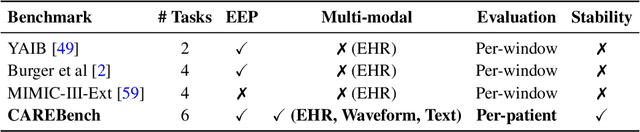
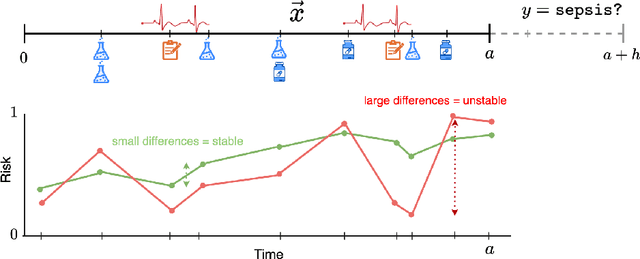

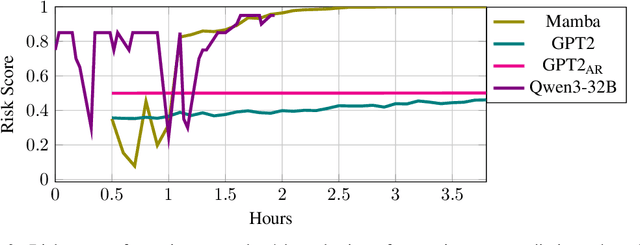
Early event prediction (EEP) systems continuously estimate a patient's imminent risk to support clinical decision-making. For bedside trust, risk trajectories must be accurate and temporally stable, shifting only with new, relevant evidence. However, current benchmarks (a) ignore stability of risk scores and (b) evaluate mainly on tabular inputs, leaving trajectory behavior untested. To address this gap, we introduce CAREBench, an EEP benchmark that evaluates deployability using multi-modal inputs-tabular EHR, ECG waveforms, and clinical text-and assesses temporal stability alongside predictive accuracy. We propose a stability metric that quantifies short-term variability in per-patient risk and penalizes abrupt oscillations based on local-Lipschitz constants. CAREBench spans six prediction tasks such as sepsis onset and compares classical learners, deep sequence models, and zero-shot LLMs. Across tasks, existing methods, especially LLMs, struggle to jointly optimize accuracy and stability, with notably poor recall at high-precision operating points. These results highlight the need for models that produce evidence-aligned, stable trajectories to earn clinician trust in continuous monitoring settings. (Code: https://github.com/SeewonChoi/CAREBench.)
Delta Activations: A Representation for Finetuned Large Language Models
Sep 04, 2025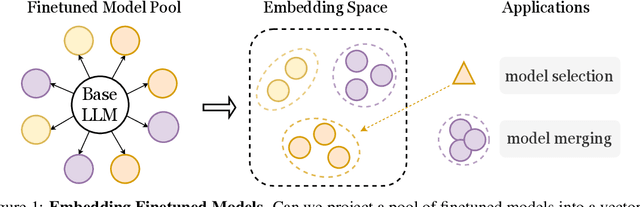
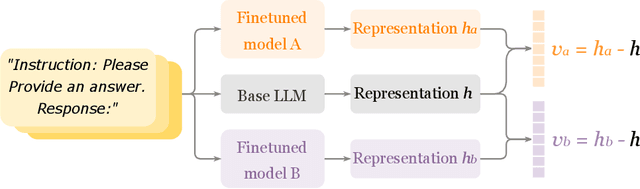
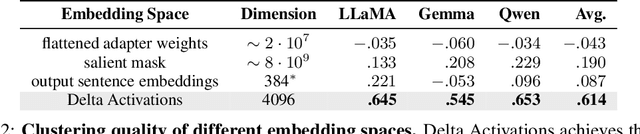
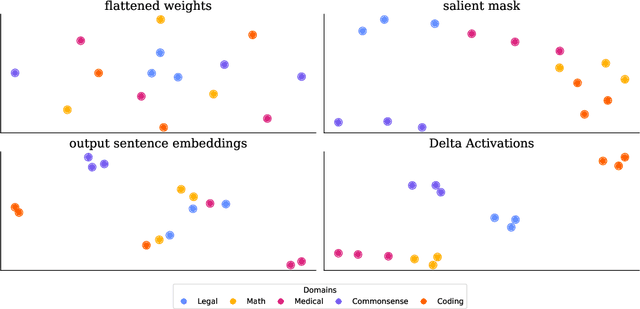
The success of powerful open source Large Language Models (LLMs) has enabled the community to create a vast collection of post-trained models adapted to specific tasks and domains. However, navigating and understanding these models remains challenging due to inconsistent metadata and unstructured repositories. We introduce Delta Activations, a method to represent finetuned models as vector embeddings by measuring shifts in their internal activations relative to a base model. This representation allows for effective clustering by domain and task, revealing structure in the model landscape. Delta Activations also demonstrate desirable properties: it is robust across finetuning settings and exhibits an additive property when finetuning datasets are mixed. In addition, we show that Delta Activations can embed tasks via few-shot finetuning, and further explore its use for model selection and merging. We hope Delta Activations can facilitate the practice of reusing publicly available models. Code is available at https://github.com/OscarXZQ/delta_activations.
The Road to Generalizable Neuro-Symbolic Learning Should be Paved with Foundation Models
May 30, 2025Neuro-symbolic learning was proposed to address challenges with training neural networks for complex reasoning tasks with the added benefits of interpretability, reliability, and efficiency. Neuro-symbolic learning methods traditionally train neural models in conjunction with symbolic programs, but they face significant challenges that limit them to simplistic problems. On the other hand, purely-neural foundation models now reach state-of-the-art performance through prompting rather than training, but they are often unreliable and lack interpretability. Supplementing foundation models with symbolic programs, which we call neuro-symbolic prompting, provides a way to use these models for complex reasoning tasks. Doing so raises the question: What role does specialized model training as part of neuro-symbolic learning have in the age of foundation models? To explore this question, we highlight three pitfalls of traditional neuro-symbolic learning with respect to the compute, data, and programs leading to generalization problems. This position paper argues that foundation models enable generalizable neuro-symbolic solutions, offering a path towards achieving the original goals of neuro-symbolic learning without the downsides of training from scratch.
Lobster: A GPU-Accelerated Framework for Neurosymbolic Programming
Mar 27, 2025Neurosymbolic programs combine deep learning with symbolic reasoning to achieve better data efficiency, interpretability, and generalizability compared to standalone deep learning approaches. However, existing neurosymbolic learning frameworks implement an uneasy marriage between a highly scalable, GPU-accelerated neural component with a slower symbolic component that runs on CPUs. We propose Lobster, a unified framework for harnessing GPUs in an end-to-end manner for neurosymbolic learning. Lobster maps a general neurosymbolic language based on Datalog to the GPU programming paradigm. This mapping is implemented via compilation to a new intermediate language called APM. The extra abstraction provided by APM allows Lobster to be both flexible, supporting discrete, probabilistic, and differentiable modes of reasoning on GPU hardware with a library of provenance semirings, and performant, implementing new optimization passes. We demonstrate that Lobster programs can solve interesting problems spanning the domains of natural language processing, image processing, program reasoning, bioinformatics, and planning. On a suite of 8 applications, Lobster achieves an average speedup of 5.3x over Scallop, a state-of-the-art neurosymbolic framework, and enables scaling of neurosymbolic solutions to previously infeasible tasks.