 Add to Chrome
 Add to Firefox
 Add to Edge
MultiPress: A Multi-Agent Framework for Interpretable Multimodal News Classification
Apr 04, 2026
With the growing prevalence of multimodal news content, effective news topic classification demands models capable of jointly understanding and reasoning over heterogeneous data such as text and images. Existing methods often process modalities independently or employ simplistic fusion strategies, limiting their ability to capture complex cross-modal interactions and leverage external knowledge. To overcome these limitations, we propose MultiPress, a novel three-stage multi-agent framework for multimodal news classification. MultiPress integrates specialized agents for multimodal perception, retrieval-augmented reasoning, and gated fusion scoring, followed by a reward-driven iterative optimization mechanism. We validate MultiPress on a newly constructed large-scale multimodal news dataset, demonstrating significant improvements over strong baselines and highlighting the effectiveness of modular multi-agent collaboration and retrieval-augmented reasoning in enhancing classification accuracy and interpretability.

HSSBench: Benchmarking Humanities and Social Sciences Ability for Multimodal Large Language Models
Jun 04, 2025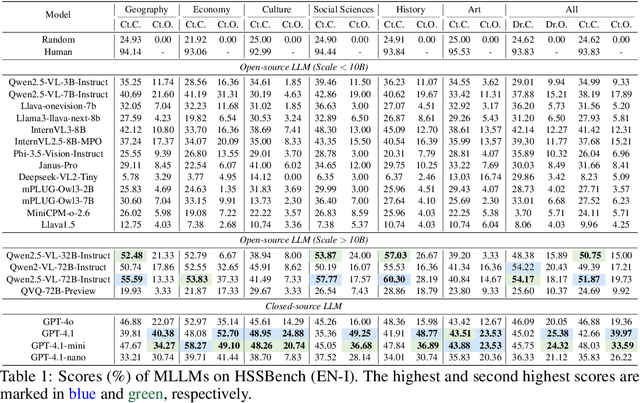
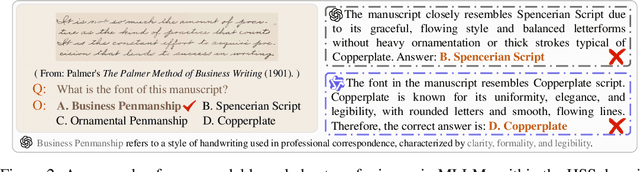
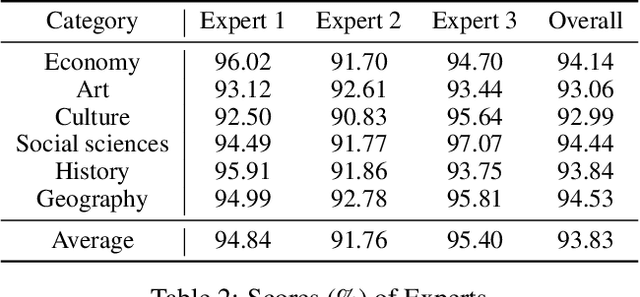
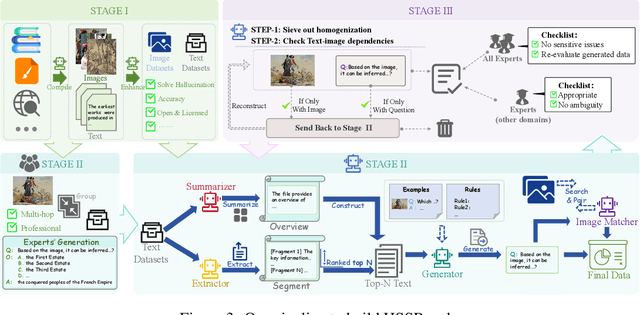
Multimodal Large Language Models (MLLMs) have demonstrated significant potential to advance a broad range of domains. However, current benchmarks for evaluating MLLMs primarily emphasize general knowledge and vertical step-by-step reasoning typical of STEM disciplines, while overlooking the distinct needs and potential of the Humanities and Social Sciences (HSS). Tasks in the HSS domain require more horizontal, interdisciplinary thinking and a deep integration of knowledge across related fields, which presents unique challenges for MLLMs, particularly in linking abstract concepts with corresponding visual representations. Addressing this gap, we present HSSBench, a dedicated benchmark designed to assess the capabilities of MLLMs on HSS tasks in multiple languages, including the six official languages of the United Nations. We also introduce a novel data generation pipeline tailored for HSS scenarios, in which multiple domain experts and automated agents collaborate to generate and iteratively refine each sample. HSSBench contains over 13,000 meticulously designed samples, covering six key categories. We benchmark more than 20 mainstream MLLMs on HSSBench and demonstrate that it poses significant challenges even for state-of-the-art models. We hope that this benchmark will inspire further research into enhancing the cross-disciplinary reasoning abilities of MLLMs, especially their capacity to internalize and connect knowledge across fields.