 Add to Chrome
 Add to Firefox
 Add to Edge
Amortising Trajectory Optimisation for Residual MPC via Implicit Contact Differentiation
Jul 27, 2026
Differentiable simulation can accelerate contact-rich trajectory optimisation by exposing local sensitivities of task outcomes to controls. Existing approaches either use finite differences, which are expensive and step-size sensitive; differentiate iterative contact solvers by unrolling automatic differentiation (AD), which stores a growing computation trace; or require intricate, solver-specific KKT sensitivity derivations. We introduce an AD-assisted implicit derivative for regularised smooth contacts and apply it to Mujoco MJX, based on the Implicit Function Theorem (IFT). The method differentiates the stationarity residual at the tolerance-converged solution, avoiding both solver unrolling and hand-assembled KKT systems. IFT keeps compiled temporary memory nearly constant with solver effort, changing by less than 4$\%$ from one to ten iterations versus 10.6$\times$ growth for unrolled AD. IFT memory grows slower with active contacts and model dimension, using 20$\times$ less memory at 256 contacts and 6$\times$ less at 16 contacts and 96 DoF. We further introduce optimiser distillation for residual MPC, amortising batched full-horizon iLQR into a policy that guides short-horizon residual iLQR. Across Finger, Franka, and Unitree, this raises six-step success by 28-98 percentage points over standard iLQR.

BayesContact: Uncertain Pose Estimation via Visuo-Tactile Proposals and Simulation-based Inference
Jul 17, 2026Contact-rich manipulation requires pose estimates that are often more accurate than what depth-only sensing provides. Existing methods, relying on vision and contact, employ costly offline training procedures that need to be retrained for new environments and geometries. We propose BayesContact, a Simulation-Based Inference framework for visuo-tactile pose estimation in peg-in-hole insertion. BayesContact maintains a particle belief over object pose and fuses depth observations with force/torque-derived contact evidence. We employ simulation based forward models to approximate these observation likelihoods. For each pose hypothesis, a renderer predicts depth measurements and a physics simulator predicts contact outcomes under guarded probing actions; both are scored against real observations to update the belief. The resulting multimodal belief also enables information-gain-based probing for active disambiguation. Across simulated geometries and real-robot experiments, BayesContact improves pose observability and insertion success over vision-only inference by 30%
ContactFusion: Stochastic Poisson Surface Maps from Visual and Contact Sensing
Mar 20, 2025Robust and precise robotic assembly entails insertion of constituent components. Insertion success is hindered when noise in scene understanding exceeds tolerance limits, especially when fabricated with tight tolerances. In this work, we propose ContactFusion which combines global mapping with local contact information, fusing point clouds with force sensing. Our method entails a Rejection Sampling based contact occupancy sensing procedure which estimates contact locations on the end-effector from Force/Torque sensing at the wrist. We demonstrate how to fuse contact with visual information into a Stochastic Poisson Surface Map (SPSMap) - a map representation that can be updated with the Stochastic Poisson Surface Reconstruction (SPSR) algorithm. We first validate the contact occupancy sensor in simulation and show its ability to detect the contact location on the robot from force sensing information. Then, we evaluate our method in a peg-in-hole task, demonstrating an improvement in the hole pose estimate with the fusion of the contact information with the SPSMap.
LiDAR guided Small obstacle Segmentation
Mar 12, 2020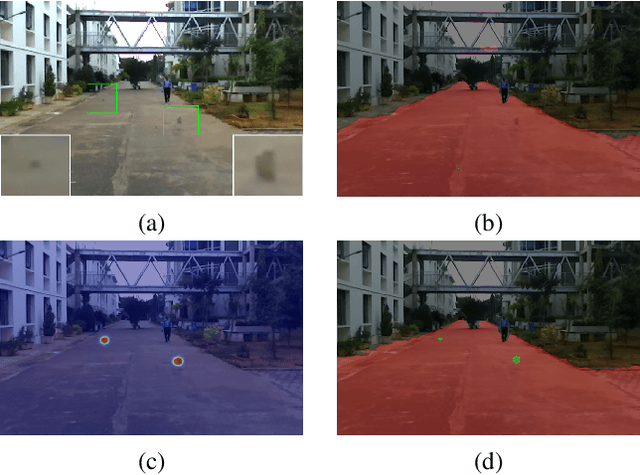
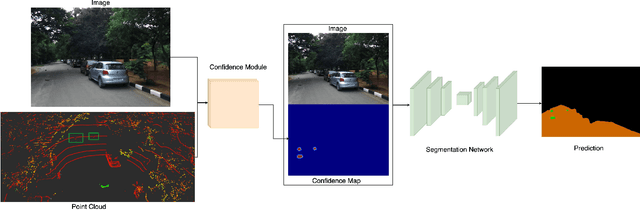
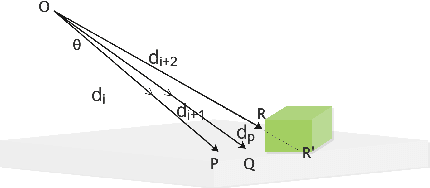
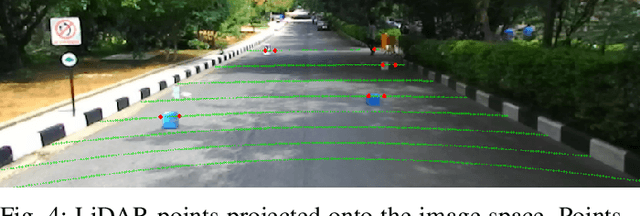
Detecting small obstacles on the road is critical for autonomous driving. In this paper, we present a method to reliably detect such obstacles through a multi-modal framework of sparse LiDAR(VLP-16) and Monocular vision. LiDAR is employed to provide additional context in the form of confidence maps to monocular segmentation networks. We show significant performance gains when the context is fed as an additional input to monocular semantic segmentation frameworks. We further present a new semantic segmentation dataset to the community, comprising of over 3000 image frames with corresponding LiDAR observations. The images come with pixel-wise annotations of three classes off-road, road, and small obstacle. We stress that precise calibration between LiDAR and camera is crucial for this task and thus propose a novel Hausdorff distance based calibration refinement method over extrinsic parameters. As a first benchmark over this dataset, we report our results with 73% instance detection up to a distance of 50 meters on challenging scenarios. Qualitatively by showcasing accurate segmentation of obstacles less than 15 cms at 50m depth and quantitatively through favourable comparisons vis a vis prior art, we vindicate the method's efficacy. Our project-page and Dataset is hosted at https://small-obstacle-dataset.github.io/